For those of you who aren’t linguists, let me explain what makes this so remarkable. As the above video shows, when Britney is pronouncing an “l” sound, she doesn’t merely place her tongue against the back of her teeth, as is normal for English speakers. Instead, she sticks her tongue out of her mouth and presses it against her upper lip. This sort of articulation is known as linguo-labial (or apico-labial) because it involves both the tongue and the lip. Now, linguo-labial sounds are extremely rare in the world’s languages, and are completely unheard of in English. So video above appears to present an unprecedented native English speaker who at least sometimes pronounces /l/ with a linguo-labial articulation.
Except maybe not. The commenters at the Language Log come up with a better hypothesis: this is a lip-syncing technique for exaggerating the articulation of the /l/, to aid in matching up video with audio and provide stronger cues for viewers. Commenters dug up music videos of other performers with the same articulation, though this is slightly mitigated by a live video of Britney which shows her doing the same thing. Unless you think that (heaven forfend!) Britney may have lip-synced a live performance.
This is a children’s book, essentially, which I picked up from the library looking for an easy introduction to Native cultures of the Pacific NW, preferably one with lots of pictures and easy reading. And that’s exactly what this was: plenty of old pictures of Tlingit, Kwakiutl, Nootka, with short, pithy discussions of their traditional foods, dress, social structures, art forms, religions, and economic activities. Nothing especially in-depth, but enough to orient me for the more scholarly works that are further down my reading list.
So I’ve signed up for Goodreads, after being pestered by a few friends. Or just one friend. Who really just suggested politely. Anyway, if anybody else wants to be my friend in that pathetic internet way, my username is jsbangs. I’ve also set it up to automatically post my book reviews, so you might see something like that around here. Heads up.
So I’ve been interviewed for the first time in my life as a professional writer. (Cue sound of trumpets and champagne glasses tinkling.) Unfortunately for your monolingual English speakers (and you polyglots without the knowledge of glorious Dacia), the interview was conducted in Romanian, and is only available at Societatea Română de Science-Fiction şi Fantasy.
Not every venue can be great all of the time. For some reason, many of my favorite short story magazines have been giving up duds, lately, which has been very disappointing.
In the most recent Clarkesworld we got Thirteen Ways of Looking At Space-Time by Catherynne Valente, an author I’ve really enjoyed in the past. But this story didn’t work at any level: a series of creation myths mish-mashed with quantum physics technobabble, mixed with autobiographical vignettes. I’m sure that was very cathartic to write, but that doesn’t mean it was very interesting to read. We also have Messenger by Julia Sidorova, a Secret History of Jesus story. Secret histories, traditionally, offer us us an alternate, fantastical explanation for historical events whose mundane details we already know. However, the existing story of Jesus is already plenty fantastical, so what Sidorova did instead is give us a slightly different set of miracles which “explain” the familiar ones. If I read this story just as a tale of a rebellious angel, it works fine, but the Jesus elements become a glaring distraction, a Chekov gun that never fires. But as a commentary on the stories of Jesus, it’s just silly. Either way, I couldn’t get anything out of it.
Over at Brain Harvest we get Invisible by Lisa Marten, which attempts to make a banal political point by way of highly exaggerated physical crudity. Not even worth the five minutes it took to read.
Strange Horizons has done marginally better. The most recent story The Big Splash was unremarkable, and the one before that (Ghost of a Horse Under a Chandelier) I didn’t even finish. But at least none of them were actually bad.
On the plus side, Beneath Ceaseless Skies has been doing very well, with Prashkina’s Fire, Eighth Eye, and The Isthmus Variation as recent highlights.
This evening I finished what should be my final edits on The Failed Apostle. I may still fiddle a bit with the all-important first chapter, but for all practical purposes this is the final draft of this novel. I’m done.
Within a week I hope to have queries hurtling across the interwebs (or plodding through the postal system, as the case may be).
Last winter, after an extremely long delay, the third volume of Ricardo Pinto’s trilogy The Stone Dance of the Chameleon was finally released with the title The Third God. I read the first volume, The Chosen, entirely by chance. I happened across it in a used bookstore and was intrigued by the cover: a trio of men wearing golden masks and elaborate robes, rowing a boat made of bone past a lush, terraced landscape, with a dramatic spire of stone splitting the sky behind them. I was looking for a good fantasy, and I’m always happy to see novels that get away from the standard Eurofantasy template, so this seemed like something promising. Plus it was cheap.
Cover of <i>The Third God</i>. Note the dinosaurs with flame-throwers.
This proved to be one of my most felicitous reading finds of the last several years. I loved The Chosen. It was one of the most immersive, delighful, delirious, and disorienting novels that I had ever read. I eagerly sought out the second book, The Standing Dead, devoured it, and then discovered that the third book had not appeared yet. I had to wait several years for it, then several more months before I finally sat down and read it—and just a few days ago I finished it.
After finishing the trilogy, I was left with a strange sense of discontentment. Much of that was the inevitable let-down of leaving a beloved world behind, which occurs whenever I finish a long, deep read. (I felt the same way after Neal Stephenson’s Anathem, which no one could accuse of being too short.) To salve the immediate itch, I set out to re-read the first volume again–partly to simply prolong the experience, and partly to see if some of the revelations and turnabouts of the third book had been properly foreshadowed. (They were.) But the greater part of my dissatisfaction, I decided, was justified unease with the structure and themes of the book.
My verdict, alas, is that The Stone Dance of the Chameleon is a failure. A brilliant, beautiful, original, and memorable failure, but a failure nonetheless.
[The rest of this discussion will be very free with spoilers, up to and including the end of the third book. However, I’ll try to keep things general and leave out most character names and specific events.]
Sensawunda spoiled
I read fantasy for the setting. Sure, I like characters and plot and language and all that, but when I pick up a chunky epic fantasy I want to go somewhere. I want to learn a foreign culture and hear strange languages. I want to feel like I could bend down and pinch the dirt of the place. And in my craving for literary teleportation, I especially crave that drug which we genre readers refer to as “sensawunda”:
It’s excitement, I think. That sense of excitement, of wonder… It’s imagination, the feeling of mystery that you get when people tell you stories about distant lands, hidden asteroids, secret locations, secret lands where things are strange, and where we’re infiltrators, or strangers. There’s something so magic about the unknown.
Robert Holdstock, Where Time Winds Blow
The Chosen has this in spades. The first book begins in a snowy, isolated hold where the protagonist Carnelian is in exile with his father. Carnelian’s father is compelled (in a way that doesn’t become clear until the last half of the third book) to return to to the walled paradise of Osrakum so he can aid in selecting the successor to the God Emperor. The rest of the book takes the form of a series of journeys from the edge of the world to its center: from the stormy hold to the shores of the Commonwealth, from the sea to the arid plateau of the Guarded Land, across the Guarded Land to the sacred gardens of Osrakum, and finally up the Pillar of Heaven to the houses of the God Emperor. This journey allows Pinto to gradually introduce the reader to the society of Commonwealth, one of the most striking and detailed fantasy settings I’ve ever read. We meet the Chosen, the ruling caste who hide their faces with masks, the sages of the Wise, who give up their eyes, ears, and tongues in exchange for the secret learning of their society, and the twisted half-human sartlar who labor to feed the Commonwealth. We see the teeming, dusty cities in sweaty detail, we travel along roads guarded by bone-girded watchtowers, and we pass through the impregnable defenses of the Three Gates to reach the paradise of Osrakum. We learn the precepts of the Law-which-must-be-obeyed with its terrible and fascinating rituals, feel the majesty of He-who-goes-before when he speaks for the Greater Chosen, and eventually ascend the stone spire of the Pillar of Heaven to the beautiful and dangerous courts where the God Emperor reigns.
Also, there are dinosaurs. In the case of the third book giant dinosaurs with flame-throwers strapped to their backs.
The Chosen, paperback cover
This ecstasy of detail and ritual was like crack to a reader like me. And therein lies the problem: while the book paints the Commonwealth and the paradise of Osrakum in lavish detail, it soon becomes clear that the overall thrust of the trilogy is the fall of Osrakum. And you can’t say that the Chosen don’t deserve it.
For alongside the beauty and complexity of Osrakum is the fact that the whole Commonwealth is built on cruelty. The food production of the Commonwealth is dependent on the brutalized sartlar slave caste. The opulence that the Chosen live in contrasts with the dire poverty found throughout most of the cities. The households of the Chosen are staffed with slaves taken from the flesh tithe–children that all the surrounding lands must hand over as tribute. The Chosen relish in terrorizing their slaves, and they engage in crucifixion as a kind of art form. The Law-that-must-be-obeyed mandates blinding, mutilation, or death to any non-Chosen that sees one of the Chosen unmasked, along with a byzantine system of rituals and rules that reinforces the difference between the sacred Chosen and their subjects. And the whole system is held together by the military ascendancy of the God Emperor’s legions, who alone have metal spearheads, armor and–most importantly–ride dragons (the aforementioned dinosaurs with flame-throwers on their backs).
This wouldn’t be such a problem if the majesty and luxury of Osrakum were merely incidentally described. Instead, Pinto gives us page after luscious page describing the jewel-encrusted hands and brocaded silk robes of the Chosen. Nor would it be a problem if the society described were just ordinarily oppressive. Instead, we get the vast viciousness of the Chosen and the pitiless Law-which-must-be-obeyed. This double-bind demands a resolution as brilliant as the depiction of the problem, some conclusion that meets the readers need for both justice and wonder.
And this is where the book fails. The ending brings justice (sort of), but it has no wonder. And even the justice is tainted, since the fall of Osrakum is accomplished by a massacre of the slaves, a famine that kills millions, and desertification of the Guarded Land. The Chosen fall, but their oppressed reap no benefit.
I spent the last quarter of the third volume in the odd position of hoping desperately that Osrakum would be saved, while feeling slightly guilty for it. But the story nearly forces the reader into that position.
Masters and slaves
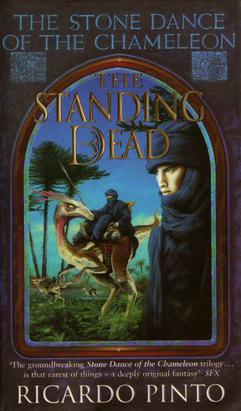
Alongside the conflict between the trilogy’s moral and literary loci, there is a marked contradiction between the book’s explicit sympathies and the viewpoints favored by its structure. Carnelian, the protagonist, is one of the Chosen. The other major character of the series, Osidian, is also Chosen, and is in fact a member of the House of Masks, the family of the God Emperor. We see all of the events of the trilogy through the eyes of privileged members of the ruling class, which means our sympathies are more with the Chosen than their inferiors. Carnelian may be unusually kind to his slaves, but he still wears the golden mask. The, Standing Dead, paperback cover
A related problem is the lack of agency of the non-Chosen characters. The second volume of the trilogy (The Standing Dead) most starkly illustrates this. The two protagonists are forced to leave Osrakum and the Guarded Land, and take refuge with a tribe of tributaries of the Chosen. These tribes are largely independent, but they are forced to pay a flesh tithe of slave children, a tax which they detest but are unable to resist. The overwhelming military domination of the Commonwealth renders any opposition they could mount ineffective, as they have nothing that can meet the power of the God Emperor’s dragon-mounted legions.
Until Osidian arrives. With a combination of personal charisma, military genius, and religious obsession Osidian manages to turn the tribes into a force that will fight his war against Osrakum. There’s more than a whiff of What These People Need Is A Honky about this (though the Chosen don’t read as white, the Plainsmen definitely read as brown), made worse by the fact that the tribes aren’t even fighting for their own liberation, but to restore the deposed Osidian. This pattern repeats throughout the second and third books as Osidian makes a series of deals with various subject peoples of the Chosen, all of whom resent their oppression, but none of which can resist effectively until they’re incorporated into Osidian’s army.
And then there’s the sartlar, the lowest slave caste. They’re the most abused of the victims of the Chosen, and so the most deserving of our sympathy, in theory. In practice, this sympathy is smothered by the fact that the sartlar are presented as not just low but loathsome. They’re called “half-men” throughout the trilogy, and no one, not even the sympathetic Carnelian, thinks of them as fully human. A handful of scenes in the final volume try to backpedal on this characterization, but it’s too little, too late. Only one sartlar character is ever named–in every other case, they appear as a faceless horde, a horde that’s compared to locusts, ants, rats, and maggots. When they play a decisive role in the final fall of Osrakum, it’s impossible for the reader to root for their success.
These narrative elements make the overall arc more a tragedy of the Chosen than a triumph of the oppressed. Such a story has a power of its own, but it’s inherently problematic, and to a certain extent undermines the moral universe that the book tries to present.
One last thing
The trilogy is remarkably short on women, and with one-and-a-half exceptions, none of the women in the story has any agency. There are reasons for this within the context of the novel–the Chosen are deliberately patriarchal–but it was still marked enough that I noticed it. Furthermore, most of the secondary female characters occur in iconic Mother roles: Ebeny, Akaisha, and Kor are almost pure archetype, and only Ykoriana has enough complexity to be a real character.
I still loved the trilogy, and highly recommend it. Don’t let my griping keep you from reading it.
Steampunk annoys me. It’s not the Victoriana: I lurve me some Victoriana. It’s the airships. Always with the bloody airships! People, listen: zeppelins are just not that cool. You gotta get over it.
The world’s museums are filled with the traditional arts of innumerable peoples whose culture has been destroyed by the sinister power of our industrial civilization: peoples who have been forced to abandon their own highly developed and beautiful techniques and significant designs in order to preserve their very lives by working as hired laborers at the production or raw materials. At the same time, modern scholars, with some honorable exceptions, have as little understood the content of folklore as did the early missionaries understand what they thought of only as the “beastly devices of the heathen”; Sir J.G. Frazer, for example, whose life has been devoted to the study of all the ramifications of folk belief and popular rites, has only to say at the end of it all, in a tone of lofty superiority, that he was “led on, step by step, into surveying, as form some spectacular height, some Pisgah of the mind, a great part of the human race; I was beguiled, as by some subtle enchanter, into indicting what I cannot but regard as dark, a tragic chronicle of human error and folly, of fruitless endeavor, wasted time and blighted hopes” — words that sound much more like an indictment of modern European civilization than a criticism of any savage society!
Noted hacker Eric S. Raymond (ESR) recently posted on his blog about a development that he thinks is forthcoming from genetics: the fact that intelligence is largely determined by genetics, and that different racial groups have significant differences in average intelligence. He’s dismissive of the “secular piety” that has kept this idea down, but he’s also not sanguine about what it will mean when the truth of racial difference is acknowledged:
It’s not going to be easy. I saw this coming in the mid-1990s, and I’m expecting the readjustment to be among the most traumatic issues in 21st-century politics. The problem with repression, on both individual and cultural levels, is that when it breaks down it tends to produce explosions of poorly-controlled emotional energy; the release products are frequently ugly. It takes little imagination to visualize a future 15 or 20 years hence in which the results of behavioral genetics are seized on as effective propaganda by neo-Nazis and other racist demagogues, with the authority of science being bent towards truly appalling consequences.
He then proposes that we can overcome the racist implications of this discovery by insisting that people be evaluated as individuals, not members of a group, and that racial identity politics of both the white supremacist and black separatist kind as the true evils.
This post is not going to argue about the evidence for or against racial differences in intelligence. You have a Google; you can quickly find a lot of people presenting evidence on both sides and decide for yourself whether this is a legitimate scientific discovery or just a racist in a lab coat. Instead, I’m interested in critiquing Raymond’s proposed solution. Is individuality really a sufficient response to racism?
Three objections came immediately to mind when I read Raymond’s post. First, while it might be admirable to commit yourself to always evaluating others as individuals, I doubt that you can actually do it consistently. At the very least, I can’t do it consistently. The habit of interpreting people you meet through the lens of the categories they belong to is deeply ingrained, and not just by social custom. Humans are pattern-matching machines, and slotting others into social groups based on gender, race, education. etc., is an unavoidable, even necessary social tactic. A dedication to individuality may be a noble ideal, but it’s not an ideal which can be consistently practiced, and in the moments when you’re unaware you cannot help but allow your actions to be shaped by the beliefs you’ve acquired about group generalities.
The second objection is a stronger version of the first: even if you, personally, are able to achieve total segregation between your opinions of the group and opinions of the individual, you cannot count on others to do so. You can, in fact, be virtually guaranteed that others won’t distinguish between individual and collective characteristics. Most people–even highly intelligent people–are bad at statistics. Humans have a strong bias towards essentialist categorizations, and minor statistical variations between groups are often reinterpreted as absolute characterizations of all members of those groups. Some people may be able to overcome this bias with effort, but it’s not reasonable to expect everyone to do so. The ideal of individualism is further threatened by the fact that, in this case, the scientific discovery is congruent with a social belief about racial attributes that was very widespread until very recently, and which persists in mutated form in much of our cultural discourse. If there is a difference in mean intelligence between races, this information will justify and intensify existing covert racist beliefs. Even racist ideas unrelated to the question intelligence will be strengthened by this facade of scientific credibility.
The final objection is the strongest: it’s not always possible to evaluate people without recourse to group identity. You might vow to treat everyone you meet as an individual. You might even succeed in getting everyone else to do the same. But you cannot eliminate the need to make judgements in situations of low information, when the most salient fact that you may have about someone is their race. This is the problem of racial profiling: when pulling someone over for a traffic violation, the officer knows next to nothing about the other driver. But he can see the driver’s skin, and he knows which races have higher rates of violent crime. Is he allowed to use this information? Is he even able to not use the information? It’s there in his subconscious, whether he thinks he’s going to act on it or not. Now generalize this dilemma across the whole spectrum of situations in which intelligence is a deciding factor. Can this be anything other than disastrous?
This affects even highly intelligent members of the low-intelligence groups. Regardless of how intelligent you are individually, you will sometimes be in situations where you cannot demonstrate your intelligence. In those situations, those around you will fall back on their beliefs about people with your visible characteristics, and if those beliefs are largely negative you will suffer negative consequences. Lots of people will be able to succeed regardless, of course, but the effect of negative expectations will be visible across the whole group. And this drop in acheivement will further encourage racist expectations, creating a positive feedback loop that retards the potential of everyone in the low-intelligence group, even if they are individually exceptional.
What’s most striking is that this, in practice, is no different than the old racist hypothesis. It has always been possible for individual geniuses to get education, wealth, and a measure of prestige, though the racist expectations of society made it more difficult for them. But those of merely average talent and dedication (which is most of us, after all) get no such consideration, and the obstacles of racism prevented most of them from acheiving what they otherwise would have. If we resurrect the theory of important racial difference, we’ll get the same result. Even if this time we are supposedly backed up by science, and even if we temper statistics with a nod towards individualism.
The comment thread on ESR’s post was a dismal thing to read, as a big chunk of it was white guys congratulating themselves for being brave and honest enough to say that black people are less intelligent. This was every bit as tedious and cringe-worthy as it sounds. (I refrained from jumping into the fray, as by the time I got there the thread had over 100 comments, which is well past the point at which all comment threads devolve into shrieking and poop-flinging.) I was most interested in the argument that developed between one commenter, Jessica Boxer, and several others, which recapitulated several of the points that I’ve made here. (It also contained a typical Bob-and-Alice moment, as one commenter condescendingly explained to Jessica that she was “muddled about racism” because she tried to bring in some social considerations broader than raw prejudice.) Jessica posed the dilemma of judgement in low-information situations in a series of hypotheticals spread across several posts:
Running from a group of young black men dressed in what looks like gang paraphernalia on the belief that such men are more prone to violence (link).
Choosing a black dance partner over a white dance partner on the belief that the black man is more likely to be a good dancer (link).
Hiring a white man over a black man on the belief that the white man is more likely to be intelligent and a hard worker (link).
The reaction to these hypotheticals was interesting. Every commenter accepted the first as a rational response. Most of them accepted the second. And the third–which I thought was clearly parallel to the first two–mostly resulted in people denying the hypothetical. That is, most responders (including ESR himself) insisted that there has to be a better way to evaluate the job candidates to avoid the need to make race the determinant. The same objection could be raised to the first two hypotheticals, of course, so why did this only come up for the third? Probably because the last example is more obviously “racist” than the first two, and more harmful detrimental to the disfavored candidate.
But given the premises of ESR’s argument, the interviewer is just as justified in making his racist choice in this scenario as he is in the first two scenarios. And this is precisely the problem: now matter how thoroughly you distinguish between individual ability and the group, sometimes group identity is the tipping factor on the scale.
Which brings us back to my original, depressing point. If there really is good evidence for racial differences in intelligence, then the resurgence of ugly and harmful racism is inevitable. Racism is not a problem that can be solved by a commitment to individuality. The best solution may in fact be the one that we’ve been pursuing for the last forty years: make racism a social taboo, and suppress its expression in polite society. And for that reason, I hope that we never get the evidence that ESR thinks is forthcoming.




 J.S. Bangs