Up at Clarkesworld this week is a historically accurate story about life in 21st century California. Phone sex, traffic jams, and gun battles. That sounds about like the California that I know. But don’t read it for the amazing historical recreations. Read it for the funny, insightful mashup of historical revisionism, reality TV, and the way it warps human relations.
Category: ephemera
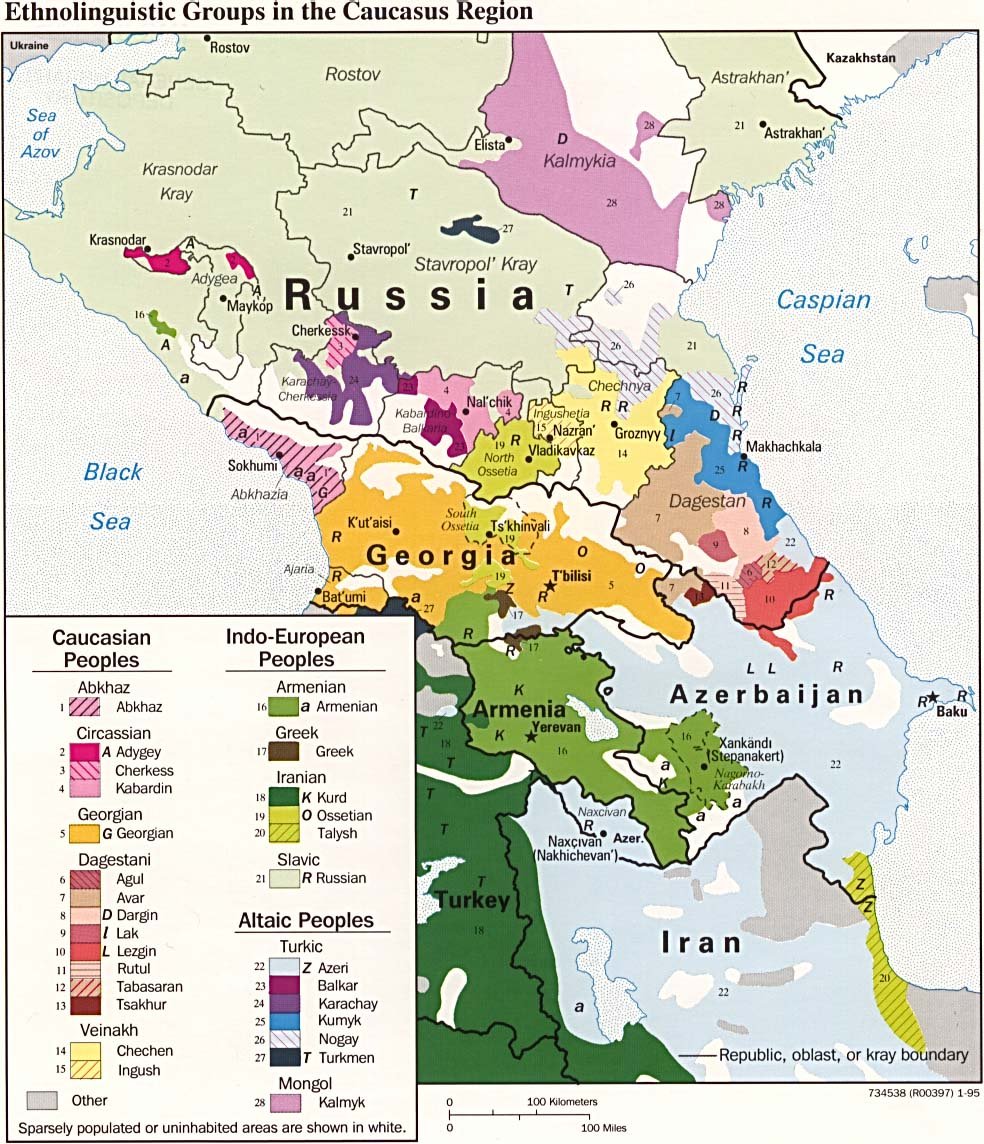
Take a look at this map of the Caucasus region. I count twenty-nine languages, in eleven different branches of three different language families.
Here’s the question: when was the last time you read a fantasy or scifi novel with that level of linguistic complexity? Heck, when was the last time you read a fantasy with three languages, let alone three language families?
Yeah, that’s what I thought.
The other interesting thing is how jumbled together all the language groups are. The boundaries overlap and bleed into each other and dance around, with little islands of one group inside the boundaries of another, and several tiny languages that exist only as enclaves within a bigger area. Keep in mind, this is a historically normal linguistic situation. We here in the USA are used to the idea of enormous, homogenous linguistic areas like contemporary North America, and so we project that assumption into our sff. If we do bring in linguistic diversity, we do it in the European style, with a simplistic “one language per country” assumption.
This is ridiculous. The really large mono-lingual areas (the Americas, Russia, Australia) are all the result of imperial expansion obliterating earlier linguistic diversity. And Europe’s “one language per country” is nothing more than an illusion: the national language of most European countries is really an amalgam of highly divergent dialects, and every European country is pockmarked with minority linguistic and ethnic enclaves. To give two examples close to (my) home, there are Germans in Romania and Romanians in Hungary.
<<Sigh>>. Well at least I’m doing my best to solve the problem :).
Rock Lobster
There are days when you really want to listen to Rock Lobster.
Then there are days when you really want to listen to the heavy metal cover of Rock Lobster. Today is one of those days:
(A)sexuality
This week at Strange Horizons: Sex With Ghosts by Sarah Kanning.
This is the first story that I can recall reading whose protagonist is explicitly asexual–that is, not hermaphroditic or ungendered, but simply lacking any sex drive. And of course she gets paired with a robotic double who consists of nothing but sex drive, and hilarity ensues.
Well, not quite hilarity. The story winds up being an interesting reflection on the nature of sexuality and personhood and the interplay between them. There is a suggestion that the sexless narrator is lacking something, and that the encounter with her hypersexed robot twin is necessary to teach her about herself and humanity. There’s a more explicit suggestion that the woman and the robot are mirror images of each other, and are so equally equipped to do the job of interviewing the robot brothel’s clients–the one because she’s completely indifferent to the clients’ behavior, and the other because she’s pruriently interested in all of the clients’ needs.
I find that an intriguing idea, though I don’t know if I’d actually apply it to life. In particular, I have known one or two people in my life who were asexual or close to it, and I don’t think that they are incomplete for it. And if I knew someone who was suffered from monomaniacal nymphomania in the way the robot does, I’d consider it deeply unhealthy. The story was nonetheless thought-provoking.
Annals of Amusing Rejections
A while ago, I got a rejection slip from JJR at F&SF for my story The Last Free Bear. However, the slip called the story The Last Free Beer.
Well, now at least I know what sorts of stories he’s looking for.
People (Don’t) Gots Issues
Hey, so it turns out that Meghan McCarron, who wrote Tetris Dooms Itself that I briefly commented on yesterday, also wrote The Magician’s House, which appeared a few weeks ago at Strange Horizons.
If I were to analyze McCarron based on these stories, I’d suggest that she has some issues that need working out. Tetris is a story about an icky, abusive relationship centered on violence and mutilation; The Magician’s House is about an icky, abusive relationship borne of an older magician’s ability to manipulate his student. Ick and abuse all around!
But I don’t actually think she has issues, mostly because (a) I’ve never met her and know nothing about her, and (b) writers are not their stories. Item (b) is the important one, here. I hate to think what someone would think who was diagnosing me based on the stuff I’ve written.
Sexual Violence
Tetris Dooms Itself by Meghan McCarron, currently up at Clarkesworld.com, reminds me a lot of Kill Me by Vylar Kaftan. Aside from the themes of sadism and masochism, they both left me feeling icky. Stories about extreme sadomasochism just don’t work for me. In the case of Tetris Dooms Itself, there’s the bonus of not understanding much of what happened in the story, even at the literal level.
On the plus side, Blue Ink by Yoon Ha Lee was awesome.
Ye gods, have I actually not posted anything since July 4?
Anyway, just like the rest of the internet, I have to link to today’s XKCD:

I find this especially touching, because I studied linguistics at the university. Linguistics FTW!
Vylar Kaftan found out that May 22 is the least common birthday in the US, which coincidentally is our son Ciprian’s birthday. He wins!
He also has a dimple, which he got from his mother. I love dimples, but am without them. His ordinary 6-week-old cuteness, multiplied by the cuteness of his dimple, makes him some kind of gurgling atomic bomb of adorability.
(Random cultural fact: in the US dimples are generally regarded as attractive. In Romania they are regarded as neutral. I wonder why?)
Opening Lines, Paragraphs, and Chapters
So I’m gearing up (slowly) to start on my next novel, and in preparation I’m thinking about openings. The opening of my laslt unpublished novel was probably the weakest part, and it’s something that I always struggle with. While pondering the ways in which my next WIP will begin, I decided to have a look at the openings of several of my favorite novels, to make a study of what they do, and what I can learn from them.
The parameters are simple: I’m looking at the first chapter of first books (if the book is part of a series), and the first sentences and first paragraphs of that chapter. It has to be a book I’ve already read, so that I can compare the opening with what I know of the rest of the book, and it has to be a book that I liked. I’ll also be sticking to genre works, and though I will use books by some famous authors, I’ll try to stick to earlier works. (The idea being that a BNA has more leeway to experiment with different kinds of openings, while I don’t.) I’m also open to suggestions if my readers (both of them) care to make them.
First up: Devices and Desires by KJ Parker. I’ll print the opening paragraph, with the opening line in bold:
“The quickest way to a man’s heart,” said the instructor, “is proverbially through his stomach. But if you want to get into his brain, I recommend the eye-socket.”
Thoughts: The first sentence is nothing special. If this were a short story, I might even recommend changing it. In a novel, you have a little more leeway–maybe as much as a page–before a reader or editor will reject you, so this is evidently okay. (Or so I’ve heard.) The second sentence that finished the paragraph is where the meat is: it illustrates the black humor that will permeate the novel, sets the tone, and establishes the theme of warfare. We already know that this will be a book about violence–specifically, as we’ll see in the next paragraph, fencing. There may be a double meaning in the instructor’s words as well: it turns out that our protag is in love, as a pretty young duchess has gotten into his brain and heart through his eye, and the results will be no less devastating than a simple rapier into the brain. Finally, this line is repeated almost verbatim at the opening of the next two books in the trilogy, providing important thematic continuity.
The second paragraph of this novel is so excellent that I feel compelled to share it, as well:
Like a whip cracking, he uncurled his languid slouch into the taut, straight lines of the lunge. His forearm launched from the elbow like an arrow as his front leg plunged forward, and the point of the long, slim sword darted, neat as a component in a machine, through the exact center of the finger-ring that dangled from a cord tied to the beam.
Now that is some really fine action writing. Take a look at those verbs: cracking, launched, plunged, darted. Notice also the phrase “neat as a component in a machine”–echoing another of the trilogy’s themes, that of mechanism and machinery.
Notice that we haven’t gotten any names yet. The protag is first mentioned in paragraph three.
The rest of the chapter:
The protag, young Duke Valens (though he isn’t actually Duke until the end of the chapter), is at a fencing lesson. This lasts for three pages, by the end of which we have a pretty clear understaning of Valens’ character. He is resentful of his father and doesn’t like being a Duke, but he is also fiercely determined, talented, and smart. Parker shows us all of this through Valens’ internal dialogue, without once resorting to overt characterization.
On page four we realize that Valens is in love. The girl he wants isn’t named at first–she’s just “she”, which is perfectly appropriate given the close 3rd POV that Parker uses. Valens is trucked off to a state dinner, where we see the representatives of a neighboring, industrialized country, and where Valens actually gets to talk to his crush. We’re introduced to the political situation and learn a little about the duchess’s character, and then…
In the second half of the chapter something strange happens. We skip a few years, find out second-hand that the duchess has been married to someone else, kill off the old Duke, and make Valens the new Duke. And then chapter two begins in a different country, roughly ten years later.
So everything in chapter one turns out to be backstory, introducing us to the pieces that will be in play when the main plot arc begins in the second chapter. This works because it’s not told as backstory: all of the description is vivid and immediate, and plenty of things happen. There is no shortage of action and character in the first chapter, and our attention is never allowed to wander.
 J.S. Bangs