This needs to go at the top of the post, even though it’s the last thing I wrote.
A few days ago I read a blog post by Elizabeth Moon, in a random act of Googling. I don’t normally follow her livejournal, and I wasn’t aware of any controversy surrounding it at the time. Later I heard that yet another “fail” incident had been stirred up over the post, which honestly ticked me off. In the past I had seen people taking the anti-racist side act like total assholes in a way that made me embarrassed to agree with them, so I was predisposed to assume that this was another tempest in a teapot. I started writing this post with that in mind.
However, when I went to actually look at the content of what had been said in the most prominent venues, I found something different. People were expressing disagreement, often vehemently, but the argument was largely free of the name-calling and egregious ad hominem that had characterized Racefail. Some people were losing it–somebody, somewhere is always losing it–but for the most part the discussion was actually constructive. Strong opinions, forcefully expressed–this is not a problem, even if the opinions are ones I disagree with. This that was the meta-point of my whole post, so where was I getting off criticizing Moon’s critics?
So I decided to leave the first half of this essay as-is, but not to finish it. Instead, this brief note acts as apology and conclusion.
Here’s some responses to Moon’s post which illustrate what I’m talking about:
The response of the Wiscon concom, which did the right thing by keeping Moon as GoH but expressing their disapproval.
K. Tempest Bradford is more strident than the comcon, and way more strident than me, but she makes some of the best arguments for her position in Why I’m going to Wiscon next year and Reasonableness.
SF Author Elizabeth Moon had a very interesting post up the other day about citizenship and the obligations of immigrants. She started off with an observation so true and pithy that I almost just want to quote it and leave the rest of it alone:
[T]he person with no loyalty to anything but his/her own pleasure is not a noble hero of individualism, but a pathetic failure as a human being.
From there she goes to riff on the responsibilities of citizenship, the particular ways in which those responsibilities impinge on immigrant communities, and the position of the Muslim immigrant community in the US. Along the way, she makes some very thoughtful and cogent points, including this one:
The point here is that in order to accept large numbers of immigrants, and maintain any social cohesion, acceptance by the receiving population is not the only requirement: immigrants must be willing and able to change, to merge with the receiving population…. Groups that self-isolate, that determinedly distinguish themselves by location, by language, by dress, will not be accepted as readily as those that plunge into the mainstream. This is not just an American problem–this is human nature, the tribalism that underlies all societies and must be constantly curtailed if larger groups are to co-exist.
This is true as a description of how societies actually work. While it might be nice to suggest that everyone be perfectly tolerant of others regardless of how different they are, this is not likely to happen on any world inhabited by actual human beings.
That said, in the conclusion to her post, Moon goes off the rails in a few different ways:
First, immigrant groups shouldn’t have to conform if they don’t want to. Self-isolation, as Moon calls it, should be allowed, though it remains inevitably true that such groups “will not be accepted as readily as those that plunge into the mainstream.”
Moon suggested that the Muslim immigrant community (most of which assimilates just fine) has been shown “much forbearance” in the wake of 9/11… which is true only insofar as it could have been a lot worse. But Muslims aren’t obliged to feel grateful that they haven’t been persecuted, and the rest of us don’t get a gold star merely for not oppressing the innocent.
I don’t see why the construction of an Islamic cultural center a few blocks from the former World Trade Center should be considered a breach of the civic duties of the Muslim community, or why it should be seen as “forbearance” for us to allow them to do so.
So I clearly disagree with major points made at the end of Moon’s post. Nonetheless, this is the sort of thing that reasonable people should be able to argue about without needing to call for the other’s head on a pike. Speech that you disagree with or which critiques a group that you belong to should not be called “hate speech” just for that reason. These sorts of issues are complicated and admit multiple points of view, and Moon clearly is thoughtful and sensible enough for me to give her the benefit of the doubt and engage her constructively.
But I forgot: this is the internet! Time to get your outrage on!
[And this is where I stopped to google, which resulted in the retractio printed above.]
Last winter, after an extremely long delay, the third volume of Ricardo Pinto’s trilogy The Stone Dance of the Chameleon was finally released with the title The Third God. I read the first volume, The Chosen, entirely by chance. I happened across it in a used bookstore and was intrigued by the cover: a trio of men wearing golden masks and elaborate robes, rowing a boat made of bone past a lush, terraced landscape, with a dramatic spire of stone splitting the sky behind them. I was looking for a good fantasy, and I’m always happy to see novels that get away from the standard Eurofantasy template, so this seemed like something promising. Plus it was cheap.
Cover of <i>The Third God</i>. Note the dinosaurs with flame-throwers.
This proved to be one of my most felicitous reading finds of the last several years. I loved The Chosen. It was one of the most immersive, delighful, delirious, and disorienting novels that I had ever read. I eagerly sought out the second book, The Standing Dead, devoured it, and then discovered that the third book had not appeared yet. I had to wait several years for it, then several more months before I finally sat down and read it—and just a few days ago I finished it.
After finishing the trilogy, I was left with a strange sense of discontentment. Much of that was the inevitable let-down of leaving a beloved world behind, which occurs whenever I finish a long, deep read. (I felt the same way after Neal Stephenson’s Anathem, which no one could accuse of being too short.) To salve the immediate itch, I set out to re-read the first volume again–partly to simply prolong the experience, and partly to see if some of the revelations and turnabouts of the third book had been properly foreshadowed. (They were.) But the greater part of my dissatisfaction, I decided, was justified unease with the structure and themes of the book.
My verdict, alas, is that The Stone Dance of the Chameleon is a failure. A brilliant, beautiful, original, and memorable failure, but a failure nonetheless.
[The rest of this discussion will be very free with spoilers, up to and including the end of the third book. However, I’ll try to keep things general and leave out most character names and specific events.]
Sensawunda spoiled
I read fantasy for the setting. Sure, I like characters and plot and language and all that, but when I pick up a chunky epic fantasy I want to go somewhere. I want to learn a foreign culture and hear strange languages. I want to feel like I could bend down and pinch the dirt of the place. And in my craving for literary teleportation, I especially crave that drug which we genre readers refer to as “sensawunda”:
It’s excitement, I think. That sense of excitement, of wonder… It’s imagination, the feeling of mystery that you get when people tell you stories about distant lands, hidden asteroids, secret locations, secret lands where things are strange, and where we’re infiltrators, or strangers. There’s something so magic about the unknown.
Robert Holdstock, Where Time Winds Blow
The Chosen has this in spades. The first book begins in a snowy, isolated hold where the protagonist Carnelian is in exile with his father. Carnelian’s father is compelled (in a way that doesn’t become clear until the last half of the third book) to return to to the walled paradise of Osrakum so he can aid in selecting the successor to the God Emperor. The rest of the book takes the form of a series of journeys from the edge of the world to its center: from the stormy hold to the shores of the Commonwealth, from the sea to the arid plateau of the Guarded Land, across the Guarded Land to the sacred gardens of Osrakum, and finally up the Pillar of Heaven to the houses of the God Emperor. This journey allows Pinto to gradually introduce the reader to the society of Commonwealth, one of the most striking and detailed fantasy settings I’ve ever read. We meet the Chosen, the ruling caste who hide their faces with masks, the sages of the Wise, who give up their eyes, ears, and tongues in exchange for the secret learning of their society, and the twisted half-human sartlar who labor to feed the Commonwealth. We see the teeming, dusty cities in sweaty detail, we travel along roads guarded by bone-girded watchtowers, and we pass through the impregnable defenses of the Three Gates to reach the paradise of Osrakum. We learn the precepts of the Law-which-must-be-obeyed with its terrible and fascinating rituals, feel the majesty of He-who-goes-before when he speaks for the Greater Chosen, and eventually ascend the stone spire of the Pillar of Heaven to the beautiful and dangerous courts where the God Emperor reigns.
Also, there are dinosaurs. In the case of the third book giant dinosaurs with flame-throwers strapped to their backs.
The Chosen, paperback cover
This ecstasy of detail and ritual was like crack to a reader like me. And therein lies the problem: while the book paints the Commonwealth and the paradise of Osrakum in lavish detail, it soon becomes clear that the overall thrust of the trilogy is the fall of Osrakum. And you can’t say that the Chosen don’t deserve it.
For alongside the beauty and complexity of Osrakum is the fact that the whole Commonwealth is built on cruelty. The food production of the Commonwealth is dependent on the brutalized sartlar slave caste. The opulence that the Chosen live in contrasts with the dire poverty found throughout most of the cities. The households of the Chosen are staffed with slaves taken from the flesh tithe–children that all the surrounding lands must hand over as tribute. The Chosen relish in terrorizing their slaves, and they engage in crucifixion as a kind of art form. The Law-that-must-be-obeyed mandates blinding, mutilation, or death to any non-Chosen that sees one of the Chosen unmasked, along with a byzantine system of rituals and rules that reinforces the difference between the sacred Chosen and their subjects. And the whole system is held together by the military ascendancy of the God Emperor’s legions, who alone have metal spearheads, armor and–most importantly–ride dragons (the aforementioned dinosaurs with flame-throwers on their backs).
This wouldn’t be such a problem if the majesty and luxury of Osrakum were merely incidentally described. Instead, Pinto gives us page after luscious page describing the jewel-encrusted hands and brocaded silk robes of the Chosen. Nor would it be a problem if the society described were just ordinarily oppressive. Instead, we get the vast viciousness of the Chosen and the pitiless Law-which-must-be-obeyed. This double-bind demands a resolution as brilliant as the depiction of the problem, some conclusion that meets the readers need for both justice and wonder.
And this is where the book fails. The ending brings justice (sort of), but it has no wonder. And even the justice is tainted, since the fall of Osrakum is accomplished by a massacre of the slaves, a famine that kills millions, and desertification of the Guarded Land. The Chosen fall, but their oppressed reap no benefit.
I spent the last quarter of the third volume in the odd position of hoping desperately that Osrakum would be saved, while feeling slightly guilty for it. But the story nearly forces the reader into that position.
Masters and slaves
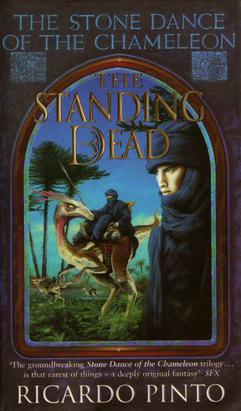
Alongside the conflict between the trilogy’s moral and literary loci, there is a marked contradiction between the book’s explicit sympathies and the viewpoints favored by its structure. Carnelian, the protagonist, is one of the Chosen. The other major character of the series, Osidian, is also Chosen, and is in fact a member of the House of Masks, the family of the God Emperor. We see all of the events of the trilogy through the eyes of privileged members of the ruling class, which means our sympathies are more with the Chosen than their inferiors. Carnelian may be unusually kind to his slaves, but he still wears the golden mask. The, Standing Dead, paperback cover
A related problem is the lack of agency of the non-Chosen characters. The second volume of the trilogy (The Standing Dead) most starkly illustrates this. The two protagonists are forced to leave Osrakum and the Guarded Land, and take refuge with a tribe of tributaries of the Chosen. These tribes are largely independent, but they are forced to pay a flesh tithe of slave children, a tax which they detest but are unable to resist. The overwhelming military domination of the Commonwealth renders any opposition they could mount ineffective, as they have nothing that can meet the power of the God Emperor’s dragon-mounted legions.
Until Osidian arrives. With a combination of personal charisma, military genius, and religious obsession Osidian manages to turn the tribes into a force that will fight his war against Osrakum. There’s more than a whiff of What These People Need Is A Honky about this (though the Chosen don’t read as white, the Plainsmen definitely read as brown), made worse by the fact that the tribes aren’t even fighting for their own liberation, but to restore the deposed Osidian. This pattern repeats throughout the second and third books as Osidian makes a series of deals with various subject peoples of the Chosen, all of whom resent their oppression, but none of which can resist effectively until they’re incorporated into Osidian’s army.
And then there’s the sartlar, the lowest slave caste. They’re the most abused of the victims of the Chosen, and so the most deserving of our sympathy, in theory. In practice, this sympathy is smothered by the fact that the sartlar are presented as not just low but loathsome. They’re called “half-men” throughout the trilogy, and no one, not even the sympathetic Carnelian, thinks of them as fully human. A handful of scenes in the final volume try to backpedal on this characterization, but it’s too little, too late. Only one sartlar character is ever named–in every other case, they appear as a faceless horde, a horde that’s compared to locusts, ants, rats, and maggots. When they play a decisive role in the final fall of Osrakum, it’s impossible for the reader to root for their success.
These narrative elements make the overall arc more a tragedy of the Chosen than a triumph of the oppressed. Such a story has a power of its own, but it’s inherently problematic, and to a certain extent undermines the moral universe that the book tries to present.
One last thing
The trilogy is remarkably short on women, and with one-and-a-half exceptions, none of the women in the story has any agency. There are reasons for this within the context of the novel–the Chosen are deliberately patriarchal–but it was still marked enough that I noticed it. Furthermore, most of the secondary female characters occur in iconic Mother roles: Ebeny, Akaisha, and Kor are almost pure archetype, and only Ykoriana has enough complexity to be a real character.
I still loved the trilogy, and highly recommend it. Don’t let my griping keep you from reading it.
Noted hacker Eric S. Raymond (ESR) recently posted on his blog about a development that he thinks is forthcoming from genetics: the fact that intelligence is largely determined by genetics, and that different racial groups have significant differences in average intelligence. He’s dismissive of the “secular piety” that has kept this idea down, but he’s also not sanguine about what it will mean when the truth of racial difference is acknowledged:
It’s not going to be easy. I saw this coming in the mid-1990s, and I’m expecting the readjustment to be among the most traumatic issues in 21st-century politics. The problem with repression, on both individual and cultural levels, is that when it breaks down it tends to produce explosions of poorly-controlled emotional energy; the release products are frequently ugly. It takes little imagination to visualize a future 15 or 20 years hence in which the results of behavioral genetics are seized on as effective propaganda by neo-Nazis and other racist demagogues, with the authority of science being bent towards truly appalling consequences.
He then proposes that we can overcome the racist implications of this discovery by insisting that people be evaluated as individuals, not members of a group, and that racial identity politics of both the white supremacist and black separatist kind as the true evils.
This post is not going to argue about the evidence for or against racial differences in intelligence. You have a Google; you can quickly find a lot of people presenting evidence on both sides and decide for yourself whether this is a legitimate scientific discovery or just a racist in a lab coat. Instead, I’m interested in critiquing Raymond’s proposed solution. Is individuality really a sufficient response to racism?
Three objections came immediately to mind when I read Raymond’s post. First, while it might be admirable to commit yourself to always evaluating others as individuals, I doubt that you can actually do it consistently. At the very least, I can’t do it consistently. The habit of interpreting people you meet through the lens of the categories they belong to is deeply ingrained, and not just by social custom. Humans are pattern-matching machines, and slotting others into social groups based on gender, race, education. etc., is an unavoidable, even necessary social tactic. A dedication to individuality may be a noble ideal, but it’s not an ideal which can be consistently practiced, and in the moments when you’re unaware you cannot help but allow your actions to be shaped by the beliefs you’ve acquired about group generalities.
The second objection is a stronger version of the first: even if you, personally, are able to achieve total segregation between your opinions of the group and opinions of the individual, you cannot count on others to do so. You can, in fact, be virtually guaranteed that others won’t distinguish between individual and collective characteristics. Most people–even highly intelligent people–are bad at statistics. Humans have a strong bias towards essentialist categorizations, and minor statistical variations between groups are often reinterpreted as absolute characterizations of all members of those groups. Some people may be able to overcome this bias with effort, but it’s not reasonable to expect everyone to do so. The ideal of individualism is further threatened by the fact that, in this case, the scientific discovery is congruent with a social belief about racial attributes that was very widespread until very recently, and which persists in mutated form in much of our cultural discourse. If there is a difference in mean intelligence between races, this information will justify and intensify existing covert racist beliefs. Even racist ideas unrelated to the question intelligence will be strengthened by this facade of scientific credibility.
The final objection is the strongest: it’s not always possible to evaluate people without recourse to group identity. You might vow to treat everyone you meet as an individual. You might even succeed in getting everyone else to do the same. But you cannot eliminate the need to make judgements in situations of low information, when the most salient fact that you may have about someone is their race. This is the problem of racial profiling: when pulling someone over for a traffic violation, the officer knows next to nothing about the other driver. But he can see the driver’s skin, and he knows which races have higher rates of violent crime. Is he allowed to use this information? Is he even able to not use the information? It’s there in his subconscious, whether he thinks he’s going to act on it or not. Now generalize this dilemma across the whole spectrum of situations in which intelligence is a deciding factor. Can this be anything other than disastrous?
This affects even highly intelligent members of the low-intelligence groups. Regardless of how intelligent you are individually, you will sometimes be in situations where you cannot demonstrate your intelligence. In those situations, those around you will fall back on their beliefs about people with your visible characteristics, and if those beliefs are largely negative you will suffer negative consequences. Lots of people will be able to succeed regardless, of course, but the effect of negative expectations will be visible across the whole group. And this drop in acheivement will further encourage racist expectations, creating a positive feedback loop that retards the potential of everyone in the low-intelligence group, even if they are individually exceptional.
What’s most striking is that this, in practice, is no different than the old racist hypothesis. It has always been possible for individual geniuses to get education, wealth, and a measure of prestige, though the racist expectations of society made it more difficult for them. But those of merely average talent and dedication (which is most of us, after all) get no such consideration, and the obstacles of racism prevented most of them from acheiving what they otherwise would have. If we resurrect the theory of important racial difference, we’ll get the same result. Even if this time we are supposedly backed up by science, and even if we temper statistics with a nod towards individualism.
The comment thread on ESR’s post was a dismal thing to read, as a big chunk of it was white guys congratulating themselves for being brave and honest enough to say that black people are less intelligent. This was every bit as tedious and cringe-worthy as it sounds. (I refrained from jumping into the fray, as by the time I got there the thread had over 100 comments, which is well past the point at which all comment threads devolve into shrieking and poop-flinging.) I was most interested in the argument that developed between one commenter, Jessica Boxer, and several others, which recapitulated several of the points that I’ve made here. (It also contained a typical Bob-and-Alice moment, as one commenter condescendingly explained to Jessica that she was “muddled about racism” because she tried to bring in some social considerations broader than raw prejudice.) Jessica posed the dilemma of judgement in low-information situations in a series of hypotheticals spread across several posts:
Running from a group of young black men dressed in what looks like gang paraphernalia on the belief that such men are more prone to violence (link).
Choosing a black dance partner over a white dance partner on the belief that the black man is more likely to be a good dancer (link).
Hiring a white man over a black man on the belief that the white man is more likely to be intelligent and a hard worker (link).
The reaction to these hypotheticals was interesting. Every commenter accepted the first as a rational response. Most of them accepted the second. And the third–which I thought was clearly parallel to the first two–mostly resulted in people denying the hypothetical. That is, most responders (including ESR himself) insisted that there has to be a better way to evaluate the job candidates to avoid the need to make race the determinant. The same objection could be raised to the first two hypotheticals, of course, so why did this only come up for the third? Probably because the last example is more obviously “racist” than the first two, and more harmful detrimental to the disfavored candidate.
But given the premises of ESR’s argument, the interviewer is just as justified in making his racist choice in this scenario as he is in the first two scenarios. And this is precisely the problem: now matter how thoroughly you distinguish between individual ability and the group, sometimes group identity is the tipping factor on the scale.
Which brings us back to my original, depressing point. If there really is good evidence for racial differences in intelligence, then the resurgence of ugly and harmful racism is inevitable. Racism is not a problem that can be solved by a commitment to individuality. The best solution may in fact be the one that we’ve been pursuing for the last forty years: make racism a social taboo, and suppress its expression in polite society. And for that reason, I hope that we never get the evidence that ESR thinks is forthcoming.
In popular discourse, the word “racist” has a well-defined, narrow meaning. It means, approximately, “Someone who harbors negative beliefs about others that are explicitly based on race.” This form of racism is subject to near-universal condemnation. You have to go very far to the right and even farther to the left to find someone who’s willing to label themselves a racist–popular right-wing figures like Rush Limbaugh and Glenn Beck deploy the word “racist” as a term of abuse against liberals, which demonstrates how universally it’s accepted that racism is bad. Furthermore, this sort of obvious racism is punished with social ostracism or worse. Using the word “nigger” can get you fired from a lot of places–and most people think that it should be that way.
So statements like the following are recognized by almost everyone as racist:
All black people are lazy. (Black people are a race, and laziness is a negative characteristic: racism.)
The Jews want to destroy America. (The Jews are understood an ethnic group: racism.)
Conversely, the following two statements are not recognized by everyone as racist:
All poor people are lazy. (Poor people are not a race: not racism.)
The Muslims want to destroy America. (Islam is understood as a religion that comprises multiple ethnicities: not racism.)
In social justice and anti-racist communities, the word “racism” (together with related words like “classism”) is used with a much broader meaning which indicts not only statements like my second two above, but also a broad umbrella of attitudes, preferences, and habits that encode racial privilege. This “racism broadly defined” is a useful construct as well, and it helps bring attention to aspects of the social milieu that are omitted from racism-narrowly-defined. But problems arise when you try to have a dialogue between people holding the narrow definition and people holding the broad definition.
Typically things start going south when Alice the Activist calls something racist-broadly-defined. Bob leaps to its defense, saying that it’s not racism-narrowly-defined. Alice insists that Bob needs to be educated about racism, and Bob claims that Alice is committing slander. Soon they have a shouting match, with Bob being called a bigot and Alice being called a race-baiter, and neither of them learng a damn thing.
Here’s the thing: both Alice and Bob are correct by their respective definitions of racism. Furthermore, since they both believe that their definition is clearly right, they each think of the other as willfully perverse. Bob is angry at Alice for imputing to him loathsome beliefs that he truly does not hold, and Alice is livid over Bob’s refusal to recognize his privilege, which acts for Alice as further proof of the fact that he’s a racist bastard. They have reached a linguistic impasse, which can only be broken if one of them is willing to learn the other’s language.
Ultimately, I think that the initiative to break the impasse has to come from Alice, as much as she may not like it. People interested in social justice are a minority, and if we actually want to persuade (as opposed to merely basking in our own rightness) we have to communicate without our jargon. The dialect of social justice is useful for those already committed to the cause–I’m not suggesting that we abandon it–but when deployed in conversation with others it becomes a stumbling block to understanding, or, worse, an badge separating Us from Them.
There’s no guarantee that this change of language will actually convince Bob, of course. But avoiding the simple kinds of misunderstanding is a decent place to start.
This month’s essay will be a little late—I’m thinking I’ll actually push it to early June. The reason? I have a mewling little WIP that’s so close to being done, and I want to push to finish it now while it’s got momentum. Essays can wait.
Our first child was a hurricane, an earthquake, a fire-breathing Godzilla kicking over tanks and knocking down buildings in the Tokyo of our pre-parenthood existence. We were aware of this to some extent before the baby was born, and so prepared for it. More accurately, like most parents we obsessed over the approaching Godzilla, learning everything we could about pregnancy, filling out pregnancy calendars with the changes we observed every week, poring over grainy ultrasound images, frequenting motherhood websites and trying on maternity clothes in varying sizes of huge. And when the little monster came belching his first blast of fire, I knew that Tokyo would never be the same again.
The first days after my first son’s birth were pure delirium. I was unable to form any coherent thought unrelated to the baby. I careened between ecstatic highs and bitter heartbreak. When the baby awoke at night to cry, I bounded out of bed, delighted at another chance to see my boy. When I couldn’t get him to stop crying, I plunged into existential despair. Was he sick? Was he going to die? Am I a bad father?
He didn’t die, and he did eventually stop crying. That seemed good enough, so we went for another. And that’s when I discovered that having a second child is nothing at all like having a first child.
In the first place, pregnancy is much more annoying. The first time you are pregnant, everything that happens is new, and so acquires a patina of wonder and magic. Well, assuming that the pregnancy isn’t a miserable death-march. The “morning sickness” that most women complain of is a light and pleasant affliction compared to the six months of all-day gut-wrenching nausea that my wife endured. This was on top of all of the normal inconveniences of pregnancy like peeing every thirty minutes, carrying around thirty extra pounds in your stomach, dealing with lower back pain caused by said pounds, and a peculiar problem that my wife had where she couldn’t be touched at all, by anyone, lest she get an overwhelming feeling of suffocation and claustrophobia. My wife describes pregnancy as the worst thing that ever happened to her. She isn’t joking.
The most difficult part was how few people were willing to sympathize or even listen. Most women have been pregnant, and so they think they know what you’re talking about. “Oh, yes, morning sickness,” they say, nodding and smiling. “Why, I threw up as much as once a day when I was pregnant!” Meanwhile my wife carrying a barf bag with her wherever she went, and counted herself lucky if she only vomited once an hour. This wasn’t helped by the fact that when people actually saw my wife, she often looked fine. She was able to summon superhuman strength from somewhere and pull herself together to go to church or the doctor–and when she couldn’t present a good face she just didn’t go, which meant that most people never saw her except when she seemed okay. I, however, had to deal with the huddling, puking mass she became when she got home, which drove me very close to punching some of those smiley-faced people making light about the problems of pregnancy.
Where was I? Oh, yes, talking about how magical pregnancy is. The ironic thing is that it was still somewhat magical seeing my wife’s belly grow and discovering new and exciting forms of vomit. It was unique and interesting, and regardless of the cost it was a new life being knit together. The second time, however, was much less magical. We hoped that the second gestation would be less brutal than the first, and it was. Maybe 10% easier, which is still 900% worse than most other pregnancies. And the shine of novelty had worn off, meaning that we mostly just wanted the pregnancy to be over so that we could have our baby. There’s no fun in being pregnant for the second time.
Labor for the second child has the undeniable advantage of being fast. For our first child, there were roughly 38 hours from the time we were admitted to the hospital to the time we actually saw our baby. Our second child came out in under 5 hours. I found the second childbirth to be much less stressful than the first, as well. I knew what to expect; I knew when to help and when to get out of the way.
One thing did not change. Nothing could diminish the delight of seeing my second boy for the first time.
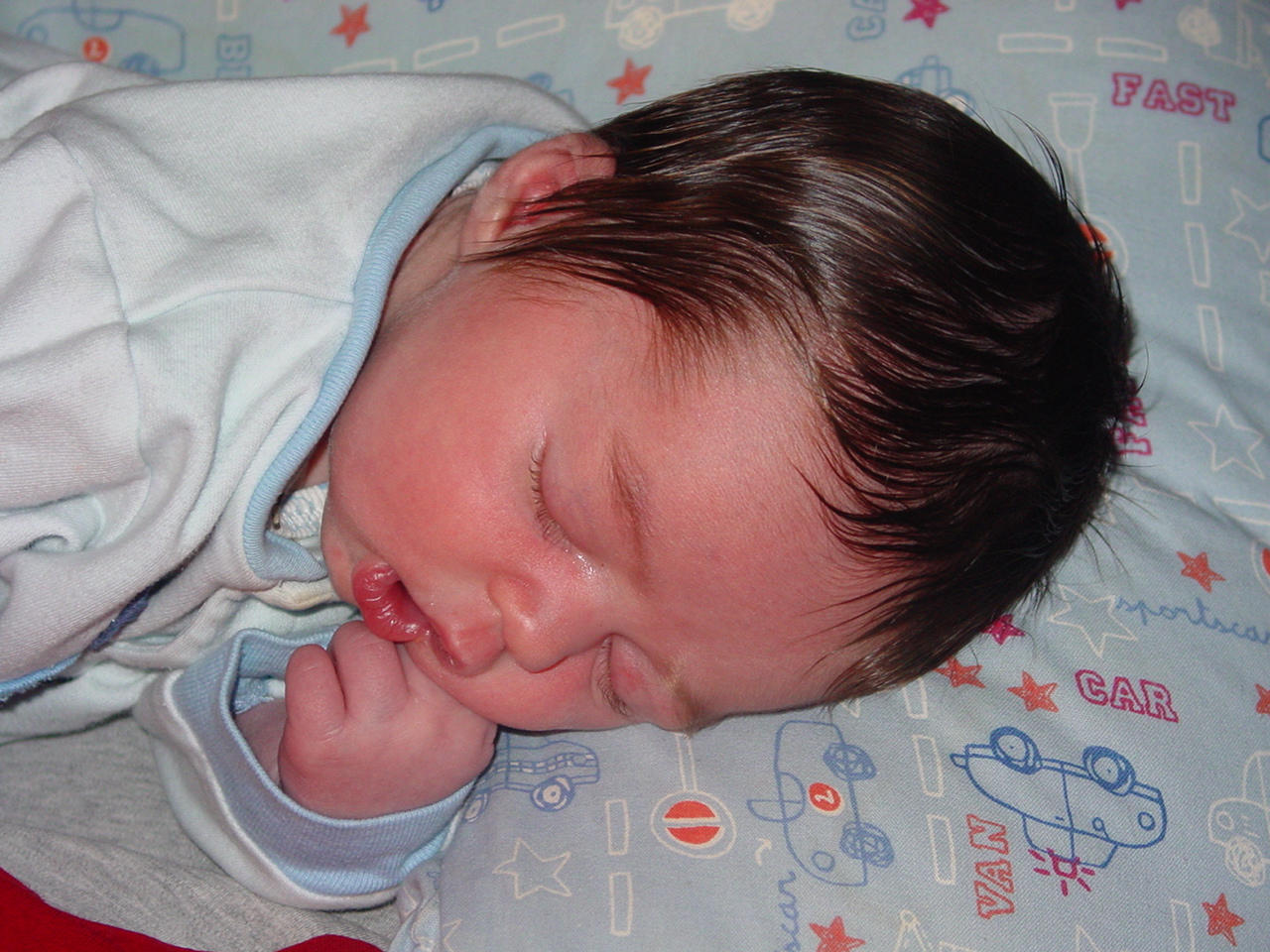
If preparing for the second child is tedious and routine, bringing the second child home is like falling into a comfortable routine. The heady delirium after our first child was gone, along with the nerves and the panic. In its place is a calm, deep joy. He sleeps like a dream, four hours at a time, leaving me and my wife fabulously well-rested. He nurses with gusto. He poops–boy does he ever poop–but after the problems we had in this area with the first, a steady supply of creamy mustard-brown poop is exactly what we want. He’s dozing next to me right now, one tiny fist held to his face, his big elfin eyes closed, an icon of serenity.
Sebastian Mircea was born April 19, 2010 at 3:43 am. He weighed 8 lbs. 1 oz. and was 21 inches long. He has great hair.
A few weeks ago I read Jo Walton talking about fantasy and origin stories. Walton makes two related, astute points: first, that the stories of origin that people tell themselves are flexible and often serve contemporary ends, and second, that the modern genre of fantasy may be a way to reclaim and reshape the origin myth for people who no longer have a living mythological tradition. She makes a couple of guesses as to why the modern genre of fantasy appeared when it did, concluding that dominance of the printing press and the appearance of canonical origin stories limited further development of origin myths in the West. These forced people to make newer, explicitly fantastical stories to fill that gap.
There’s quite a lot of meat to Walton’s hypothesis. In particular, it’s well-known that J.R.R. Tolkein originally set out to write a new mythos for the British Isles, being disappointed in the weak mythological foundation that the actual Celts and Anglo-Saxons left. Tolkein, more than any other modern fantasist, seems to have consciously undertaken the project that Walton describes, and Tolkein towers over the genre of fantasy so completely that every post-Tolkeinian writer has to grapple with those same issues. But at the same time, this thesis misses something. By the time the Lord of the Rings came to print, Tolkein’s literary work had changed so radically that it no longer looked much like an English mythology. And if the history of Middle Earth really were the origin story of Britain, would it be so popular with people elsewhere?
Yet I do think that Walton is fundamentally correct about fantasy’s concern with origins. I just think that the origin myth which the fantasists are telling is not the origin myth of a particular place. It’s the myth of a particular time. The era that fantasy purports to explain to us is modernity, our own time, and the story that it usually tells is that of the Fall.
There are two great Falls that have formed the imagination of people raised in a Western culture: the Original Sin that expelled mankind from Eden, and the Fall of Rome that marked the beginning of the Dark Ages. (The Fall of Rome is a historical event in the way that the Fall from Eden is not, but it still has a mythological significance for our culture’s self-understanding.) Despite his Catholic faith, Tolkein most heavily draws on this second example for his great fantasy: LotR is the story of the end of the age of the Elves and the beginning of the dominion of Men. The power of Sauron is broken, but the cost of that breaking is that the high culture and numinous magic of the Elves disappear from Middle-Earth. We are left with the mundane world of Men, stripped of magic, in which the incredible achievements of the Elves remain only as memories in Gondor and a few other outposts of civilization. This post-Elvish Dark Age is the world that we live in.
Tolkein is telling, in other words, the origin story of the modern world, structured as a tragic story of passing. Modernity is characterized by disenchantment: the displacement of the sacred, magical, and numinous cosmos by the impersonal, mechanical universe described by science and dominated by industry. The passing away of the Elves dramatizes this shift. We live in the world of Men, without Elves, without magic, and without the presence of the sacred that characterized the Elvish world. In this analogy it’s significant that the Elves didn’t just die–instead, they go across the sea to the West, a place where magic and the gods still exist, but cut off and distant from the realm of Middle-Earth. This is reminiscent of the change of orientation of popular religion in the rationalized West, away from divine healing, wards against the demonic, and other forms of supernaturalism, and towards rationalism and moralism focused on a happy afterlife. A great many people still believe in some kind of divine or supernatural power, but few expect to have any contact with it, just as most people will never see the Elves.
The second element of Tolkein’s commentary on modernity is, of course, industrialization. Both Sauron and Saruman are associated with industry, and here Tolkein doesn’t spare any disdain. Saruman’s greatest sin (and the cause of his downfall at the hands of the Ents) is his transformation of Orthanc into a hellish factory, a gross mimic of the blasted wasteland of Mordor. But the most poignant example of this is the poor Shire, where Saruman’s influence means the ruin of the hobbit-holes and the intrusion of ugly brick bastions eyesores–a change which probably reflects Tolkein’s own experience of the transformation of the English countryside. He wrote a better ending for Middle-Earth, though: Orthanc is cleansed, Mordor’s power is broken, and the Shire is saved from the encroachment of industry. The lesson for us is that our world has not been so spared. One can’t help but think of Tolkein’s rueful note that if LotR were an metaphor for WWII, the hobbits “would not have survived long except as slaves”.
Tolkein’s influence over modern fantasy is so vast that nearly every fantasist that comes after him is participating in this conversation about modernity, consciously or not. The End Of Magic is one of the ur-plots of fantasy, and you can while away an afternoon trying to name significant fantasy works that don’t have an Original Sin or a Fallen Empire somewhere in their background. And fantasy is most often about restoring the status quo ante, where even if big changes occur in the shape of the world, they usually involve restoring an earlier, purer, unfallen state. This does not mean that fantasy is necessarily reactionary–though it often is. Rather, this conversation about the origins and merits of modernity lies at the heart of the genre, and arguably is the reason why fantasy exists as a genre in the first place.
Nowhere is this more evident than in the recent explosion of steampunk as a subculture and literary genre. Steampunk is explicitly located in the early industrial era, and its appropriation of the Victorian mills and factories for its playthings speaks volumes of its attitude towards modernity. As a whole, this is a more optimistic take on the victory of industrialism: engines and gears are presented as elements of whimsy rather than oppression. This gives steampunk an interesting ambiguity. On the one hand, it can be seen as ratifying and celebrating industrialization. However, its creativity and wild revisionism suggest a dissatisfaction with the way things actually turned out, and an exploration of the paths not taken in the early modern period. This is a genre that is engaging critically with the roots of the modern world, without needing to retreat all the way to the pastoral vision of Tolkein and his successors.
Yet steampunk is often considered a subgenre of science fiction rather than fantasy. After all, there are no Elves in 19th-century London. But I argue that by this criterion, at least, steampunk is clearly fantasy: it tells a story of origin, which is the purview of fantasy. Science fiction is not nearly so preoccupied with the origins of modernity, because SF is eschatology.
There is no one source that dominates SF in the way that Tolkein dominates fantasy, but Star Trek comes close. And Star Trek is completely, unapologetically modern. The future, Star Trek assures us, is great. Earth is united, there is no more poverty, racism and sexism are banished, and humanity embarks on new voyages of peaceful discover. The essential features of modernity are all preserved, but the negative elements of contemporary life are purged. The future turns out to be just like the present, only better. This is one way of evaluating the telos of modernism: we have already passed through the big change by becoming liberal and technological, and what remains is a smooth progression of advancement along those axes.
This is one kind of optimistic future, one that’s fallen out of favor these days. The alternatives, however, tend to be even more explicitly concerned with Last Things. The Singularity, the “rapture for nerds”, asserts that technology will not only make us happier humans, but eventually turn us into godlike post-humans. This makes the telos of modernity into the total transformation of humanity and the world, into something more powerful and wonderful than has ever yet existed. Conversely, the post-apocalyptic genre shows us the world after it’s been destroyed–usually because of something we did. This is the pessimistic eschaton, in which we destroy ourselves whether by nuclear war or ecological catastrophe or killer robots. But this shows that turn away from straightforward, progressive futures has not dampened the eschatological fervor of science fiction. If anything, it’s been amplified and given weirder, more bombastic colors worthy of John the Revelator himself.
These are old, venerable tropes of Western literature: the fall (when magic and the old order of the Elves passed away), damnation (when our technology brings us to Armageddon), or salvation (when our technology lifts us to the Singularity). Placing the generic features of fantasy and science fiction in this light suggests another intriguing reason why these genres appeared at this time. We moderns are acutely, painfully aware of how different we are from the people of earlier ages, for better or worse. Whether or not modernity is actually a unique era of history is a different question, but we certainly want to think that we are. And if we’re so different, how did we get that way? And where are we going? The key problem that speculative fiction solves is not that old origin stories became too fixed, but that they became inadequate to explain the present.
We need new myths to orient us. This need is filled by fantasy and science fiction as new books of Genesis and Revelation.
A gypsy and his neighbor set out to build their houses. They spared no expense, and they succeeded in building two identical houses, brick for brick. When they were done, they both stepped back to admire their work. “What a great house!” the one said. “I’ll bet that I can sell it for a million dollars.” “What a great house!” the gypsy said. “I’ll bet that I can sell mine for two million dollars.” “What?” the neighbor said. “Our houses are identical. Why would yours sell for twice what mine sells for?” “Easy,” the gyspy said. “I don’t live next to a gyspy.”
And here’s a true story that happened to me while I was living in Romania: I lived outside of town and had to take a bus into work. I lived near a gypsy enclave, and my bus was often filled with people bringing their wares into town. One day the bus was very crowded (as usual), and I offered my seat to a youngish gypsy woman who looked tired and weary. She took it without a word. Then, about halfway through the trip, she started harassing me to give her money. I politely ignored her, but she became increasingly strident, offering to tell me my fortune in exchange for whatever money I was willing to give her. As she grew more insistent I grew more impatient, until the bus finally arrived downtown and I hurriedly disembarked to escape. No luck. She followed me, pulling on my sleeve and almost physically attempting to keep me from leaving. In exasperation I stuck my hand into my pocket and pulled out the first thing that I found: a 1000 lei coin (a tiny pittance, since a loaf of bread cost 10,000 lei at the time). I tried to push it into her hand, but it slipped out and fell into the muck and snow at the edge of the bus stop. She dashed after it, then looked at me in disgust when she realized that she had dirtied her hands for such a pathetic sum. A cop was standing nearby, and he started laughing. He winked at me in camaraderie–he naturally assumed that I had done this on purpose to humiliate the woman. Horrified and embarrassed, I fled from the bus stop and towards downtown. I say these two things to illustrate the following points:
Romani (gypsies) are subjected to immense, pervasive prejudice in Romania. One simply assumes that gypsies are dirty, irresponsible, rapacious, abusive, fortune-tellers, thieves, and swindlers. Anti-Romani racism is nearly universal and almost never questioned. In this sense Romania is quite different from the US, where racism is usually covert and subtle. Romanian bias is overt, obvious, and most of all considered normal.
At the same time, the prejudice is not really racial. It’s cultural. Romani who adopt mainstream dress, language, and lifestyle are pretty easily integrated. My wife descends from such a family: her paternal grandparents were gypsies who settled and entered Romanian mainstream, and this heritage has had close to zero impact on her and the rest of her family. She and all of her sisters are darker-skinned than the average Romanian, but no-one cares. I knew other people who were obviously Romani, but who had no trouble integrating into normal economic life once they took up Romanian dress, religion, etc. This also contrasts with historical attitudes in the US, where one-drop rules meant that people with mixed ancestry felt the full weight of segregation.
Partly for this reason, official attempts to redress this situation have been entirely ineffective, from what I can see. Officially, the Romani are not țigani but romi, and public-service advertisements against racism are visible in all major cities. The result? People now tell racist jokes using the word rom instead of țigan. Progress, eh? Additionally, there’s very little political consciousness among the gypsies themselves (that I know of). This dooms any attempts to address the problem through official channels, and makes the gestures that have been undertaken seem like condescension.
The story of what happened to me on the bus illustrates a problem with many of the accepted narratives about why racial stereotypes exist. In this feel-good just-so story, stereotypes are a means for the privileged to keep the underclass down, and closer interaction with the oppressed shows the stereotype to be false, and so racism disappears. My experience was just the opposite. Most interactions that most people have with gypsies in Romania serve to reinforce the stereotype. Indeed, the most horrific stories of spousal and child abuse I’ve ever heard have come from my sister-in-law and her husband, who do social work in an impoverished gypsy village. Their experience working closely with the Romani has not served to create the comfortable illusion that the gypsies are “just like us” beneath their skin, but rather has deepened the impression that there are terrible dysfunctions in Romani culture and mores.
Since the real divide between gypsies and Romanians in Romania is cultural, some people would counsel tolerance and mutual respect. Tolerance might be possible, but it will never lead to respect, because the differences between mainstream and Romani culture are imbued with moral significance. For example, it is not uncommon for Romani women to be married in their teens, and to have a few children by the time they reach their twenties. This is combined with widespread domestic abuse and general misogyny. Is this something that should be tolerated and respected? And this is just one example that I picked as congenial to Westerners–there are many other examples of cultural differences imbued with moral significance that separate the gypsy minority from the Romanian mainstream.
There is a conflict between the desire to preserve and respect Romani culture and the desire to eliminate prejudice against the Romani, because the culture is largely the cause of the prejudice. Okay, we say, we’ll keep the good (or neutral) aspects of the culture and get rid of the bad ones. Keep the bright dresses and lose the child marriage. Okay, but which cultural aspects are good and which are bad? And who gets to decide? The Romani themselves, or well-meaning liberal bureaucrats in Bucharest and Brussels? I have a hunch who’s actually going to set the policies that determine the future of Romani in Romania, and I’m suspicious that it’s just another form of racism, masquerading as multiculturalism.
And yet… I don’t think that we should be complacent about the treatment of gypsies in Romania (or anywhere else). I just think that we should be realistic about the content and the causes of prejudice. If you like this, you may be interested in A visitor’s guide to Romanian racism.





 J.S. Bangs