After writing my review of Shogun, there was one aspect of the book and its larger context which I wanted to comment on, but which wouldn’t fit into a book review. That is the issue of race, and the general idea of a white POV character surrounded by people of color.

This story template is known in SFF circles as What These People Need Is A Honky (and do read the linked article there — it’s interesting and funny), and it crops up frequently. Shogun is frequently mentioned in discussions of this topic, because it’s an excellent example, falling pretty neatly into the fake outline given at the link above:

White guy flees from his own culture for personal reasons (to set him up as different from those with white privilege). White guy meets natives. Natives educate white guy. White guy learns the way of natives, possibly also converting a native person who was originally doubtful of him, thereby proving white guy’s worthiness. White guy fights for natives. White guy makes dramatic escape while the native guy dies, possibly trying to help the white guy. The movie then ends with a dramatic coda and captions that inform the audience that despite white guy’s triumph, the Situation Remains Dire.

Shogun departs from this template mostly in the ending: the final victory belongs to the daimyo Toranaga, not the English sailor Blackthorne, and the Situation does not Remain Dire. Nonetheless, it’s easy to see how an actual Japanese person might be irritated by the presentation of feudal Japan in the book. The Japanese characters, while extremely sympathetic and often more compelling than the European characters, are thoroughly exoticized. The standard of comparison is always Western, the intended audience is assumed to be Western, and the Japanese civilization is presented as an object of fascination and evaluation by Western eyes.

And not just any Western evaluator, but a modern Western evaluator. James Clavell clearly loves Japanese culture, and he sets of a variety of contrasts in which we are meant to side with the Japanese against the early-modern European visitors: the relative religious neutrality of their monarchs, the sexual license and experimentation, the relative equality of the samurai women, their cleanliness, and their diet. The intended audience of the book may be Western, but the reader is clearly meant to side with the Japanese.

This story trope nearly always works this way: the story is presented to an audience that is presumed to be white and Western, yet the audience is asked to engage their sympathies against the West and for the "natives". But this presents us with a paradox. Why should stories which implicitly normalize the Western POV also explicitly criticize Western culture? And why is it that stories of this sort are often simultaneously accused of Western racism and colonialism and anti-Western revisionism?

The answer, I think, is that this story trope has a place in an ongoing argument within the confines of Western culture about the relationship between technology, culture, and human flourishing. The essence of the honky narrative is to present a dichotomy between Western society, which is technologically advanced but artistically and spiritually deficient, and a non-Western society which is technologically backwards, but rich is culture and spirituality. In Shogun, Blackthorne brings Western guns, cannons, shipbuilding, and navigation techniques to the Japanese who lack them, while he acquires a Japanese aesthetic sense and spiritual peace. The same pattern repeats in Avatar, Dances With Wolves, and other notable stories in this type. In every case, the non-Western culture is used as a mirror for the West, casting into relief the tension between technological and spiritual excellence, and its sympathetic presentation of the "natives" is a way of arguing for the incompleteness of technological society.

This explains why the honky narrative is so often reviled for being anti-Western. The West has achieved its current position of global dominance with a combination of technological and scientific ingenuity, and the core tenet of the honky narrative is that technological prowess is ultimately less important than artistic and spiritual wholeness. Furthermore, the audience-members are themselves steeped in technological society (and in the case of Avatar, the presentation of the story itself is a technological masterwork), so the white protagonist’s struggle to understand and integrate himself in the native society reflects the audience’s reluctance to give up their own technological comforts. The argument of all of these stories is that we, the white, Western audience, are missing out on something.

None of which mitigates the complaint from the other side of the aisle about the shallow and insulting depiction of the natives, and the assumption that the audience is white and Western. Non-Westerners and non-whites do not necessarily appreciate being press-ganged into service as object lessons for the more privileged. Nor should they.

And this is why I find myself conflicted about the honky narrative. I understand the complaints lodged against it, but I’m still very sympathetic to the core argument of the trope. Technological and scientific triumphalism leave me cold. I cheer on the protagonist as he questions his certainties about what constitutes "progress". Plus, I’m kind of white myself, so it’s convenient and comfortable to learn about another culture from a POV similar to my own.

It is probable best to simply judge every instance of this trope on its own merits. Shogun seems to me to avoid the worst excesses of the trope, as its Japanese characters are more interesting and have more agency than the white characters. (It’s also well-written and fantastically paced.) Avatar is worse on both counts, with a derivative storyline and more racially problematic overtones. Other books and movies run the gamut. Your mileage may vary.

Tonight I just finished the first draft of a short story. Yeah!

Okay, that’s not such a big deal, since I’ve finished the first drafts of lots of stories, but this is the first one I’ve pulled off in a while. I spent most of the first part of this year writing a novel, then I took a brief break from writing, and the two stories I tried to finish after that just didn’t work out. But this one turned out well.

Granted, it’s a total mess right now, with terrible pacing, a nonsensical conclusion, and some heavyhanded speechifying in the middle. But: it’s a first draft. And it’s done.

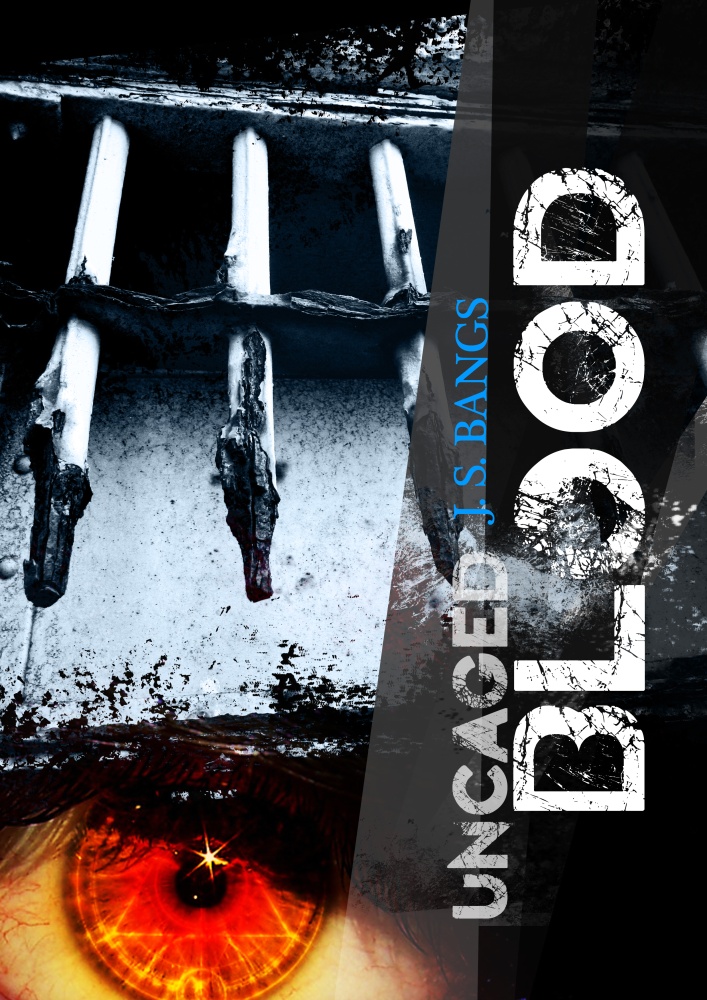
So remember my novella whose rights reverted to me? The one that I promised would be re-released with a new cover and a new title?

Well I’m proud to present to you:

Uncaged Blood

Read an excerpt and find links to buy here.

The new cover is SO MUCH BETTER than the old cover. The design and layout must be credited to Nathan Gramesc of Deluxe Photography, a photographer, web designer, and Level 9 Photoshop Mage, who managed to wring the beauty shown above out of the pile of “interesting prison pics” that I threw at him.

And the title has been freed from its, shall we say, unfortunate polysemy.

I’m extremely happy with the way this turned out. It’s the first thing I’ve self-published and it probably will not be the last.

A long, rambling introduction.

A few weeks ago I released phonix 0.8, the latest version of my phonological modeling language. And now that you’ve read the previous sentence, assuming you haven’t already clicked away in boredom, I hear you saying What the heck is a phonological modeling language?

Let me explain. No, let me sum up.

Languages change their sounds over time: Spanish and French have different sounds than Latin, and different sounds from each other. However, there are regular correspondences between the Latin sounds in a word and the resulting sounds in Spanish, and with a good set of rules you can generate Spanish words from Latin ones. However, to do this you need a model of the sounds in Latin and how they relate to each other, and a set of rules that describes how those sounds change over time and what the conditions are for turning one sound into another. This is what phonix does: it defines a special notation for describing a language’s sound system and the rules which apply to that system, then it allows you to apply those rules to lists of words.

All of this demonstrates that I’m a huge language nerd. I majored in Linguistics in college, and I was (as one under-motivated classmate said) "one of those people who reads linguistics books in their spare time". As a language nerd I spend an inordinate amount of time thinking about the languages used in my stories. And sometimes I think I’m the only one, since most fantasy and science fiction writing sucks a big one one this.

I feel a rant coming on.

Common failure modes of language in SF

Here they are, in decreasing order of fail:

  1. There are only two languages, the Modern and Old-Timey. Everyone speaks Modern, and no one can understand Old-Timey except maybe for the wizard. Guilty of this: Robert Jordan.

The problem with this model is that if the language has changed enough that the older form is incomprehensible, then unless the language community is very small the language should also have split into multiple daughter languages.

  1. There is one language for every country on the map. They are all obvious knock-offs of some familiar language in this world. Nonetheless, the protagonist never meets anyone that he can’t speak with. Guilty of this: Tad Williams.

This is a lot better than option #1, but it contains the problematic assumption that countries only contain one language. Americans, in particular, seem to fall into this assumption because we’re used to our vast, linguistically homogeneous country. But the majority of the countries in the world are home to multiple, mutually unintelligible language groups, and often dozens or hundreds of such groups. In a pre-modern setting, our protagonist should fine that the local vernacular becomes incomprehensible as soon as he’s traveled more than a few days from his house.

  1. There are multiple languages, but there is one common language that everyone speaks, so let’s just use that and keep all of the other languages out of it. Guilty of this: J.R.R. Tolkein.

This is tolerable, and it’s this approach that’s taken by Tolkein and those of his followers who bothered to care. There is often something of a handwave to this explanation—the author has posited this in order to avoid having to actually think about the languages in their setting too deeply—but at least it’s superficially plausible and has historical precedent.

  1. OMG SO MANY LANGUAGES. There are lots of languages, and they all have a distinctive phonology, syntax, and vocabulary. The historical relationships between the languages are well-documented and understood. They have their own writing systems. Really, there’s far more information about the languages of this world than anyone could reasonably hope to assimilate.

I actually don’t know any published authors in this category. Mark Rosenfeld has done amazing work in documenting his world of Almea, but alas he’s never been published. Such is the fate of many a conlanger.

So now you’re depressed. Your options are to write about language in your setting badly, or to spend years and years elaborating something that most readers don’t care about anyway.

There is one more option.

Pretend that it doesn’t exist. I read an interesting article the other day about how language is handled—or, more accurately, isn’t handled—in the Magic: the Gathering tie-in novels. (Scroll down to the "Letter of the Week" to see the discussion.) A letter asked how characters from different planes of the Multiverse can talk to each other without needing to learn a foreign language, and the author responded quite directly with "just ignore that":

The risk is over-explaining. To use a Star Trek example again, this time in a negative way—it’s like the episode where they explain why all the humanoid races on the show all basically look alike. Ugh. It’s one thing to poke fun at the show’s makeup budget and do armchair xenobiological critiques of how the aliens resemble each other so much, but it’s quite another to expect the show to provide an in-universe explanation of those budgetary or story-based limitations. Either you didn’t think it was a problem before and now this explanation throws an awkward spotlight on it, which diminishes your enjoyment of the formula, or you did think it was a problem but you had learned to live with it but now suddenly you have to live with the show’s one groan-worthy and set-in-stone explanation forever.

An explanation like "Well, everybody across the Multiverse happens to speak the same language because a long time ago blahblahblah" or "Well, all planeswalkers find that they can communicate just fine because the spark blahblahblah" may ultimately cause more problems than it fixes. It might actually reduce enjoyment to patch over one of those weird, load-bearing plot-holes that are kinda ugly but that make the fantasy genre possible.

Though it makes me want to cry a little, this guy has a really good point. No amount of world-building will cover everything. And if you don’t have the skills or the patience to make the languages, why bother? More importantly, if your story doesn’t need the linguistic detail, then maybe you should just leave it out.

Not me, though.

We all have our obsessions. I’ll be using phonix to apply the sound changes for deriving Prasi from Old Tzingrizil. And I’ll be having a great time of it, even if no-one cares.

I never get tired of talking about Tolkien. And occasionally I see something really great, which I really have to share. Behold, Alan Jacobs taking on a common, but misguided criticism of Tolkien.

It has just become the tale that middle-to-highbrow critics tell — ever since Edmund Wilson was saying his own manifestly untrue things about Tolkien in the New Yorker fifty years ago — that Tolkien’s fictional world is morally simplistic and rigidly Manichaean. It may be true that the story of the Ring is less morally ambiguous than the average realistic novel, but that’s primarily because Tolkien wasn’t especially interested in the problem of knowing right from wrong. His concern was to explore the psychology of the moment when you know right from wrong but aren’t sure whether you have the courage and fortitude to do the right thing.

Modern liberalism likes to think that all our problems are epistemological: we are afflicted by never knowing with sufficient clarity what we ought to do. Our fictions tend to reflect that assumption. Tolkien, not being a modern liberal, thought it more interesting to explore situations when people know what they need to know but may lack the strength of will to act on that knowledge. He might say, and with some justification, that contemporary literary fiction is not simplistic in regard to such problems but oblivious to them.

Forgive me, Alan, for quoting about half of your article. It was too good to omit anything.

Shogun
Shogun by James Clavell
My rating: 4 of 5 stars

This book is ostensibly the story of John Blackthorne, an Englishman piloting of a Dutch sailing ship which is attempting to circumnavigate the globe in 1600. Their ship runs aground before a storm in a village on the east coast of Japan, and from there Blackthorne and the rest of the Dutch crew are quickly caught up in the fractious, Byzantine politics of feudal Japan.

I say that the book is “ostensibly” about Blackthorne, because while the book begins with his POV and follows most of his adventures, the center of the story and the driver of the plot is Toranaga, the Japanese daimyo who takes Blackthorne into his care and implicates him into his drive to become Shogun, the supreme military leader of japan.

The character of Toranaga is a masterful creation: a political genius, a master of the double- and triple-cross, always a step ahead of his rivals, playing the chess game of Japanese feudal politics with awe-inspiring brilliance. At the beginning of the novel he faces a political crisis as the other leading daimyos of Japan correctly see him as the greatest threat, and have banded together to eliminate him or drive him to seppuku. As the novel progresses things apparently go from bad to worse as Toranaga’s enemies multiply and his resources dwindle—yet he repeatedly escapes from apparently invincible traps and turns disasters into victories. At the same time, Clavell paints Toranaga as an enlightened, humanistic, and sympathetic ruler, the sort of man who deserves to establish a dynasty lasting centuries.

While Toranaga is undoubtedly the book’s center, the numerous secondary characters fill out Clavell’s depiction of feudal Japan. Blackthorne advises Toranaga in the use of muskets, providing a crucial element in his military plans, all the while pursuing a doomed romance with the Lady Mariko Toda. We meet a variety of other Japanese nobles, Toranaga’s allies and enemies, who are variously craven, cruel, and courageous. Other characters include Japanese peasants and courtesans, Portuguese traders and sailors, and Jesuit missionaries working to preserve the Church and its lucrative trade routes. The resulting tapestry, involving religious and political rivalries stretching across Europe, Asia, and the Americas, is extremely complex, but is introduced in a way that makes it easy to understand and follow.

Of course, my biggest question after finishing such an enormous historical epic is How accurate is all of this? After doing a little bit of research, I’m pleased to say that the book generally seems to hold up. Toranaga is based pretty closely on Tokugawa Ieyasu, who founded the Tokugawa Shogunate that lasted until the mid-19th century. The story of John Blackthorne is based on the life of William Adams. Clavell’s telling certains contains its embellishments and anachronisms, but the core narrative is historical, and the depiction of feudal Japan seems to be remarkably accurate.

If you’re looking for a long (and I do mean long) immersive read, or a friendly way to introduce yourself to a crucial time in Japanese history, I recommend this highly.

View all my reviews

As I mentioned a few weeks ago, the rights to my previously-published novella The Taint recently reverted to me, and as a result I’m working to self-publish it. Which means that I spent much of the weekend playing with epub creation software, trying to get an idea of what it’ll take to put together a professional-looking book. And I learned something surprising.

This stuff is easy.

I was expecting something harder. I was expecting to spend hours poring over obscure specs, or wrestling with ugly, obscure, and bud-ridden open source software to get it to work. But it turns out that the software to do this is dirt-simple, and it’s called pandoc. Pandoc is amazing. It took me literally a few minutes to generate my first .epub file from the plain text version of my story. (I blogged once before about my extremely nerdy writing setup, and the basics have been unchanged since then. I now use Markdown rather than LaTeX for formatting, but I still write everything in plain text first.) It took me about fifteen more minutes to learn everything I needed to know about changing the fonts and layout in the generated file. I spent more time looking for e-reader software to try out the new book on than I did actually building the book.

And then, of course, I lost a few hours trying out formatting tweaks. That was a dark and twisty corner of hell to fall in to. The conclusion of that experiment was that CSS support across e-readers is very inconsistent, and ultimately doesn’t matter. I’ve got the font and the margins how I want them, so I will force myself not to care about the rest, no matter how often the alluring siren of CSS customization calls out to me.

With this hurdle out of the way, I expect that I’ll have the completed ebook ready sooner rather than later. The cover is being worked on, though you can’t see it yet. Pretty much everything else is good to go. It should be in e-bookstores in time for the holiday rush. (Do e-books have holiday rushes? Is that a thing?) Anyway, watch this space.