1. I already have a change of NaNoWriMo plans. The story for week #3 will not be Whalesong, as previously written into the schedule, but rather There Is No Such Place As Canada. It’s a story about oppression, specifically the oppression of Canadians. It should be a riot. Week four, then, is a wildcard, in which I write any story whose plot comes to me in time, but the current candidates are either Whalesong or The Blasphemous, the Cruel, and the Weak.

2. So evidently there’s some kind of election coming up? Based on the coverage, it appears that the candidates are a notorious international anarcho-terrorist and a rapacious, black-hearted banker who wears funny underwear. Plus there are third-party candidates, who are hilarious. So I’m encouraging everyone to do their part for democracy and not vote.

3. Jim Hines has a good NaNo pep talk. So do lots of other people, for that matter. See, NaNoWriMo would be a good thing you could do instead of voting next Tuesday. I have your best interests in mind.

It’s coming. Can you feel it? It sounds like thousands of keyboards being battered all at once, their keys clattering, crying, and falling silent. You can smell it on the wind. The smell of imagination, the incense of hope, and the bitter smoke of despair. The writers approach, their eyes wide, their fingers trembling, and on their lips the mantra: fifty thousand, fifty thousand, fifty thousand.

NaNoWriMo.

I’ve plunged into the madness of NaNoWriMo once before, and emerged, miraculously, victorious. I’m told there are not many that succeed on their first foray into that ravenous land. On that occasion I was writing a novel, The Failed Apostle, and I successfully penned its first 60,000 words that November. It was very hard. I was very glad I did it.

I am foolish enough to try again, after a fashion.

This time I do not have a novel which I would like to begin. I do, however, have another kid, and a larger and more pressing set of responsibilities. Examining my current projects and the realities of my schedule, I have put myself another, more realistic goal: I shall write four short stories in the month of November. One each week.

All together, these stories will probably not total more than 20,000 words—but this is hardly the point. As any short story writer will tell you, 2,000 words of short story may take as much effort as 20,000 words from a novel. Your canvas is smaller, and so your attention to detail must be greater. Under current conditions, writing a full rough draft of a story normally takes me much more than a week, so this will still be a significant challenge to my dedication and time. I think it will be worth it.

As with last time, I do not go into battle unprepared. I have chosen which stories I will write, and slotted them into a schedule.

  1. The Heresy Trial of Friar Travolo, about a monk who proves a thesis which is scandalous to the mathematical authorities of his day. This one is cheating, somewhat, since I already have it half-written. I do not care, though. It’s a difficult story for me to write, somewhat outside my usual oeuvre, and finishing it within its allotted week will be challenge enough.

  2. Mr. Yamamoto’s Night Janitorial and Demon-Hunting Service, about a young man who is trained to empty the trash bins and, if necessary, exorcise them. This one I have pretty clearly plotted in my head. It’s something of a satire.

  3. Whalesong, a story about (obviously) sunspots. This one is only a vague idea, yet.

  4. The Blasphemous, the Cruel, and the Weak. I have no idea what this one is about. I only have the title, which I love, but I still have to discover what the plot is.

Nor do I expect that I will have finished with these stories by the end of the month. It is enough that they be complete; making them be good is the task of the months to follow.

In 1908, the poet T.E. Hulme gave a famous speech at in which he laid out the programme for modernist poetry, inveighing in vigorous language against rhyme and meter. His influence was already considerable by that time, and his address would both solidify his position and influence English literature for the rest of the 20th century:

Regular metre to this impressionist poetry is cramping, jangling, meaningless, and out of place. Into the delicate pattern of images and colour it introduces the heavy, crude pattern of rhetorical verse. It destroys the effect just as a barrel organ does, when it intrudes into the subtle interwoven harmonies of the modern symphony. It is a delicate and difficult art, that of evoking an image, of fitting the rhythm to the idea, and one is tempted to fall back to the comforting and easy arms of the old, regular metre, which takes away all the trouble for us.

Metered verse was, for Hulme and the other modernist poets, a crutch and an obstacle to authentic poetic expression. And rhyme, though already failing by the time that Hulme gave his speech, lost any chance of its survival as a vigorous part of modern poetry by this salvo. The edicts of Hulme and his influential cabal of modern poets (including Ezra Pound, James Joyce, and others) effectively directed the mainstream of English-language poetry (and, to a large degree, its prose) for the rest of the century.

All of which is preamble to something I heard a few weeks ago on This American Life. They commemorated the passing of one of their frequent contributors David Lakoff, with this excerpt from his new novel. Written in verse. In rhyming verse.

It was sadness that gripped him far more than the fear
that, if facing the truth, he had maybe a year.
When poetic phrases like “eyes, look your last”
become true, all you want is to stay, to hold fast.  
A new, fierce attachment to all of this world
now pierced him. It stabbed like a deity-hurled
lightning bolt, lancing him, sent from above, 
left him giddy and tearful. It felt like young love.

Listen to the whole episode here..

And I could only think: rhyme is back, baby.

Of course one admittedly quirky novel doesn’t make a trend. But it’s one of several examples I’ve met lately of significant literary projects written in rhyming verse, which does suggest that there’s something in the water. Part of it is the hipster mentality—all of the examples that I’ve heard have been rhyming couplets, the cheesiest form of rhyme, the literary equivalent of wearing your dad’s chunky black glasses and plaid sweater vest. Part of it is 21st century remix culture, playing on old discredited poetic forms just for contrast and quirk.

And some of it is the inevitable tendency of "progress" to turn on its ancestors. (This is something that I’ve remarked on before,) Once you embrace novelty and progression as literary virtues, you set yourself up to be rejected a few generations down the line once your radical, progressive views have become commonplace. I don’t know if there’s any forceful rejection of unrhymed poetry going on here, and there certainly doesn’t seem to be any kind of organized pro-rhyme school of poetry coming together. Literature in the early 21st century does not seem to lend itself to that sort of movement-building. Instead, it’s just that rhyme is becoming hip. And being hip is a more powerful motivator than being progressive ever was.

Which brings me to my real point: "progress" and "novelty" are terrible things to hold as literary virtues. Hipsterism is better, but only a little.

(Also, rhyme is awesome, but I still don’t think I want to read an entire rhyming novel.)

I need to read more Raymond Chandler.

The Big Sleep cover

Two weeks ago I went away with my wife for a weekend at a nearby bed-and-breakfast, and I took along a copy of Carver’s The Big Sleep that I had picked up from a friend. I knew Carver only by reputation, as a sort of godfather of the mystery genre, someone that many people spoke highly of. I had heard the name Philip Marlowe, and I had the vague impression that his books all took place in smoky film noir settings full of sultry dames, bootleggers, wise guys with pistols tucked into their pants, and dirty cops.

These things all turned out to be true.

However, The Big Sleep wasn’t nearly as pulpy as I expected it to be, nor as pulpy as my summary above might suggest. Chandler wasn’t much for spectacle, and he plays down the more lurid aspects of his work rather than playing them up for titillation. What I expected the least, though, was how brisk and exacting the prose was. Chandler’s style eschews florid detail and "literary" ostentation, and instead lays out his scenes and arranges his words with crisp, punchy directness. Take the opening paragraph:

It was about eleven o’clock in the morning, mid-October, with the sun not shining and a look of hard wet rain in the clearness of the foothills. I was wearing my powder-blue suit, with dark shirt, tie and display handkerchief, black brogues, black wool socks with dark blue clocks on them. I was neat, clean, shaved and sober, and I didn’t care who knew it. I was everything the well-dressed private detective ought to be. I was calling on four million dollars.

I love this line: I was neat, clean, shaved and sober, and I didn’t care who knew it. Here we’ve got setting, tone, character, and the first note of the plot, all in just a few sentences. The presentation of the first-person protagonist, Phillip Marlowe, is especially deft. We get no direct characterization of Marlowe at all, and no expansive inner monologues or deep explorations of his inner life. But this doesn’t mean that Marlowe is a cipher; on the contrary, by the end of the book you know him very well, but you know him by virtue of his actions and, more importantly, by observing the world through his eyes, noticing what he notices, and feeling the effect of the words he chooses to describe it. This is marvellously effective. The plot never slows down to reveal the characters, yet we never have to wonder about who the characters are.

The plot construction, too, is excellent, especially in the opening chapters. We get a series of questions, and then a trickle of answers, each of which brings with it new questions. There is a constant sense of progress, but never a plateau or a moment where there is nothing to keep driving us forward. By chapters:

  1. Q: Why is General Sternwood hiring Marlowe? Q: What is up with his daughter Carmen?
  2. A: Sternwood is being blackmailed by A.G. Geiger, who claims to have information about Carmen. Q: What does Geiger know?
  3. Q: What is up with Victoria Sternwood? Q: What does Rusty Regan have to do with all this?
  4. Q: What sort of business is Geiger really running out of his "bookstore"?
  5. A: Geiger lends pornographic books. Q: What’s the connection to Carmen?
  6. Q: Who killed Geiger? And what does it mean for the Sternwood?

Chapter 6 is where things really pick up, as the sleepy little blackmail case suddenly becomes a murder case, and solving the murder requires Marlowe to untangle the rest of the questions posed in those first six chapters, as well as other questions posed thereafter. Then, about halfway through, things seem to wrap up… but following the last few loose ends (including things foreshadowed in those very first chapters) leads to another, deeper layer of mystery whose resolution is more difficult and more chilling.

The internets tell me that this was Chandler’s first Marlowe book, but that it was stitched together from previously published short stories. Knowing the book’s hybrid nature, one can make out some seams here and there, but overall this is a remarkably coherent and remarkably good early novel. I’ll be coming back to Chandler.

I’ve been busy lately: family from sundry parts of America and Romania have been visiting, bringing the total people under our roof to nine at one point. This has severely cut into my time for writing, hence the sudden lack of posts.

But a friend of mine Marlene Dotterer recently posted the Look Challenge, and I thought it was interesting enough to take her up on it.

1. Find the first occurrence of the word “look” in your WIP, and post the surrounding paragraph.
2. Tag others to do the same.

My current WiP is a short story called The Heresy Trial of Friar Travolo, and conveniently the first instance of “look” in the story is the description of the eponymous Friar:

And so I met the famed heretic. Travolo is a small man, stooped at the neck, with muddy brown eyes and a thin, greasy beard, unpleasant to look at. His chamber was floored with planks of wood and furnished only with a straw mattress and a burlap rag for a blanket, and the only source of light was what trickled in from the narrow windows set into the stone walls of the tower. I carried a lamp, but without it it was very dark, and Travolo had no lamp of his own. Yet by the lamplight I could see that he had fashioned a crude pencil from wood, and in the stone walls had begun to scratch the outlines of an exegesis right at the spot where the light would fall on it as it slipped through the window in the evening.

I tag Natasha and Corey, should either of them happen to see this. (But if you’re reading this you’re welcome to participate, even if you aren’t either of them.)

The Man Who Was Thursday
The Man Who Was Thursday by G.K. Chesterton
My rating: 4 of 5 stars

I don’t think I’m nearly creative or audacious enough to write something like The Man Who Was Thursday. I could barely believe that I was reading it.

Ostensibly, this is the story of Gabriel Syme, a gentleman, a poet, and a lover of law and order. In the first chapter he takes up an argument with another poet Lucian Gregory, an anarchist poseur. They argue heatedly but ineffectually, and both of them dismiss the other as harmless. However, the evening turns strange when Gregory swears Syme to secrecy, then conducts him to the underground lair of the European Council of Anarchists, where he reveals that he belongs to a cabal of anarchist terrorists, all of whom have taken up disguises as harmless bourgeois dilettantes to throw the police off their scent. Syme then reveals to Gregory that he is in fact a member of the police force, who has been drafted into a secret cadre of police intellectuals commissioned to prevent crimes arising from bad philosophy.

Both of them swear to keep the other’s secret. The anarchist parliament convenes, and Gregory’s election proceeds as predicted, until Syme intervenes. He contrives to pass himself off as a representative of the Council’s president, discredits Gregory, and has himself elected to the council in Gregory’s place.

This double deception is indicative of the whole absurdist tone of the book. People disguise themselves as exactly what they are, fight bitterly with their allies, and collude with their enemies, and by the end of the book even the ridiculous premise described above turns out to be something other than the truth. After Syme is elected to the Council of Anarchists, he becomes privy to a plot to kill both the Czar and the Prime Minister of France with a bomb, and sets out to somehow derail the assassinations without revealing himself to the rest of the group. His attempts result in him being chased by an octogenarian through a London snow storm, a duel with the Marquis of St. Eustache, a desperate flight through the French countryside, and a battle with an anarchist horde at the seashore. None of these incidents are what they seem at first, and all of them are accompanied by further revelations about the true nature of the characters and organizations in the story.

This structure is both the novel’s strength and its greatest weakness. By the third iteration of "this person is not what they seem", it becomes fairly obvious what the general direction of the story is, and some of the final twists in the main plot seemed rather perfunctory. However, as the plot dissolves into obfuscation, a larger and more pressing mystery comes forth, like a shape looming out of the fog: Who is the President of the Council of Anarchists, and what does he actually want? The answer to this question is strange, unexpected, and beautiful. Finding it out also involves a hijacked hansom cab, an elephant, and a hot air balloon.

In many ways, this novel feels like a spiritual predecessor to The Prisoner. As in The Prisoner, the story’s conceit revolves around hidden identities and double-crosses, and as with The Prisoner the novel’s ending does not resolve the plot in any literal manner. Rather, as the story nears its conclusion it ascends out of its novelistic trappings into something like a fairy tale, offering a conclusion which addresses the novel’s questions spiritually and philosophically. Not all readers will like the ending, but I doubt many will doubt its audacity and originality.

If you like Chesterton, you will doubtlessly like this book. If you don’t like Chesterton, you may enjoy this anyway, if nothing else as an example of how to write a cosmic comedy in the guise of a police thriller.

View all my reviews

I’m writing a story. My problem is that a big part of this story takes place in China, and outside of the usual clichés I know next to nothing about China.

Ignorance is not an unsolvable problem, of course. There are lots of books about China — I have two on my nightstand right now — and of course the internet is brimming with info. You can with a little reading and a little googling get enough of a feel for a place to write about it convincingly, or at least avoid looking like a fool.

But what you cannot get from books and googled images is insight. Even if the book you’re reading offers interesting insights, they’re somebody else’s insights, and nothing is worse than recycled insight. A revelation that somebody else has earned by living in and seeking to understand a place can only be a fact when it’s repeated to others, and by the time it comes third-hand it’s already a cliché.

Why do I need insight into China? Mostly it’s the structure of the story: the protagonist comes to China thinking that he’s looking for one thing, fails to find it, but is redirected to seeking something else instead. It would be nice if the protagonist’s failure and renewal were related in a deep and interesting way to the country that he’s visiting. The story doesn’t really require that his destination be China — it could be Vietnam or India or Brazil or any number of other places around the globe — but wherever it is, the place as presented in the story must seem authentic, and must relate organically to the character’s transformation. It will not do to have him visit Exotic Foreign Locale #12 and be impressed by the friendly but nondescript brown-skinned natives. I’m trying to be a little more original than that.

And that’s why I’m trawling my sources looking for the thing that’s going to turn him around. I don’t know what it is yet, but I trust that when I see it things will click and I’ll know how to finish my story.

(If you, by the way, have anything interesting along these lines to share, please do so in the comments. I can’t say what I’m looking for, but anything interesting and informative about the rapidly industrializing countries of Asia or Latin America would fit.)

N.K. Jemisin recently blogged about magic. I quote:

It’s hard out here for a fantasy writer, after all; there’s all these rules I’m supposed to follow, or the Fantasy Police might come and make me do hard labor in the Cold Iron Mines. For example: I keep hearing that magic has to have rules. It has to be logical. It has to have limitations, consequences, energy exchange, internal consistency, clear cause and effect, thoroughly-tested laws with repeatable results and –

Waitaminnit.

This is magic we’re talking about here, right? Force of nature, kinda woo-woo and froo-froo, things beyond our ken, and all that? And most of all, not science? Because sometimes I wonder.

I couldn’t agree more. The point of magic, the whole reason why it’s magic and not science is that it does not submit to rational analysis. Magic is unempirical. Magic is non-repeatable. If you can reproduce it in a lab, or bottle it, and sell it on shelves, it ain’t magic. Read the Jemisin article for more details.

Having made this declaration, however, I find myself at a loss for what to call the many "magical" systems one finds in books which are not mysterious, unempirical, or non-repeatable. This category of non-magic includes Robert Jordan’s Wheel of Time, Modessitt’s Recluce books, most of Brandon Sanderson’s books, and almost everything that goes under the rubric of D&D or other RPGs. "Crypto-science" was the first thing I thought of: the magical systems in these books basically operate under the same principles as any other scientific technology, though their mechanisms are completely fictional. Sometimes magic is distinguished from technology by requiring an innate "spark"; in other cases magical talent appears to be more like a talent for art or math, where some people have a special aptitude, but the basics are teachable to anyone.

What’s notable, though, is that in all of these cases magic is impersonal. It doesn’t depend fundamentally on who you are or who you’re dealing with. Magic, like science, works the same for everyone. So I settled on the terminology of impersonal magic to describe these systems.

We can contrast this with personal magic systems, in which the identity of the magic-user is crucial to the working of magic. In Lord of the Rings, Gandalf says the Elvish word for "fire", strikes the wet wood with his staff, and a fire starts. The other characters could talk Elvish and swing sticks around all night and not get anything other than splinters. Gandalf’s magic works the way it does not because he’s tapping into secret forces which anyone could invoke, but because he’s Gandalf.

This is different even from Robert Jordan’s case, which it superficially resembles. Rand from the Wheel of Time may be the Dragon Reborn, but his identity as the Dragon merely means that he can channel really, really well. The One Power that he channels is not any different for him than it is for anybody else, and his abilities differ in degree but not in kind from those of every other channeler in the series. The one exception may be the prophecies regarding the Last Battle, in which the person of the Dragon might play a role beyond that of merely channeling a lot (it’s not exactly clear). But if that happened it would be an exception, a mere glimmer of personality shining through what is otherwise a very impersonal system.

Analyzing the difference in terms of personality illuminates why I prefer the personal systems to the impersonal. Under an impersonal system, using magic is a technological activity; under a personal system it’s a social one. Impersonal magic derives from what you do; personal magic derives from who you are. This difference allows the personal systems to illuminate different aspects of the human experience. An impersonal system will tend to be about intellect, analysis, and power, while a personal system will tend to be about passion, relationship, and love. This doesn’t mean that I dislike impersonal magic systems, necessarily — intellect is a fine thing, and I wouldn’t want to suggest otherwise — but ultimately I find the metaphorical range of the personal magic systems more to my liking.

In The Wedding of Earth and Sky, magic is intensely personal. The driver of the plot is a spiritual strife between two of the Powers of the world, and the problems that it causes cannot be solved by mere power, but only by reconciliation. This is the sort of story that can only be told with a personal magic system, and that’s why I wrote it.

Yivrian has been conceived as a member of a language family, though none of the other members of the family have ever seen significant development. This presented me with a challenge and an opportunity when I sat down to write my current WiP, since it’s set in a part of the world that doesn’t speak Yivrian, but one of its sister languages Praseo.

Praseo, known as Praçí in an earlier incarnation, is the language of the city of Prasa (formerly Praç) and its environs. Praseo was originally conceived as a Portuguese-like relative of Yivrian, and it retains several features from that early stage: nasal vowels, several syllable reductions, and vocalization of coda -l to create lots of diphthongs ending in -o. However, over time that Portuguese flavor has largely been lost, partly because my conception of the conculture of the Yivrian cultural area changed quite a bit, and partly because the Yivrian lexical base was hard to warp into something that felt Romance-like. The current incarnation has phonoaesthetic elements of Japanese and Pacific Northwest Native American languages to go with the Portuguese substrate, but it retains enough similarity to Yivrian to feel like a member of the same family.

But I may be getting ahead of myself. Let me show you a chart of Yivrian’s close relatives:
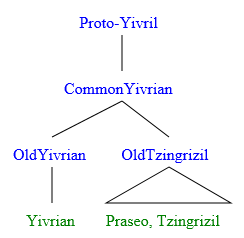
There is not a lot of breadth here, as the near relatives of Yivrian number only two (plus a possible, unnamed third language which I haven’t included in the chart above, since it’s little more than conjecture at this point). For brevity, I often refer to the languages mentioned above with the following abbreviations:

  • PY (Proto-Yivril)
  • CY (Common Yivrian)
  • OY (Old Yivrian)
  • OTz (Old Tzingrizil)
  • Y (Yivrian)
  • Pr (Praseo)
  • Tz (Tzingrizil)

[Speaking from an in-universe perspective:] Yivrian, Praseo, and Tzingrizil are all attested, literary languages that had hundreds of thousands of speakers during the classical period and are quite well-documented. The “old” languages Old Yivrian and Old Tzingrizil are also attested, though much more sparsely, while the ancestral languages of Common Yivrian and Proto-Yivril are only known through reconstruction. There is a pretty high level of intelligibility between OY and OTz, though the daughter languages are all mutually unintelligible.

[Speaking from a conlanging perspective:] My Yivrian lexicon includes the ancestral Common Yivrian forms for all of its entries (except those that are borrowings or later coinages, obviously), which means that I have a pretty large CY lexical base to use for deriving other sister languages. The challenge that this presents, though, is to create forms that are phonoaesthetically pleasing and linguistically plausible for the other daughter languages. Y itself doesn’t have this problem, since all of the CY forms in the lexicon were created by extrapolating backwards from Y, but I find that the sound changes from CY forward to the other daughters require a lot of tweaking. Next post I may go into detail on a few of the problems I encountered and some solutions that I worked up for them.

But using Praseo for my WiP actually presented a bigger problem. Namely, the people in the book don’t actually speak Praseo yet.

The book I’m working on is set in an early part of the Yivrian history, at the stage of Old Yivrian and Old Tzingrizil. The story takes place in and around Prasa, but at the time of the story Prasa had been settled by explorers from Tsingris for only about two generations. So the characters are largely speaking OTz. But I don’t want to use OTz for my names and language snippets, because OTz is ugly. I have strong phonoaesthetic expectations for my conlangs, especially those that are going to go into books. I consider OY and OTz to be intermediate stages, and I don’t much worry about tuning them, but this means that they aren’t suitable for use as the main conlang sources in a novel. Furthermore, I have to keep my readers in mind — it would be really confusing if I publish three different novels in different time periods, and all of the place names were slightly different in each book due to linguistic shifts.

To get around these problems, I established a policy which I intend to follow from here on out. All place names and language snippets appear in the canonical, classical form of each language, which is generally the latest developed form of the language in con-historical time. Furthermore, wherever possible place names are given in the form of the local language, regardless of the language of the speaker or POV character in the story. That is, the city of Prasa will always be called Prasa, since that’s its name in Praseo, despite the fact that in Y the name is Parath, and in Tz it’s something else yet.

But all of this is just backstory and extra-literary justification for my linguistic decisions. The actual work of creating Praseo is still underway, and next week I’ll talk about some of the challenges.

In conlang parlance, a naming language is a language sketch which is designed only for generating names in a work of fiction. Naming languages are sometimes held in low regard by conlangers as not being "real" languages, but this is an unnecessary bias. A naming language is like a minimalist painting: it only consists of a few strokes, but it should suggest the shape of something much bigger, and when done well it has a beauty and an elegance of its own.

Also, often you just don’t have time to create a full language. And that’s how it was with Yakhat: I needed a language to provide placenames and personal names for one of the tribes in the story, but I didn’t have the time or the interest to develop a full-blown lang for them. So I made a naming language.

All you need for a good naming language is two things:

  1. A phonology
  2. Some basic morphology

Yakhat phonology is very simple. I want the language to be reminiscent of the languages of Southeast Asia, so I pick out the following consonant phonemes:

p   t   tʃ  k
b   d   dʒ  g
bʱ  dʱ      
            kʰ
    s   ʃ
m   n
    l, r 
        j

Some unusual things to note: we have a single series of aspirated stops, but the labial and dental members are phonetically voiced, while the velar member is voiceless. At a featural level, all of these stops are unspecified for voice, but the labial and dental members are phonetically voiced because they lie further forward in the oral cavity and thus easily fall prey to spontaneous voicing. And why is the aspirated affricate missing? Here I imagine that there once was an aspirated affricate /tʃʰ/, but that this member became deaffricated and gives the /ʃ/ phoneme shown above.

Meta-linguistic concerns actually drive most of the decisions above. I like the digraphs bh and dh, but I dislike ph and th, since English speakers are likely to pronounce those as [f] and [θ] respectively. Furthermore, /tʃʰ/ is nearly impossible to romanize well, as you either choose the abominable chh, or you use ch and then find some other way to indicate /tʃ/. The conjectured sound change above justifies me avoiding it, and gives me an excuse to include /ʃ/, which I had already used in several names that I liked very much.

To this basic phoneme set, I add a few basic phonotactic constraints and some phonological processes, which I won’t cover in detail here. You’ll see some of them in action below.

On to morphology. For the purposes of my language, I created exactly two morphemes: a patronymic suffix -lik, and a reduplicative suffix for collective plurals. The patronymic is unremarkable. The primary character from this tribe is named Keshlik /’kɛʃlɪk/, the son of Keishul /’ke:ʃul/. In the derivation of that name you can observe a few phonological processes at work, such as syncope of an unstressed vowel, but otherwise there’s little to say.

The reduplicative plural is much more interesting. The hometown of the primary character is Khaat Ban [kʰa:t ban], and the people from his town are known as the Khaatat [kʰa:tat]. This collective plural is formed by reduplicating the vowel and final consonant of the stem: Khaat Ban gives Khaatat, those from Louk Ban are the Lougok, and those from Bhut Ban the Bhudhut, etc. You can observe several phonological changes in these forms. For example, voice and aspiration are both neutralized in codas, so that Bhut has the underlying form /bʱudʱ/ which is realized as [bʱut] in the simple name, but the underlying form of the final consonant reasserts itself in the reduplicated form.

And that’s it! With a relatively simple phonology, a few phonological rules, and some morphemes I have a naming language, but one that has just enough depth to suggest that a complete language underlies it. I don’t know what the stems of the names mean, and I don’t need to. If I ever decide that I need to elaborate Yakhat further, I’ll already have the groundwork laid down to create something fuller.

Next time: Praseo, and the challenges of developing something for a language family you already have.