So my last article about Romania was perhaps overly negative, being as it was all Racism! Poverty! Thieves! Swindlers! I ended with a note that Romania is still a great place to visit, but my wife pointed out that this was somewhat underwhelming following the cascade of negativity in the rest of the article.

So here’s a list of things that I think you’ll enjoy in Romanian culture, things which should persuade you, the American or British traveler, to come and visit. I’m not going to list things that you’ll find in any tourist’s guide, so don’t expect me to go on about the gorgeous monasteries, or the wildness of the Carpathian mountains, or the medieval charm of Brașov. Rather, here’s a few things about Romanian culture that may surprise and delight you.

When you go to Romania, try to make some Romanian friends. Get invited to their house. Then be amazed at how kind and generous they are. When you are a guest in Romania, they will always offer you coffee, and tea, and possibly also wine, beer, and țuica. It would be unthinkable to do otherwise. Furthermore, I’ve never found Romanian hospitality to be begrudging or forced. Romanians seem to truly enjoy having guests, and they are happiest when their visitors are well-fed and slightly drunk.
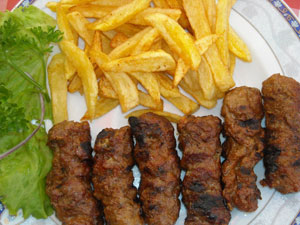
Romanian mici
Mici, in their natural habitat accompanied by homemade potato fries and cabbage

While you’re at your Romanian friends’ house, they will very likely serve you excellent Romanian food. If you are very lucky, they’ll break out the grill and make some mici (pronounced “meech”), which are traditional grilled sausages made from a mixture of beef and lamb infused with garlic and other spices. Let me say this without exaggeration: Mici are some of the best grilled meat you will ever have. I’ve never had any kind of American sausage that approaches a good plate of mici for succulence, flavor, and aroma. You will go home and tell your friends about the awesome mici that you had in Romania, and they will all be jealous.

If you happen to attend a wedding, or any other major life celebration such as funerals, baptisms, or a parastas (about which more below), you’ll also be feted with sarmale. Sarmale are cabbage leaves stuffed with rice, meat, onions, carrots, and spices, then boiled in a pressure cooker for several hours. There are also vegetarian variants made with almonds or mushrooms, which are equally delicious—unlike mici, this is one Romanian dish which can be vegetarian-friendly. Sarmale are savory and slightly greasy, and are best eaten dollopped with sour cream, which transports them from the realm of the merely tasty to the heavens of deliciousness.

Sarmale with mămăligă (boiled corn flour)

(A separate word needs to be put in here for smântâna or “sour cream”, which is nothing like the sour cream you’re probably familiar with. It is runnier, richer, and has a flavor which makes American dairy products hang their heads in shame. But beware! Western-style grocery stores have begun to infest Romania, and they often sell sub-standard Western-style “sour cream” erroneously labeled as smântâna. Skip the grocery stores and go to the local outdoor market to find the good stuff.)

Now that you’re nice and full, go outside for a walk with your friends. You may notice that the young women in your company are holding hands, and that the young men put their arms around each other, and talk with their faces close together. Despite what you think, none of these people are gay, and their behavior does not carry any romantic signals. Romanians are comfortable with a much higher level of casual, friendly touch between people of the same sex than Americans are. You may initially find this off-putting or uncomfortable, but try to give it a shot. After a while you may find that you appreciate the fact that your friends have a lower wall of personal space around them, and may think of American friendships as relatively cold and sterile in comparison.

Conversely, touching between members of the opposite sex is more strictly regulated than in America, and gestures which would be purely friendly over here may be interpreted as romantic come-ons over there. Beware of the signals you are sending.

If you attempt to learn Romanian and are of a non-confrontational disposition (like myself), you may be initally surprised by the fact that Romanians seem to always be yelling at each other. Sometimes they seem perpetually angry. This is a mistaken impression. The fact is that Romanians just like to speak in strong voices, and their typical, normal intonation is one which may seem harsh or rude to an American. You’ll get used to this. After a while you’ll think that it’s fun, and you’ll be amused when your English-speaking parents think that you’re fighting with your wife after you’ve had a perfectly civil Romanian discussion about what to eat for dinner.

Finally, you’ll find that Romanians are on average far more spiritual and pious than Americans. This varies from person to person, of course, but it’s hard not to notice that Romanian spirituality is both more public and less demonstrative than American religion. There are churches everywhere, and people cross themselves consistently when they pass by one. The churches are open from dawn to dusk, and no matter when you go in you’re likely to find one or two people quietly praying or lighting candles. Priests in long black cassocks are a common sight on the streets. The countryside is thick with monasteries. When you take a train trip, you may see a priest or hieromonk going from car to car offering to bless people for their journey, and accepting small donations in return. Yet within this context of greater religiosity, you’ll also find that Romanians are less strident and fractious about their faith than Americans. The culture war overtones that attend to your choice of church (or your decision not to attend church) in America is largely absent. Romanians are content to attend to their spiritual lives without being so noisy about it.

I clearly remember an event from one of my first trips to Romania that illustrates all of these points beautifully. I had wandered into the back of a church on a Saturday afternoon, not expecting to find much of anything there, but to my surprise some kind of family service was getting underway. I tried to quietly duck out, but to my consternation a Romanian grandmother grabbed me by the hands and physically dragged me to the front of the church, insisting loudly that I stay as their guest. I had never seen these people before, but they were determined that I join them.

A parastas similar to the one I unwittingly attended

The woman parked me near the front of the church, in a crowd of older Romanian men standing around sombrely. A big table covered with food and candles lay in front of the iconostaz, and soon after the family (and me) had settled, a pair of priests began a long, chanted prayer. My Romanian wasn’t nearly good enough at that time to follow the archaic, liturgical language, especially not when it was being chanted in a droning, echoey church. I remember that they seemed to say Doamne miluiește an awful lot. This went on for probably thirty fascinating, fidgety minutes. Then all of the men moved forward, pushing me with them, and we lifted up the food-laden table and waved it in the air. To this day, I have no idea what that particular aspect of the ritual meant, though I later found out that the service I was at is called a parastas, a service of remembrance that’s held at certain anniversaries of a person’s death.

And then it was done, and the feasting began. Right outside the church the family broke out bottles of țuica, fresh-baked bread, and big trays of sarmale, sharing them copiously with me and all of the rest of their guests. Bewildered and flabbergasted, I ate my fill, all the time thanking my hosts for their generosity. After about fifteen more minutes the party broke up, and I wandered happily back to my apartment, unsure of what I had seen but delirious with the experience.

Hopefully your trip to Romania will be just as memorable.

So I’m at work the other day singing along to David Bowie in my cubicle (like you do), and I hear the following lines:

Well she’s a total blam-blam
She said she had to squeeze it but she—
And then she—

And I think to myself, that skipped beat at the end of each line is so much more salacious than anything Bowie could have actually said.

This is an instance of an oft-repeated point: what you can’t see is often far sexier, more horrifying, or more inspiring than what you can see. This is easy to forget. There’s a reason why many modern horror films are referred to as “torture porn” — just as porn reduces eroticism to a numbing, empty series of copulations and money shots, horror that shows us everything is merely desensitizing, destroying the very terror it is supposed to provoke.

A competent writer or director, on the other hand, knows just how much he should show before cutting away.

Consider the shower scene from Psycho. A modern director might have given us a much less coy scene, with full frontal nudity and plenty of close-ups of the knife going in and blood gushing out. Hitchcock knew better. His scene gives us hints of Janet Leigh’s naked body, but not the whole thing. We see the killer’s face, but only obscured by a curtain or hidden in shadow. We see a knife, and we see blood, but the fact of knife piercing flesh is left to implication.

I’ve heard it said that Hitchcock was forced to do this by the censorial codes of the day, and indeed the scene skirted the edge of scandal in its time. But Hitchcock was still a better artist than that. Even if offered today’s license for vulgar exhibitionism, he would know better than to indulge.

On the opposite end of the spectrum, consider this book of “lost” sex scenes from Jane Austen. Granted, the book is a joke. Still, it seems to entirely miss the point of Austen’s dialogues, which are so wonderful precisely because so much is left to inference and implication. The pornographic impulse is completely missing from Austen’s work, as Austen knew that the most romantic scene, indeed the most erotic scene, is one in which the romance and the eros are present only in the blank spaces around the actual words. It says nothing good about us that someone thought that Austen could be “improved” by adding some sex scenes.

(The one bright spot in all this is that this book has plenty of one star reviews.)

What does this have to do with me? Well, I complained a few days ago about not having the appropriate vocabulary to directly describe a childbirth scene, and having to resort to circumlocution and euphemism. I have started to reconsider my position on this. It is possible that these scenes may be made more affecting by avoiding direct description, and leaving the gory and intimate details to the reader’s imagination.

Something to consider when I start to revise.

My current WIP, a novel titled The Wedding of Earth and Sky has not one but two childbirth scenes. Both are described fairly graphically (for important plot-thematic reasons). And this presents me with a problem.

It’s impossible to talk about childbirth without talking about vaginas.

Now, I’m perfectly happy talking about vaginas in my novel, but I’d like to be able to do so with language that matches the tone and setting of the story. And the word vagina is entirely unsuited for this task. The word is:

  1. Modern, which clashes with the Bronze Age setting
  2. Clinical, which creates a psychic distance between the reader and the details which are meant to be visceral and intimate
  3. Latinate, which mixes poorly with the earthy, homey feel created by the largely Germanic vocabulary I’ve used elsewhere.

But all of the other one-word options are worse. The word cunt avoids all three of the problems above, but it introduces a new problem, which is that it’s vulgar and may provoke the reader to recoil or snicker. Other options are childish, or something worse.

At present I’m mostly using euphemism and circumlocution, which at least allows me to maintain my tone and setting. But it’s extremely annoying that there is no vocabulary available to me that isn’t fatally tainted by one thing or another.

The most popular article I’ve ever written was Romani, Racism, and Romania, which continually ranks among the most-viewed pages here on this blog. And I see that a Google search for “romanian racism” currently has my article as hit #3. So obviously I hit a nerve on something with that discussion. In particular, I seem to get a lot of Americans who have gone or are going to Romania, and want some context for what seems like a lot of racist behavior on the part of the Romanians.

I’m here to fill that need.

I write from the perspective of a white, middle-class North American. And I’m writing this for the benefit of anyone visiting Romania from America or Western Europe, though I don’t necessarily assume that you’re white. (We’ll cover that below.) My view of Romania is an outsider’s view. However, I speak Romanian fluently, I lived in Romania for a year before getting married, I’m now married to a Romanian, and we continue to visit the country frequently.

Romanians and Anglophone whites

If you go to Romania as an American or British person, you probably won’t experience anything that you’d call racism. However, if you actually attempt to engage in conversation with the locals, you’ll find a lot of stereotypes and assumptions that Romanians make about you. This may occasionally provoke some discomfort.

Rich guy
A typical American
The first and most obvious thing: everyone will assume that you’re rich. And truth be told, you are pretty rich, compared to most of the people that you meet. This can lead to some uncomfortable situations. Some people may ask you for money, and they may become upset if you won’t give it to them. People may not understand the difference between “can afford to go out for dinner every night while on vacation” and “can afford to give someone a $600 laptop on a whim”, since buying a laptop and going out to dinner frequently are equally signals of wealth and influence to typical working-class Romanians. In general Romanians are very generous with each other; conversely, if you start to make Romanian friends, they will expect and assume that you are going to be generous with them. Many people find this presumption of wealth and generosity to be off-putting–I certainly did when I first started building Romanian friendships.

A related point is that you may discover people speaking to you with a certain amount of resentment. Romanians often feel like they’ve been unjustly maligned by history, and that foreigners don’t appreciate their considerable cultural and historical acheivements. As a result they may display a nasty inferiority complex that manifests as the need to constantly put down Westerners, or try to impress them by playing it cool.

Many Romanians are credulous of conspiracy theories and fringe scientific ideas that Americans find ridiculous. An example: I once had the truly surreal experience of talking to a Romanian who insisted that the Jews controlled the banks and the governments. However, he said they were doing as good a job as anyone, so he was content to let them continue.

Romanians who have never been abroad get most of their ideas about America from movies and television. Think about that for a moment. A lot of Romanians assume that America is basically Southern California + New York. And not the actual California and New York, but the Hollywood versions.

Romanians and English-speaking people of color

(I hate the term “people of color”, but I don’t know of anything else that can be used in this situation.)

If you’re a black, Asian, Indian, Native American, or other non-white American, you may be in for a somewhat rougher time in Romania. You’ll find that most of the stereotypes discussed above also apply to you, but with an additional wrinkle: many Romanians will never have meet or spoken to a non-white, non-gypsy person before you. This creates additional opportunities for discomfort.

A lot of people will simply be curious. Try not to take this personally. Americans have been conditioned to avoid directly mentioning or commenting on someone’s race, while Romanians have not. You’ll find that Romanians gleefully trample over the conversational niceties that Americans observe when discussing race. This may come across as rudeness, but it really shouldn’t be interpreted as racism. In fact, you may find that Romanians hold fewer racial stereotypes about blacks and Asians than Americans do, simply because there are almost no people of those races living in Romania and there are no cultural narratives defining what PoC are “supposed” to be like.

The Romanian dependence on Western pop culture without the rest of the Western cultural context can have some surprising and upsetting consequences. I had to explain to my sister-in-law that it’s not okay to call black people “nigger”, and that it’s in fact extremely offensive. She didn’t see what the big deal was: rappers and movie characters use the word all the time! The subtleties of in-group vs. out-group usage were lost on her, and she had no understanding of the history of the word. (Romanians know that black people used to be slaves in America, because for some reason Uncle Tom’s Cabin is quite popular in translation there, but they’re largely oblivious to the complex, bitter history of American race relations following the Civil War.) If you find yourself in a similar situation in Romania, it’s important to be forgiving and remember that your Romanian acquaintances are very likely oblivious to the racist significance of their language.

On the other hand, due to the inferiority complex mentioned above, some Romanians will fixate on any available reason to belittle a Western visitor, including their race. Some people will always be assholes. Hopefully you won’t have to deal with very many of these people.

Romanians and gypsies

Ah, here is where things get bad.

(I’m going to use the word gypsy throughout this section rather than the preferred Roma or Romani, simply to avoid any possible confusion between Romani and Romanian. The two words have nothing to do with each other, and the resemblance between them is completely coincidental.)

Before coming to Romania I thought of gypsies basically the same way I thought of pirates: something exotic and alluring that existed only in distant times and places. I was very excited to see real, live gypsies when I came to Romania. But discovering the actual situation of the gypsies in Romania was a rather rude shock.

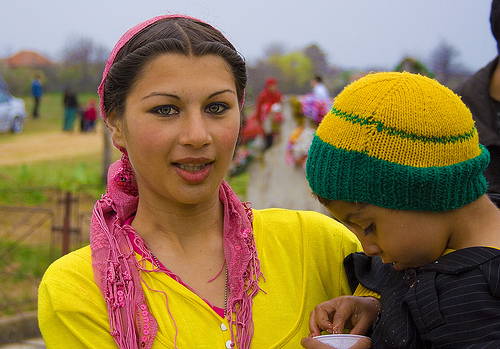
Tiganca cu copil
A young Romanian gypsy woman and her child
The relationship between Romanians and gypsies is the only thing in Romania that’s remotely analogous to the relationship between American whites and blacks. Gypsies have never been enslaved en masse, but they’ve formed a permanent underclass for pretty much the entirety of their history in Romania. Most of them speak Romanian, but many of them also speak a dialect of Roma, their native Indic language. Traditionally gypsies were nomadic, traveling in caravans from place to place, but many of them were forcibly settled during the Communist era, creating miserable little gypsy villages and ghettoes across the country. Most gypsies live in tremendous poverty, they have a very high illiteracy rate, and they’re plagued by many of the same the social ills that attend to the inner cities in America.

If you’re visiting from America or Western Europe, you’re not a gypsy. Even if you’re dark skinned, even if you actually have gypsy ancestry, even if you think of yourself as gypsy, your Western wealth and status make you Not A Gypsy in Romanian eyes. However, you’re going to see plenty of gypsies in Romania, and you may be very disturbed by what you find there.

Romanians carry lots of stereotypes about gypsies. Here’s just a few:

  • Gypsies are swindlers. If you try to make a bargain with one, you’d better watch out, because he’s going to try to screw you over.
  • Gypsies are thieves. If you live near gypsies, you’d better lock everything up tight, because otherwise the gypsies will break in and steal it. Keep a tight grip on your wallet if you see gypsies in the market.
  • Gypsies practice witchcraft. You can often see gypsies acting as fortune-tellers in the markets. They can work hexes on you if you insult them.

There are basically two ways to react to this situation, and if you stay in Romania long enough you’re likely to experience both poles of this dichotomy. The options are:

Stuff White People Think: Obviously the gypsies are an oppressed people. The stereotypes about them are completely unfounded, and in fact the existence of all of these negative stereotypes is the reason that gypsies are so poor and underprivileged. If Romanians would just open their eyes and stop being so racist, they’d see that the gypsies are wonderful people with a beautiful culture of their own, and the gypsies and the Romanians would live in perfect harmony.

This viewpoint is likely to persist until the second or third time you get followed through the market with a gypsy woman on your tail begging loudly to read your palm, or until the gypsy boys down the street break into your ground-floor apartment. At that point you’re likely to Buy Into the Hype. Everything that Romanians say about gypsies is true. The gypsies are poor because they’re filthy and dishonest. You have every right to avoid them on the street and watch them distrustfully when you see them in the market. And naturally you’ll want to find another apartment further away from those people.

At this point, it would be nice to say that my experiences in Romania disproved the stereotypes and showed the baselessness of Romanian anti-gypsy prejudice, but that would be a lie. In reality, despite my initial favorable disposition to the gypsy people, I rather quickly learned to keep my wits and wallets about me when I saw gypsies approaching. This sort of thing falls into the realm of unfortunate necessity, a necessity that many people have discovered.

So what does this practically mean for you, the intrepid traveler?

In the first place, I’ll repeat the advice that any tourist is likely to receive. Don’t give money to panhandlers (of any race). Don’t go to people offering to read palms, tarot cards, or any other kind of fortune-telling, no matter how fun or innocent it might seem. Keep an eye on your valuables, especially when in crowded public places like markets. Do all of these things double when gypsies are involved. You may feel uncomfortable about doing so—I certainly feel uncomfortable giving this advice—but you’re not actually helping the gypsies any by letting them steal from you.

On the other hand, don’t hesitate to buy from gypsy vendors who are selling handicrafts or homemade goods.

Don’t bother arguing with Romanians about gypsies and racism or anything of the sort. They’ll tell you that you don’t know what you’re talking about, and they’ll be right.

If you actually want to help the welfare of gypsies in Romania, I recommend that you donate to a reputable Romanian charity, or one dedicated to helping gypsies across Europe. You, as a visitor to Romania, are not in much of a position to change Romanian culture or make any real difference in the lives of the gypsies that you meet. However, there are many charities that are doing real work to increase literacy, provide job training, etc., and they’re much better equipped to actually help people break out of the trap of poverty and crime.

One last thing

Have fun in Romania. I love the country, and I can’t wait until the next time my family and I get to go back.

Please read this before commenting: A more positive follow-up. I get a lot of people complaining in the comments that I was overly negative about Romania, so I want to make sure that people see the other side and realize that there are lots of great things about Romania, and I don’t want to discourage anyone from going there.

I’m about halfway through my current WIP, which means (naturally) that I’ve spent the last hour reading about placental abruption. This is what happens when you reach the point in your novel at which things must move from Bad to Worse: you get online and you try to find the worst thing that could possibly happen to your characters. Because you love them.

On the one hand, it’s amazing that I can ask Google to please tell me about complications in late-term pregnancy, and a few minutes later I’m looking at pictures of detached placentas. On the other hand, gawd this is going to be hard to write about. Really, really hard. And this isn’t even the worst thing that might happen in this novel.

But it’s like they say: Kill your darlings. Kill them with a detached placenta if you have to. Don’t flinch.

HomeHome by Marilynne Robinson
My rating: 5 of 5 stars

This book is the followup to Marilynne Robinson’s previous novel Giliad, and it improves on its predecessor in every way. Given that Gilead was a work of rare beauty and insight, the fact that Home has done it one better is a magnificient achievement.

Gilead was in many ways the archetypal literary novel: jewel-like writing, flawed but poignant characters, steeped in questions of philosophy, religion, and beauty–and no plot at all. Oh, sure, there was something kind of resembling a plot that eventually got started about 2/3s of the way through the book, but the conflict that sketched the final act of that book was in no sense the driver of the book as a whole. Home, on the other hand, has plenty of plot. It has, in fact, the same plot that appeared in the last third of Gilead: the return of Jack Boughton, the black sheep of the Boughton clan, to his family home after twenty years absense.

In Gilead we get only sidelong glances at what effect this has on the Boughton family, as Gilead was framed as the journal of Ames, who was a lifelong friend to the Boughton clan. But Home is told from the point of view of Glory Boughton, the youngest of the Boughton daughters, who has returned home to her father’s house after the failure of her long-delayed engagement. Glory gives us a much more intimate look into the family relations of the Boughton clan, and provides a closer perspective on the reprobate (but perhaps reformed) Jack and their father, a Presbyterian minister. Much of the book is taken up with Glory’s reminisces of her childhood in the Boughton home, and these reminisces, along with the quiet turmoil stirred up by Jack’s return, provide us with a deep and compelling look into the Boughton home. Here Robinson has done something really remarkable, describing a family that is neither a saintly ideal nor a mass of dysfunction, but a family that’s flawed but good. The understanding that the author brings us of the joys and failures of the Boughton clan is the novel’s strongest point.

The ending of the book does not suggest pat answers or easy resolutions to the problems of the family, and the singular problem of their prodigal Jack. But it is nonetheless full of hope.

This is the best book I’ve read yet this year.

View all my reviews

I previously blogged about an experiment in Facebook advertising that I undertook. The gist of the experiment was to see if I could generate an appreciable bump in sales of my e-book The Taint by doing a Facebook ad campaign, and if so, whether that bump was big enough to cause the campaign to pay for itself. And now that we’ve reached the middle of June, the campaign is long over, the sales numbers are in, and I can offer some data and some conclusions.

Preliminaries

Facebook offers you a pretty wide variety of options for how you set up your ad campaign. I went with the defaults for pretty much everything. Most importantly, I chose the automatic bidding strategy, which means that I let FB choose how it was going to spend the money I allocated for the campaign. FB, like Google, allocates ads based on a “bidding” metaphor in which different ads indicate via a virtual “bid” how badly they want to appear in a particular slot. As I understand it, this means that every time FB wants to show you an ad, it goes through all of the active ad campaigns that match something in your profile and asks them how much they’re willing to spend to be shown at that moment. Based on some algorithm that looks at the advertising budget and the target user’s profile, FB decides how much that particular ad slot is “worth” to your ad, and the ad that wants to be shown the most wins.

However, with FB you only pay for clicks, not impressions. An impression is when someone merely sees your ad, while a click is when they actually click on it (duh) and see whatever you linked to.

A standard FB ad (which you’ve seen hundreds of if you’ve ever been on FB) consists of a thumbnail-sized image with a few lines of text next to it. I originally was just going to use my book cover as the thumbnail, but it turned into a mushy gray blob when it was scaled down to the proper size. Instead, I cropped out just the title and used that. My finished ad looked like this:

The ad as it appeared in Facebook

Advertising performance

Here’s the raw numbers:

Campaign Reach:
43,535

Frequency:
2.3

Clicks:
21

Click-Through Rate:
0.021%

Spent:
$29.99

First thoughts were, “Wow, that’s a lot of reach,” followed by, “Wow, that’s not very many clicks.” In FB lingo, “Reach” is the number of distinct people who saw the ad, “Frequency” is the average number of times the ad was shown to each person that saw it, and “Clicks” is the actual number of clicks generated because of this. I was pleasantly surprised at how many people saw the ad, even with my very modest bid. If my campaign were the sort of thing where merely getting the word out and increasing awareness helped, I’d consider that a good sign.

But as you can see, the “Click-Through Rate” (CTR) was awful. Or was it? I really have no idea what a realistic CTR is, and whether my ad did better or worse than the average. What is clear is that you need a lot of views to get even a modest number of clicks–which makes since, since I very rarely click on internet advertising, and I don’t expect that a lot of other people do differently.

So I spent $30 to get 21 people to click on my ad, meaning that I spent $1.42 per click. This is not a very good rate. When I’m spending that much per click, my “conversion rate” (the number of clicks that turn into actual sales) would have to be close to 100% in order to break even. Which leads me to my next point.

Effect on sales

I had to wait until the middle of June to get my royalty statement for the month of May, which showed exactly how many books I sold. Since clicking the ad brought you to the main Lyrical Press site, I took the number of sales directly from Lyrical as an indication of the number of sales resulting from the ad. Lyrical’s ebooks are available in a large number of venues, but most likely anyone who bought the book as a result of the ad also bought it directly from Lyrical, since that’s where the ad pointed to. So how many books did I sell directly from the Lyrical site in May?

Zero.

(I did sell books through other storefronts, though.)

This is not terribly surprising, given the numbers above. Based on what I’ve heard on the nets, ad conversion rates vary from 1%-5%, so getting zero conversions from only 21 clicks is possible, even likely. So while this report is kind of glum, we have to accept it as the consequence of our overall ad performance.

Conclusions

The primary question that I wanted to answer by doing this experiment was whether a Facebook ad campaign could create an appreciable spike in sales of an e-book at a low price point. And the answer to that is a resounding no. My small initial outlay did not pay for itself in terms of increased royalties. It would not have paid for itself even if I were self-published and getting 100% of receipts. At the price level I set, there was no perceptible bump in sales at all.

Nonetheless, I consider the experiment a success because it did furnish a clear and unambiguous answer to the question I posed at the beginning. The benefit derived from a low-cost ad campaign doesn’t pay for the ad, and so makes no financial sense for a small-press author such as myself.

There are a few ways I could tweak the experiment which could give different (more profitable) results. Sometime in the future I may try to repeat this experiment varying the parameters below.

  • Spend more money. It’s possible that my ad budget was so low that I was outbid for all of the high-performing ad slots (in terms of page placement, appropriateness to the user, etc.), and got only the dregs. If this is the case, then spending, say, $100 or $1000 might get me exponentially more results. This would mean that there’s a minimum amount that you have to spend to get an appreciable result from advertising, and that spending any amount below that threshold is simply wasted. In support of this theory, I note that FB told me that there were about 6 million potential viewers of my ad, but I actually hit less than 1% of those.
  • Get a better ad. I’m pretty happy with what I came up with for my first try, but I’m sure there are ways I could make it more effective. With a little reading on ad design and a little practice, I could probably come up with something more enticing.
  • Don’t send people to Lyrical. I might get better results if I had the ad point to the book’s Amazon page, since most people will already have an account on Amazon, and anything that removes the barriers to a sale would be a benefit. Furthermore, Amazon owns the currently dominant e-reader, and streamlining sales to the Kindle would be a huge win.

Hopefully this was interesting and helpful to anybody else who is published with small presses or self-published, and who may be contemplating such a move in the future.

Let me direct your attention to Terrible Minds, which has the list that you need to study. It’s great. Here’s my favorite tip:

Say it five times fast: momentum-momentum-momentum-momentum-momentum. Actually, don’t say it five times fast. I just tried and burst a blood vessel on the inside of my sinuses. The point remains: writing a novel is about gaining steam, about acceleration, about momentum. You lose it every time you stop to revise a scene in the middle, to look up a word, to ponder or change the plot. It’s like a long road-trip: don’t stop for hitchhikers, don’t stop to piss, don’t stop for a Arby’s Big Beef and Cheddar. Just drive. Leave notes in your draft. Highlight empty spaces. Fill text with XXX and know you’ll come back later.

[What follows is a conjecture, not something I’m absolutely convinced of.]

An alternate history in which Hitler survived and Stalin was defeated would be less bad than the history that we actually got, in which Stalin survived and Hitler was defeated.

Consider: Hitler consigned roughly 6 million people to death in his concentration camps. Stalin killed over 20 million people. On this basis alone, Stalin is a greater monster than Hitler. Hitler’s Holocaust is generally regarded as a greater crime than Stalin’s gulags because Hitler was targeting the extermination of a specific race, a genocide, while Stalin’s enemies were a much broader group. But now that I think of it, I’m not sure that “killed a wider variety of people” is really a point in Stalin’s favor.

Consider also that Stalinist Marxism was a deliberately international creed, which was successfully exported all over the globe, bringing mayhem, misery, and murder wherever it went. Many nations were turned from mildly disfunctional to horrific hellholes by the infection of Stalinism. (The dysfunction is necessary for Stalinism to get a foothold, but once it arrives Stalinism invariably makes things worse, not better.) Nazi Aryanism was a much more local form of insanity, which couldn’t really be replicated in other places or times. Fascism was never successfully exported outside of Europe, and it’s quite plausible that a Nazi Empire that occupied Eastern Europe would have been more benign than the Soviet Union.

The price of leaving Stalin in power was nuclear proliferation, the Cold War, and the long series of nasty conflicts all over the globe in which both the U.S. and the U.S.S.R. committed atrocities. We are still dealing with the echoes of those conflicts in the form of the interminable Israeli/Palestinian conflict, Islamist terrorism, and various Third World dictators, which were favored by the U.S. in earlier times as a stopgap against Communist expansion.

We have developed a national mythology that identifies Nazi Germany as a manifestation of Pure Evil which had to be eradicated at all costs, and we constantly remind ourselves of this fact by building monuments to the Nazi atrocities and killing the Nazis over and over again in movies and video games. Meanwhile Stalin’s Russia is regarded as an enemy, but an enemy that could be temporarily regarded as an ally, and who we could afford to oppose slowly over the next fify years rather than demolishing all at once in a hail of bombs. It is possible that this valuation has it backwards.

(Counterarguments: if Hitler had been allowed to live, it’s possible that he would eventually have racked up a body count as great as Stalin’s. And it’s very plausible that the U.S. would have fallen into a Cold War with Germany that was as costly and destructive as the actual Cold War.)