Having completed my move halfway across the country, I’m now adjusting to the fact that my oldest child and his grandparents have joined us from Romania, so my household of three has just become a household of six. Two of them don’t speak English, one of them doesn’t speak anything but does cry at high volume, and one of them talks in that garrulous, nonsensical way toddlers do. Plus I’m trying to buy a house.
So, yeah, I’m busy with things other than blogging. Expect things to stay quiet for a while.
Now Lvov could see the Interface itself, the terminus of the wormhole: The Interface was a blue-white tetrahedron, an angular cage that exploded at her from infinity.
The bolding is mine, and I use it to highlight a phrase that bothered me to no end when I read it. (You can tell that I was bothered because I stopped reading to write this blog post.) My problem is what the hell does that mean? It’s an evocative turn of phrase, all right, but it doesn’t do one thing to actually help me see, hear, or feel whatever it is our poor protagonist Lvov is seeing.
Writers: don’t do this. Your metaphors can be awesome and all, but they had better mean something.
I’ve finished two superlative works of art in the last few days, and I hope to write something about each of them. The first was One Hundred Years of Solitude by Gabriel Garcia Marquez, and I first thought I might write a formal review. But what could I possibly add by my blatherings to one of the most celebrated and analyzed books of the 20th century? Better to let Marquez speak for himself.
I present the following long quote from near the beginning of the book. I nearly wept the first time I read this. A parable (he who has ears, let him hear), for we who wait in absurd rooms and hope to receive a draught of that gentle liquid and remember.
No one was alarmed at first. On the contrary, they were happy at not sleeping because there was so much to do in Macondo in those days that there was barely enough time. They worked so hard that soon they had nothing else to do and they could be found at three o’clock in the morning with their arms crossed, counting the notes in the waltz of the clock. Those who wanted to sleep, not from fatigue but because of the nostalgia for dreams, tried all kinds of methods of exhausting themselves. They would gather together to converse endlessly, to tell over and over for hours on end the same jokes, to complicate to the limits of exasperation the story about the capon, which was an endless game in which the narrator asked if they wanted him to tell them the story about the capon, and when they answered yes, the narrator would say that he had not asked them to say yes, but whether they wanted him to tell them the story about the capon, and when they answered no, the narrator told them that he had not asked them to say no, but whether they wanted him to tell them the story about the capon, and when they remained silent the narrator told them that he had not asked them to remain silent but whether they wanted him to tell them the story about the capon, and no one could leave because the narrator would say that he had not asked them to leave but whether they wanted him to tell them the story about the capon, and so on and on in a vicious circle that lasted entire nights.
When Jose Arcadio Buendia realized that the plague had invaded the town, he gathered together the heads of families to explain to them what he knew about the sickness of insomnia, and they agreed on methods to prevent the scourge from spreading to other towns in the swamp. That was why they took the bells off the goats, bells that the Arabs had swapped them for macaws, and put them at the entrance to town at the disposal of those who would not listen to the advice and entreaties of the sentinels and insisted on visiting the town. All strangers who passed, through the streets of Macondo at that time had to ring their bells so that the sick people would know that they were healthy. They were not allowed to eat or drink anything during their stay, for there was no doubt but that the illness was transmitted by mouth, and all food and drink had been contaminated by insomnia. In that way they kept the plague restricted to the perimeter of the town. So effective was the quarantine that the day came when the emergency situation was accepted as a natural thing and life was organized in such a way that work picked up its rhythm again and no one worried any more about the useless habit of sleeping.
It was Aureliano who conceived the formula that was to protect them against loss of memory for several months. He discovered it by chance. An expert insomniac, having been one of the first, he had learned the art of silver work to perfection. One day he was looking for the small anvil that he used for laminating metals and he could not remember its name. His father told him: “Stake.” Aureliano wrote the name on a piece of paper that he pasted to the base of the small anvil: stake. In that way he was sure of not forgetting it in the future. It did not occur to him that this was the first manifestation of a loss of memory, because the object had a difficult name to remember. But a few days later he discovered that he had trouble remembering almost every object in the laboratory. Then he marked them with their respective names so that all he had to do was read the inscription in order to identify them. When his father told him about his alarm at having forgotten even the most impressive happenings of his childhood, Aureliano explained his method to him, and Jose Arcadio Buendia put it into practice all through the house and later on imposed it on the whole village. With an inked brush he marked everything with its name: table, chair; clock, door; wall, bed, pan. He went to the corral and marked the animals and plants: cow, goat, pig, hen, cassava, caladium, banana. Little by little, studying the infinite possibilities of a loss of memory, he realized that the day might come when things would be recognized by their inscriptions but that no one would remember their use. Then he was more explicit. The sign that he hung on the neck of the cow was an exemplary proof of the way in which the inhabitants of Macondo were prepared to fight against loss of memory: This is the cow. She must be milked every morning so that she will produce milk, and the milk must be boiled in order to be mixed with coffee to make coffee and milk. Thus they went on living in a reality that was slipping away, momentarily captured by words, but which would escape irremediably when they forgot the values of the written letters.
At the beginning of the road into the swamp they put up a sign that said MACONDO and another larger one on the main street that said GOD EXISTS. In all the houses keys to memorizing objects and feelings had been written. But the system demanded so much vigilance and moral strength that many succumbed to the spell of an imaginary reality, one invented by themselves, which was less practical for them but more comforting. Pilar Ternera was the one who contributed most to popularize that mystification when she conceived the trick of reading the past in cards as she had read the future before. By means of that recourse the insomniacs began to live in a reality built on the uncertain alternatives of the cards, where a father was remembered faintly as the dark man who had arrived at the beginning of April and a mother was remembered only as the dark woman who wore a gold ring on her left hand, and where a birth date was reduced to the last Tuesday on which a lark sang in the laurel tree. Defeated by those practices of consolation, Jose Arcadio Buendia then decided to build the memory machine that he had desired once in order to remember the marvelous inventions of the gypsies. The artifact was based on the possibility of reviewing every morning, from beginning to end, the totality of knowledge acquired during one’s life. He conceived of it as a spinning dictionary that a person placed on the axis could operate by means of a lever, so that in very few hours there would pass before his eyes the notions most necessary for life. He had succeeded in writing almost fourteen thousand entries when along the road from the swamp a strange looking old man with the sad sleepers’ bell appeared, carrying a bulging suitcase tied with a rope and pulling a cart covered with black cloth. The old man went straight to the house of Jose Arcadio Buendia.
Visitacion did not recognize him when she opened the door and she thought he had come with the idea of selling something, unaware that nothing could be sold in a town that was sinking irrevocably into the quicksand of forgetfulness. He was a decrepit man. Although his voice was also broken by uncertainty and his hands seemed to doubt the existence of things, it was evident that he came from the world where men could still sleep and remember. Jose Arcadio Buendia was found sitting in the living room fanning himself with a patched black hat as he read with compassionate attention the signals pasted to the walls. The old man greeted him with a broad show of affection, afraid that he had known him at another time and that he did not remember him now. But the visitor was aware of his falseness. The old man felt himself forgotten, not with the irremediable forgetfulness of the heart, but with a different kind of forgetfulness, which was more cruel and irrevocable and which he knew very well because it was the forgetfulness of death. Then he understood. He opened the suitcase crammed with indecipherable objects and from among them he took out a little case with many flasks. He gave Jose Arcadio Buendia a drink of a gentle color and the light went on in his memory. His eyes became moist from weeping even before he noticed himself in an absurd living room where objects were labeled and before he was ashamed of the solemn nonsense written on the walls, and even before he recognized the newcomer with a dazzling glow of joy.
Leo Grin kicked a hornets nest late last week when he asserted that modern fantasy is represents a nihilistic turn away from the glorious heritage of Robert E. Howard and JRR Tolkein. I’ve been following the article and its responses across the net since then, trying to come up with something to say about the proceedings, though at this point the conversation is too broad for me to do more than poke at the most interesting bits. But such interesting bits those are!
I’m more than a little sympathetic to Grin’s complaint, as I had suffered the same thing with the disappointment of Chronicles of the Black Company. But unfortunately I think that the original piece comes across as too much of a personal complaint, with enough political slant that it was easy for his detractors to dismiss him. That’s why I’m glad for Theo’s essay at Black Gate, which expands on the original points and turns the discussion away from gripes and into actual analysis of the texts in question. I agree with nearly every point that Theo makes here, though I also appreciated the counterpoint by Matthew Surridge, whose demonstrates mostly that the “new” trend of anti-heroic fantasy is actually quite old. Also, if I may be forgiven one more link and one more self-contradiction, I found that this “rebuttal” from Philip Athans is also pretty close to what I would want to say.
If I may reiterate one point that several people made in the links above, there is an enormous difference between fantasy that is merely dark and fantasy that is actually nihilistic and anti-heroic. Tolkein could be very dark (I won’t comment on Howard, as I’ve never read him), and the Silmarillion drinks deeply from the chilly well of Norse mythic fatalism. Thus, for example, this blog post titled “Missing the Point” is guilty of missing the point in a far worse way than Grin. Tolkein’s world may be hopeless and often tragic, but it is a world in which goodness unambiguously exists, and in which heroes distinguish themselves by fighting for the good even when their defeat is assured. This is the furthest thing in the world from a fantasy with no notion of virtue, in which there are no heroes who comport themselves virtuously. And again: the existence of Tolkeinian heroes who falter in virtue and who are seduced or corrupted by evil is not a repudiation of goodness, but a way of putting it into high relief. If I may quote the original article:
Think of a Lord of the Rings where, after stringing you along for thousands of pages, all of the hobbits end up dying of cancer contracted by their proximity to the Ring, Aragorn is revealed to be a buffoonish puppet-king of no honor and false might, and Gandalf no sooner celebrates the defeat of Sauron than he executes a long-held plot to become the new Dark Lord of Middle-earth…
This wouldn’t just be a different story, but a dramatically worse one. Fortunately, Tolkein didn’t write it that way.
It does occur to me that a reason — one possible reason — for the rise of the new gritty may be not the death of morality but the death of belief in the stories that we were told to believe were the truest measure of what is foundational….
So I am not surprised to see some of the writers of today writing skeptically or critically or even cynically about the institutions and “sentiments” that we have societally been raised to valorize even and maybe especially in the fiction we tell ourselves to try to describe what I might call “deeper truths” about culture and society and our place in it. So maybe those people write in ways that are uncomfortable, unpleasant, or downright ugly.
This is the most original take on the whole controversy, but I still want to pick it apart.
On the one hand: it’s possible that the “new gritty” is meant as a reaction against old narratives that have lost their power. But if that’s what those authors are trying to do, then I think they’re doing an awfully poor job of it, because—look, you can question conventional narratives or whatever without sliding into nihilism and madness. What you might do, instead, is offer an alternate model of heroism, an alternate view of goodness. If you do this well you can wind up with something that is compelling, inspiring, and life-changing in much the way that Tolkein and the classical heroic narratives are, but which compels people in a direction that you find more salutory. If you don’t think this can be done, I refer you to the entire oeurve of Ursula K. LeGuin, especially the Earthsea novels and her recent Annals of the Western Shore books. These books repudiate conventional heroic tropes in a variety of ways, but the result is not a demoralizing darkness, but the calm and confident demonstration that there is another way.
Of course, we can’t all be Ursula K. LeGuin. (Oh, but what if we could?) Still, if we grant that the foundations of reactionary fantasy are rotten (not something I agree with, but for the sake of argument), then a lot of the dark, gritty fantasy that I’ve sampled seems like it’s just kicking in the creaky old doors and drawing obscene graffiti in the entrance hall. If the literary building is decrepit, who cares? But this doesn’t impress me. Better you build something beautiful in the ruins.
A final aside: Elliot also mentioned that Grin doesn’t talk about female fantasists at all, and I agree with her that this is an important omission. As I look over my shelves, I notice that all of the really good fantasies that I’ve read in the past few years have been written by women. The real solution to the problem of too much rotten nihilist fantasy may be to just read less Joe Abercrombie and more Carol Berg.
Let there be a little country without many people.
Let them have tools that do the work of ten or a hundred,
and never use them.
Let them be mindful of death
and disinclined to long journeys.
They’d have ships and carriages,
but no place to go.
They’d have armor and weapons,
but no parades.
Instead of writing,
they might go back to using knotted cords.
They’d enjoy eating,
take pleasure in clothes,
be happy with their houses,
devoted to their customs.
The next little country might be so close
the people could hear cocks crowing
and dogs barking there,
but they’d grow old and die
without ever having been there.
From Ursula K. LeGuin’s adaptation of the Tao Te Ching
Things have been quiet here lately, for a variety of reasons. One big reason is that I’ve been tied up trying to move cross-country, something that’s finally (finally!) going to happen in the middle of March. I’ll update further when the date comes.
In the meantime, there’s been lots of thumping on the intertubes about this article, about which I may have something to say soon.
I had almost written off Orson Scott Card. Like everyone else, I was blown away by Ender’s Game when I first read it, and I read the rest of that series and the majority of his early works when I was in high school and college. But I had ignored him for the past several years, mostly because he seemed determined to beat the dead horse of the Ender Universe to no good end, and because the quality of his novels seemed to be declining.
But here comes Lightspeed Magazine with an OSC reprint, but one that’s new to me: The Elephants of Poznan. A remarkable, beautiful and disturbing story, as good as anything I’ve read in the past few years. I’d forgotten what a prose stylist OSC can be when he wants to, but the writing in this story is perfect, reaching a level of elegiac craftsmanship that represents the best of the genre. And really, I don’t know why I’m surprised. I remember when I read Maps in a Mirror, OSC’s brick-sized short story collection, that though his novels tend to careen between brilliance and hackery, his short stories were uniformly excellent. This proves to be no exception.
I gave up on this one. I can see why some people might like it, but in the end this book has none of the things that I look for in fantasy.
In the first place, Cooke’s descriptive style is extremely sparse. Very little is described and much is implied or left to the imagination. This is a good thing, I suppose, since given how appallingly grim this book is it might be even more revolting if things were described in detail. As is, the style of this book is like one of those modern paintings in which a figure is evoked with only a few well-placed brush strokes, except that the only color here is greasy black, and the resulting figure is one of violence, rape, and betrayal.
The plot is meandering and equally depressing. We follow the Black Company, a bunch of scoundrels who accidentally wind up working for the Dark Lord, who is in this case a Dark Lady. They kill and fight and get drunk and kill some more, and it’s all very repetitive and empty-seeming. There’s a suggestion of someone called the White Rose who may be able to restore goodness to the world, and given that the third book in this volume is called The White Rose, I assume that they eventually find her. But I’m not willing to slog through 500 pages of filth to find out if that’s the case.
On top of that, the worldbuilding is paper-thin. I was a third of the way through the first book when I gave up, and I couldn’t tell you the first thing about the history of the world, the way its magic works, nor even what the major nations are. As far as I can tell, the setting is Generic European Fantasy, but really it’s just a prop that the author throws around it order to give his characters some place to kill in.
If you’re the sort of reader who likes reading about villains and doesn’t care about deep settings and rich description (in other words, if you’re the opposite of me), then you might like this. But I’ll be staying away from Glen Cook and the Black Company after this.
We’ve all seen The Graduate, right? And we’ve all seen that famous scene where the old guy tells the young depressed guy that he should get into plastics, because there’s a great future in plastics? If you have been living in an underground bunker waiting for the end of the world for the past forty years and haven’t had time to brush up on your pop culture, here’s a refresher:
We all know why this scene is funny. It’s not because the old guy’s advice is wrong–on the contrary, plastics would be an excellent industry for a young college graduate to make money and build a solid career. Rather, it’s because it’s plastic, man. Plastic, the symbol of artificiality and artifice, of soulless corporate industrialism and estrangement from wilderness, the destruction of the environment and the victory of consumer conformity, the opposite of nature and freedom and apple pie and having sex with your girlfriend’s mother and all of the other good and wholesome things that The Graduate stands for.
However, not too many years before The Graduate, plastic had an entirely different connotation. In the 30’s and 40’s bakelite plastic was used in luxury items from jewelry to handrails–heck, vintage bakelite jewelry from those eras 30’s and the 40’s can still fetch a decent price on eBay. Disney World had a plastic demonstration “Home of the Future” in which almost everything was made of plastic (and which proved to be nearly indestructible, as described in the linked article). Plastic was touted as the material of the future for everything from furniture to footwear. But most importantly, plastic was new, plastic was The Future, and there is nothing more good, wholesome, and American than The Future.
The couch is made of plastic. At one point people thought this was a good idea. The Graduate came out in 1967, putting it near the beginning of the backlash against plastic that grew throughout the 60’s and the 70’s, and which by now has simply become part of our cultural background. Today, we regard the old enthusiasm for plastic as quaint and naïve, or at worst slightly evil. (Plastic is bad for the environment, after all.) It took approximately 30 years for plastic to go from being The Future to being something a crufty old man tells you to get into at a depressing cocktail party. In 1952 being against plastic was to be a hidebound reactionary. (Are you against The Future?) But in 1967, being against plastic was to be a progressive, a man of good taste, and on the vanguard of things to come.
But I didn’t really come here to talk about plastic. Instead I want to talk about the internet. Because unlike plastic, the internet is new. The Intenet is The Future.
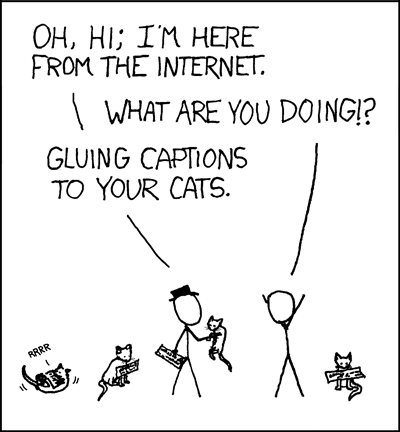
If you want to know why the internet is The Future, you should just read Clay Shirky. If you don’t have time to read all of Shirky’s articles, you could just read Jeff Atwood on Clay Shirky or Cory Doctorow on Clay Shirky, as they all say pretty much the same thing. Basically, things used to be terrible, because there wasn’t an internet. People had to consume mass-market media and professional journalism and had no place to put pictures of their cats. Now, however, we have an internet, so everyone can make videos on YouTube and be a blog journalist and amuse us with cat pictures, hilariously captioned.
And in reality, this is pretty cool. YouTube amuses me at least as often as network TV used to, Wikipedia is far more useful than any dead-tree encyclopedia, Facebook keeps me in touch with family that I would otherwise rarely talk to, I wouldn’t be writing a blog without the internet, and I’ve even been known to LOL at the odd cat every now and again. I don’t dispute the massive utility of the internet, and the advantages it offers over older means of communication. However, when I read the glowing, ecstatic pronouncements of the internet evangelists (and Shirky is only one, and not even the most hyperbolic), I get this queasy feeling of deja-vu. See, we’ve been promised The Future before.
So here’s my prediction: in the future, the internet enthusiasm of the 90’s and 00’s will seem as quaint and misplaced as the plastic enthusiasm of the 50’s.
Note what this does not predict. I am not predicting that the internet will go away or become less important. The people who predicted that plastic would be everywhere turned out to be correct: at least half of the things on my desk right now are made out of plastic, and I suspect that it’s literally impossible to go a day in America without using a plastic product of some kind. In the same way, the future internet will probably be more ubiquitous, more limitless, and more inescapable than it is now. But this very inescapability may destroy our earlier enthusiasm for it. Once the internet has ceased to be The Future and become the present, we’ll become keenly aware of its limitations and downsides, and attuned to the laments over what we’ve lost by giving in to a world of total connectivity.
The problem the present-day internet evangelists is that they believe too fully in the myth of progress, which is what makes them prone to believe that the internet-enabled future will be utopian, or at least a vast improvement over the present. You may find Shirky admitting that the change from the pre-internet to the post-internet age involves some painful transitions (this is his favorite line when it comes to the newspaper industry), but this admission does not cop to the possibility that the pain will simply go on forever, that the post-internet age will simply be objectively worse than the pre-internet age in some important ways. This is abundantly clear in Shirky’s “Thinking the Unthinkable”, which is refreshingly blunt about the way that the internet has vitiated the old model of journalism, but nonetheless optimistic that things will eventually settle down to a newer, better status quo. Little thought is spared for the possibility that journalism in The Future may just be more sporadic, more partisan, less reliable, and less influential than the journalism of the present–that the models which the internet breaks may never be put back together, and a suitable replacement may never be found.
This is part of the myth of progress: any amount of destruction in the name of progress is acceptible, as all is justified as a necessary step towards The Future. And because the myth of progress is so powerful in our society, almost every new technological advancement is greeted with this same starry-eyed adoration, and all criticism of the role and nature of that technology is powerfully marginalized, at least for a while. Only once a technological change is complete, once the handmaid of The Future has proven once more to be merely the whore of the present, do the forces of criticism, reflection, and conservation begin to come into balance with the forces of progress.
IN UR REALITY
This is already starting to happen with the internet. Just in the past few months I’ve read an excellent, astute discussion of the social damage of Facebook, disguised as a movie review, a cranky reminder that the changes wrought by the internet are not as massive as we’d like to think, and an impassioned defence of secrecy in the face of Wikileaks. If the internet is plastic, then we’re in the mid 1960’s, when the backlash against plastic was beginning to enter the mainstream but hadn’t yet displaced the previous narrative of plastic triumphalism. And in these critiques it’s easy to see the outlines of a new consensus that may emerge once the internet has fallen out of The Future and into the present: a preference for intimacy and privacy over openness and publicity, a higher, nostalgic value given to face-to-face interations, and a distrust of the culture of the technologists that enable and promote this structure. The geeks will be the new suits, and the creepy guy telling you to go into plastics at a cocktail party will be Paul Graham.
It will be some time before the internet completely loses the sheen of The Future. Give it at least a decade. It is nonetheless inevitable—nothing can remain in The Future forever (except maybe the vaporous Singularity), and once the internet becomes firmly rooted in the present, criticism will become fair game. More importantly, once the internet becomes part of the status quo, the myth of progress will begin to work against it rather than for it, as the status quo is by definition not progressive. The open question, it seems to me, is whether internet enthusiasm will come to be seen as merely naïve, or actually evil.
Quaint is the best bet. The current crop of tech-lovers are certainly not evil themselves, and we haven’t yet seen anything that is both clearly evil and fundamentally tied to internet-enabled communication. Wikileaks, though, gives us an interesting glimpse at what may be to come. If a ponce like Julian Assange can embarrass the most powerful country in the world and get away with it, then it’s possible that someone who’s smart, ambitious, and evil could do something similar in a way that would be really disastrous. Our e-Hitler could easily get the sympathy of most of the world’s hackers and geeks, who would gladly participate in an open-source world-domination project written in Python if it were framed in the right way. And if that happened, you’d better believe that the rest of the world would turn against the tech-lovers right quick.
That’s pretty unlikely, though. Plus, who am I kidding? I’m a geek myself, I work for a tech company and I spend all day on the internet. I’m just part of the problem.


 J.S. Bangs