So you remember my NaNoWriMo novel? The one I wrote approx 55K words of in under a month? The one whose count is still shown on the sidebar?
It’s DONE.
I put the last period on the first draft this afternoon. I had to spend a few minutes after that stitching some things together, as the last chapters had been written with drafts on two different computers, but that’s done, too. The version that I just saved is now officially Draft One. Celebration time!
Here’s what it looks like:
The Failed Apostle
Letters: 471,988
Words: 82,587
Pages (manuscript format): 378
First sentence: The dossier called him a difficult case.
Middle sentence: “I’ve never seen a device like this one.”
Last sentence: “We should move,” he said. “We got a long ways to go.”
People intentionally killed by the protagonist: one
Fictional animal species introduced: three
Stab wounds inflicted on major characters: four
Pages of tedious exposition that will be cut from the final draft: Oh, probably twenty or so
Pages of repetitive dialogue that will be cut from the final draft: At least ten
Most overused synonym for said: “whispered”
Most inexplicably popular adjective: “yellow”
Level of irritation with current draft: high
Required vacation time from writing before returning to revise: about a month
The entire city of Seattle has been paralyzed by record-breaking snowfall! It snowed enough of Wednesday night to keep me home for the next two days, then Saturday (last night) we were hit by a legitimate blizzard. Or at least the closest thing to a blizzard that I’ve ever seen in Seattle. And what do we have right now?
If there’s one thing I love, it hyper-inflated analysis of the deep philosophical significance of pop culture. And that’s why I adore this piece on Jim Carrey, which opens thusly:
In the year 2038, when we’re all living out of corroded Kia Sportages, beneath an ozone layer so threadbare you can toast a slice of bread simply by hanging it out the window, scavengers will make a discovery. In the basement of a ruined midwestern mall they will find, miraculously preserved, a fresco depicting the totemic movie scenes of Jim Carrey: Carrey as Truman Burbank in The Truman Show, standing in a private elevator shaft of rainfall on an otherwise dry beach; as Fletcher Reede in Liar Liar, being attacked by the pen in his own hand; as Charlie Baileygates, the schizophrenic highway patrolman of Me, Myself & Irene, strangling an enormous cow; as Bruce Almighty’s Bruce Nolan, with the power of God in his index finger, causing fire hydrants to pop and the skirts of desirable women to billow up around their waists; and as Ace Ventura, bent over, hands on rump, ventriloquizing through parted butt cheeks. After rubbing at the wall with ragged sleeves, the discoverers will fall back in awe. And the voice of the tribal priest will be heard, apostrophizing this huge graffito. “Oh, modern man,” he will say, in a voice rich with pity. “How lonely you were, and how divided. And how you loved to talk out of your ass.”
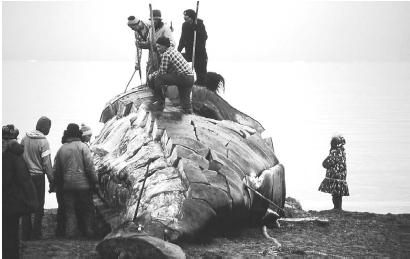
So the animal was bowhead whale–legally hunted and slaughtered by actual Inuit hunters, for those who care. I was under the impression that bowhead aren’t endangered, but it looks like I was wrong! So now I can scratch “Eat an endangered animal” off of my life goals list.
(How did I get whale meat slaughtered by the Inuit? From a guy at my church who helped them with their hunt. Why was he helping them with their hunt? I don’t know, actually. I’ll have to get a clearer story from him at some point.)
But the real question is: was it any good? Eh, not so much. We tried it two ways: first raw and half-frozen with crystals of ice on its surface, and heavily salted. This is evidently the preferred Inuit way to eat whale. If you’ve ever had chilled raw salmon, imagine a similar taste and texture, but drenched in cow’s blood. That’s pretty close to what it was like. Whale meat is incredibly dark and very bloody, so much that the heavy bloody flavor overwhelmed the tasty fishy flavor. If you’ve ever eaten liver or cow’s heart and liked them, then you might like this.
This was actually better than the second thing we did, though, which was to cut the meat into fillets and bake it according to a recipe I found on the internet. The fully cooked meat was black, which was kind of scary. It also wasn’t very good. The cooked-blood flavor even more completely obliterated the fish flavor, and the seasonings we baked it with (red wine, onion, peppercorns and rosemary) didn’t mesh well with the texture and flavor of the meat. We wound up throwing most of it away (but we only had a pound, so I don’t feel very bad).
Despite this disappointment, I found myself with the taste lingering in my mouth all through the next day, and in retrospect I don’t think that it was that bad, especially when eaten raw. If offered the salted raw meat again, I’d probably take it, and I’d be interesting in trying a recipe prepared by someone who actually knew what they were doing.
I’m currently reading A Wrinkle in Time by Madeleine L’Engle for the first time. This is considered a YA classic, and for a good reason: it’s awesome. For reasons which could be the subject of their own post I was never able to read it in childhood, which might be just as well because now I get to puzzle over a curious multilingual typo in the book.
I’m reading the 1979 Dell edition, the one with this cover: This is the edition that I grew up seeing as a kid; all of the other cover images that the book has sported seem like pretenders to me.
I mention this only because it’s possible that later printings have corrected the errors I’m about to discuss.
There is a character, Mrs. Who, who frequently speaks in quotations. At one point she quotes Euripides in the original Greek. The quotation is printed thus (printed large to make the accents clearer):
“Αεηπου οὐδὲν, πὰντα δ’ εηπἰζειυ χρωετ.
Translation (from the book): Nothing is hopeless; we must hope for everything.
Now anyone with a little Classical Greek (which I minored in) could tell you that this is nonsense. Three of the words are nonexistent, and the diacritics are placed in violation of every rule of Greek accentuation. However, with the help of the translation I was able to guess what went wrong and reconstruct the original.
There are two simple letter mistakes: lambda (λ) has been replaced with eta (η) in every instance, and nu (ν) has been replaced with ypsilon (υ) in two places. The latter mistake is quite easy to make; the former is a bit more puzzling, but we’ll let it go. The final word stumped me until I realized that someone had substituted tau (τ) for iota-with-circumflex (ῖ). Making those substitutions, we arrive at this:
Ἄελπον οὐδὲν, πάντα δ’ ἐλπίζειν χρωεῖ.
(You’ll notice that I’ve corrected all of the accents, too. The errors here are very comprehensible and easy to make–and let us take a moment to pity the poor typesetter who was tasked with setting this line, based on a probably handwritten fragment in a language he didn’t know. He had probably never ever heard of a smooth-breathing-with-acute-accent mark, and so may be forgiven for using a double-quote in its place. Alongside the numerous other errors.)
This matches the translation given, and satisfies me. Only two questions remain:
Why Ἄελπον and not Ἄνελπον?
Whence the omega in χρωεῖ? The word that I know is χρεῖ; but perhaps the long form is a poetic variant that I’m not aware of.
Of course, both of these things could also be typesetting errors, but they don’t seem easy to explain in the way that the other substitutions are.
Update: My erudite friend Brett sent me the following in private correspondence:
The TLG says it’s Euripides Trag., Fragmenta (Nauck) 761.1:
Ἅελπτον οὐδέν, πάντα δ’ ἐλπίζειν χρηῶν
lit. ‘nothing hopeless/unhoped, it’s necessary to hope for everything.’ L’Engle’s source translator took the first clause as “nothing is hopeless” which seems fine. An Italian on the single google result I got (http://spazioinwind.libero.it/gattonero/index5_RCol.htm) apparently takes it as “nothing [can happen] unhoped for” or “[if the thing is] unhoped for [then it doesn’t get achieved].” Ἅελπον doesn’t seem to be a word, and it looks like the last word’s typo may be switching ω and η, and replacing _ν with τ for whatever reason. I wonder in a positive, respectful, evocative sort of way what the draft the typesetter was going off of looked like. Finally, a-elp- rather than *_an-elp-_ is the privativized stem of ‘hope’ because _elp-_ originally started with digamma (http://www.aoidoi.org/articles/epic/digamma.html), indicating (with asterisks now meaning prehistoric rather than incorrect) *_n-welp-to-_ > *_awelpto-_ > _aelpto-_. If you have a different edition of the book see if they’ve corrected any typos
I have to mention that the current issue of Beneath Ceaseless Skies is pure excellence. Do you like fantasy stories? Do you like interesting characters and riveting storytelling? Then go and read both of its current stories, now.
The first story, The God-Death of Halla is one of those “elaborate religious ritual” stories that I’ve talked about before, but completely unsubverted. That is, it turns out that the God is being manipulated, but the reality of the God is unambiguously established throughout the story. The conclusion was exciting and glowed with the numinous–something hard to do in a short story.
The second, Precious Meat could easily pass for science fiction. The narrator is non-human, and nothing magical happens. What I loved about it, though, was the fact that it takes place at the moment the narrator’s species is passing into a social mode of existence; which is to say becoming fully sentient, and becoming something that we humans can relate to.
Two long days of writing, and a big push for the end. I didn’t really even plan to cross the finish line yesterday: my goal was 47,000 words, but I hit that at around 4pm. Then I realized I had the whole rest of the day, and nothing else planned–so I went for it. And a huge thanks to Larisa, who literally cheered me on as I was getting my way across the goal line.
So! Here’s the finish-line celebration breakdown:
First sentence: The dossier called him a difficult case.
Winning sentence: “I’m glad you’re awake,” he said. (I find this amusingly appropriate given my state at the time I finally finished. Did I mention that the night before Larisa and I were up eight times with the baby?)
Best sentence of the night: But on every side, thick cables like severed tendons slithered across the floor.
Of course, this doesn’t mean that the novel itself is done. My private goal is to reach 60,000 words by Nov. 30, then finish the first draft (estimated at 75,000 words) by Dec. 13.
Articles like this are why you must read widely, my friends. I have tears in my eyes, now, and I’m thinking about perfume, something that I have seriously never thought about for more than two minutes in my entire life. And the real treat is that I now have a story idea.


 J.S. Bangs