So my last article about Romania was perhaps overly negative, being as it was all Racism! Poverty! Thieves! Swindlers! I ended with a note that Romania is still a great place to visit, but my wife pointed out that this was somewhat underwhelming following the cascade of negativity in the rest of the article.

So here’s a list of things that I think you’ll enjoy in Romanian culture, things which should persuade you, the American or British traveler, to come and visit. I’m not going to list things that you’ll find in any tourist’s guide, so don’t expect me to go on about the gorgeous monasteries, or the wildness of the Carpathian mountains, or the medieval charm of Brașov. Rather, here’s a few things about Romanian culture that may surprise and delight you.

When you go to Romania, try to make some Romanian friends. Get invited to their house. Then be amazed at how kind and generous they are. When you are a guest in Romania, they will always offer you coffee, and tea, and possibly also wine, beer, and țuica. It would be unthinkable to do otherwise. Furthermore, I’ve never found Romanian hospitality to be begrudging or forced. Romanians seem to truly enjoy having guests, and they are happiest when their visitors are well-fed and slightly drunk.
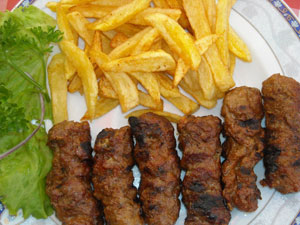
Romanian mici
Mici, in their natural habitat accompanied by homemade potato fries and cabbage

While you’re at your Romanian friends’ house, they will very likely serve you excellent Romanian food. If you are very lucky, they’ll break out the grill and make some mici (pronounced “meech”), which are traditional grilled sausages made from a mixture of beef and lamb infused with garlic and other spices. Let me say this without exaggeration: Mici are some of the best grilled meat you will ever have. I’ve never had any kind of American sausage that approaches a good plate of mici for succulence, flavor, and aroma. You will go home and tell your friends about the awesome mici that you had in Romania, and they will all be jealous.

If you happen to attend a wedding, or any other major life celebration such as funerals, baptisms, or a parastas (about which more below), you’ll also be feted with sarmale. Sarmale are cabbage leaves stuffed with rice, meat, onions, carrots, and spices, then boiled in a pressure cooker for several hours. There are also vegetarian variants made with almonds or mushrooms, which are equally delicious—unlike mici, this is one Romanian dish which can be vegetarian-friendly. Sarmale are savory and slightly greasy, and are best eaten dollopped with sour cream, which transports them from the realm of the merely tasty to the heavens of deliciousness.

Sarmale with mămăligă (boiled corn flour)

(A separate word needs to be put in here for smântâna or “sour cream”, which is nothing like the sour cream you’re probably familiar with. It is runnier, richer, and has a flavor which makes American dairy products hang their heads in shame. But beware! Western-style grocery stores have begun to infest Romania, and they often sell sub-standard Western-style “sour cream” erroneously labeled as smântâna. Skip the grocery stores and go to the local outdoor market to find the good stuff.)

Now that you’re nice and full, go outside for a walk with your friends. You may notice that the young women in your company are holding hands, and that the young men put their arms around each other, and talk with their faces close together. Despite what you think, none of these people are gay, and their behavior does not carry any romantic signals. Romanians are comfortable with a much higher level of casual, friendly touch between people of the same sex than Americans are. You may initially find this off-putting or uncomfortable, but try to give it a shot. After a while you may find that you appreciate the fact that your friends have a lower wall of personal space around them, and may think of American friendships as relatively cold and sterile in comparison.

Conversely, touching between members of the opposite sex is more strictly regulated than in America, and gestures which would be purely friendly over here may be interpreted as romantic come-ons over there. Beware of the signals you are sending.

If you attempt to learn Romanian and are of a non-confrontational disposition (like myself), you may be initally surprised by the fact that Romanians seem to always be yelling at each other. Sometimes they seem perpetually angry. This is a mistaken impression. The fact is that Romanians just like to speak in strong voices, and their typical, normal intonation is one which may seem harsh or rude to an American. You’ll get used to this. After a while you’ll think that it’s fun, and you’ll be amused when your English-speaking parents think that you’re fighting with your wife after you’ve had a perfectly civil Romanian discussion about what to eat for dinner.

Finally, you’ll find that Romanians are on average far more spiritual and pious than Americans. This varies from person to person, of course, but it’s hard not to notice that Romanian spirituality is both more public and less demonstrative than American religion. There are churches everywhere, and people cross themselves consistently when they pass by one. The churches are open from dawn to dusk, and no matter when you go in you’re likely to find one or two people quietly praying or lighting candles. Priests in long black cassocks are a common sight on the streets. The countryside is thick with monasteries. When you take a train trip, you may see a priest or hieromonk going from car to car offering to bless people for their journey, and accepting small donations in return. Yet within this context of greater religiosity, you’ll also find that Romanians are less strident and fractious about their faith than Americans. The culture war overtones that attend to your choice of church (or your decision not to attend church) in America is largely absent. Romanians are content to attend to their spiritual lives without being so noisy about it.

I clearly remember an event from one of my first trips to Romania that illustrates all of these points beautifully. I had wandered into the back of a church on a Saturday afternoon, not expecting to find much of anything there, but to my surprise some kind of family service was getting underway. I tried to quietly duck out, but to my consternation a Romanian grandmother grabbed me by the hands and physically dragged me to the front of the church, insisting loudly that I stay as their guest. I had never seen these people before, but they were determined that I join them.

A parastas similar to the one I unwittingly attended

The woman parked me near the front of the church, in a crowd of older Romanian men standing around sombrely. A big table covered with food and candles lay in front of the iconostaz, and soon after the family (and me) had settled, a pair of priests began a long, chanted prayer. My Romanian wasn’t nearly good enough at that time to follow the archaic, liturgical language, especially not when it was being chanted in a droning, echoey church. I remember that they seemed to say Doamne miluiește an awful lot. This went on for probably thirty fascinating, fidgety minutes. Then all of the men moved forward, pushing me with them, and we lifted up the food-laden table and waved it in the air. To this day, I have no idea what that particular aspect of the ritual meant, though I later found out that the service I was at is called a parastas, a service of remembrance that’s held at certain anniversaries of a person’s death.

And then it was done, and the feasting began. Right outside the church the family broke out bottles of țuica, fresh-baked bread, and big trays of sarmale, sharing them copiously with me and all of the rest of their guests. Bewildered and flabbergasted, I ate my fill, all the time thanking my hosts for their generosity. After about fifteen more minutes the party broke up, and I wandered happily back to my apartment, unsure of what I had seen but delirious with the experience.

Hopefully your trip to Romania will be just as memorable.

The most popular article I’ve ever written was Romani, Racism, and Romania, which continually ranks among the most-viewed pages here on this blog. And I see that a Google search for “romanian racism” currently has my article as hit #3. So obviously I hit a nerve on something with that discussion. In particular, I seem to get a lot of Americans who have gone or are going to Romania, and want some context for what seems like a lot of racist behavior on the part of the Romanians.

I’m here to fill that need.

I write from the perspective of a white, middle-class North American. And I’m writing this for the benefit of anyone visiting Romania from America or Western Europe, though I don’t necessarily assume that you’re white. (We’ll cover that below.) My view of Romania is an outsider’s view. However, I speak Romanian fluently, I lived in Romania for a year before getting married, I’m now married to a Romanian, and we continue to visit the country frequently.

Romanians and Anglophone whites

If you go to Romania as an American or British person, you probably won’t experience anything that you’d call racism. However, if you actually attempt to engage in conversation with the locals, you’ll find a lot of stereotypes and assumptions that Romanians make about you. This may occasionally provoke some discomfort.

Rich guy
A typical American
The first and most obvious thing: everyone will assume that you’re rich. And truth be told, you are pretty rich, compared to most of the people that you meet. This can lead to some uncomfortable situations. Some people may ask you for money, and they may become upset if you won’t give it to them. People may not understand the difference between “can afford to go out for dinner every night while on vacation” and “can afford to give someone a $600 laptop on a whim”, since buying a laptop and going out to dinner frequently are equally signals of wealth and influence to typical working-class Romanians. In general Romanians are very generous with each other; conversely, if you start to make Romanian friends, they will expect and assume that you are going to be generous with them. Many people find this presumption of wealth and generosity to be off-putting–I certainly did when I first started building Romanian friendships.

A related point is that you may discover people speaking to you with a certain amount of resentment. Romanians often feel like they’ve been unjustly maligned by history, and that foreigners don’t appreciate their considerable cultural and historical acheivements. As a result they may display a nasty inferiority complex that manifests as the need to constantly put down Westerners, or try to impress them by playing it cool.

Many Romanians are credulous of conspiracy theories and fringe scientific ideas that Americans find ridiculous. An example: I once had the truly surreal experience of talking to a Romanian who insisted that the Jews controlled the banks and the governments. However, he said they were doing as good a job as anyone, so he was content to let them continue.

Romanians who have never been abroad get most of their ideas about America from movies and television. Think about that for a moment. A lot of Romanians assume that America is basically Southern California + New York. And not the actual California and New York, but the Hollywood versions.

Romanians and English-speaking people of color

(I hate the term “people of color”, but I don’t know of anything else that can be used in this situation.)

If you’re a black, Asian, Indian, Native American, or other non-white American, you may be in for a somewhat rougher time in Romania. You’ll find that most of the stereotypes discussed above also apply to you, but with an additional wrinkle: many Romanians will never have meet or spoken to a non-white, non-gypsy person before you. This creates additional opportunities for discomfort.

A lot of people will simply be curious. Try not to take this personally. Americans have been conditioned to avoid directly mentioning or commenting on someone’s race, while Romanians have not. You’ll find that Romanians gleefully trample over the conversational niceties that Americans observe when discussing race. This may come across as rudeness, but it really shouldn’t be interpreted as racism. In fact, you may find that Romanians hold fewer racial stereotypes about blacks and Asians than Americans do, simply because there are almost no people of those races living in Romania and there are no cultural narratives defining what PoC are “supposed” to be like.

The Romanian dependence on Western pop culture without the rest of the Western cultural context can have some surprising and upsetting consequences. I had to explain to my sister-in-law that it’s not okay to call black people “nigger”, and that it’s in fact extremely offensive. She didn’t see what the big deal was: rappers and movie characters use the word all the time! The subtleties of in-group vs. out-group usage were lost on her, and she had no understanding of the history of the word. (Romanians know that black people used to be slaves in America, because for some reason Uncle Tom’s Cabin is quite popular in translation there, but they’re largely oblivious to the complex, bitter history of American race relations following the Civil War.) If you find yourself in a similar situation in Romania, it’s important to be forgiving and remember that your Romanian acquaintances are very likely oblivious to the racist significance of their language.

On the other hand, due to the inferiority complex mentioned above, some Romanians will fixate on any available reason to belittle a Western visitor, including their race. Some people will always be assholes. Hopefully you won’t have to deal with very many of these people.

Romanians and gypsies

Ah, here is where things get bad.

(I’m going to use the word gypsy throughout this section rather than the preferred Roma or Romani, simply to avoid any possible confusion between Romani and Romanian. The two words have nothing to do with each other, and the resemblance between them is completely coincidental.)

Before coming to Romania I thought of gypsies basically the same way I thought of pirates: something exotic and alluring that existed only in distant times and places. I was very excited to see real, live gypsies when I came to Romania. But discovering the actual situation of the gypsies in Romania was a rather rude shock.

Tiganca cu copil
A young Romanian gypsy woman and her child
The relationship between Romanians and gypsies is the only thing in Romania that’s remotely analogous to the relationship between American whites and blacks. Gypsies have never been enslaved en masse, but they’ve formed a permanent underclass for pretty much the entirety of their history in Romania. Most of them speak Romanian, but many of them also speak a dialect of Roma, their native Indic language. Traditionally gypsies were nomadic, traveling in caravans from place to place, but many of them were forcibly settled during the Communist era, creating miserable little gypsy villages and ghettoes across the country. Most gypsies live in tremendous poverty, they have a very high illiteracy rate, and they’re plagued by many of the same the social ills that attend to the inner cities in America.

If you’re visiting from America or Western Europe, you’re not a gypsy. Even if you’re dark skinned, even if you actually have gypsy ancestry, even if you think of yourself as gypsy, your Western wealth and status make you Not A Gypsy in Romanian eyes. However, you’re going to see plenty of gypsies in Romania, and you may be very disturbed by what you find there.

Romanians carry lots of stereotypes about gypsies. Here’s just a few:

  • Gypsies are swindlers. If you try to make a bargain with one, you’d better watch out, because he’s going to try to screw you over.
  • Gypsies are thieves. If you live near gypsies, you’d better lock everything up tight, because otherwise the gypsies will break in and steal it. Keep a tight grip on your wallet if you see gypsies in the market.
  • Gypsies practice witchcraft. You can often see gypsies acting as fortune-tellers in the markets. They can work hexes on you if you insult them.

There are basically two ways to react to this situation, and if you stay in Romania long enough you’re likely to experience both poles of this dichotomy. The options are:

Stuff White People Think: Obviously the gypsies are an oppressed people. The stereotypes about them are completely unfounded, and in fact the existence of all of these negative stereotypes is the reason that gypsies are so poor and underprivileged. If Romanians would just open their eyes and stop being so racist, they’d see that the gypsies are wonderful people with a beautiful culture of their own, and the gypsies and the Romanians would live in perfect harmony.

This viewpoint is likely to persist until the second or third time you get followed through the market with a gypsy woman on your tail begging loudly to read your palm, or until the gypsy boys down the street break into your ground-floor apartment. At that point you’re likely to Buy Into the Hype. Everything that Romanians say about gypsies is true. The gypsies are poor because they’re filthy and dishonest. You have every right to avoid them on the street and watch them distrustfully when you see them in the market. And naturally you’ll want to find another apartment further away from those people.

At this point, it would be nice to say that my experiences in Romania disproved the stereotypes and showed the baselessness of Romanian anti-gypsy prejudice, but that would be a lie. In reality, despite my initial favorable disposition to the gypsy people, I rather quickly learned to keep my wits and wallets about me when I saw gypsies approaching. This sort of thing falls into the realm of unfortunate necessity, a necessity that many people have discovered.

So what does this practically mean for you, the intrepid traveler?

In the first place, I’ll repeat the advice that any tourist is likely to receive. Don’t give money to panhandlers (of any race). Don’t go to people offering to read palms, tarot cards, or any other kind of fortune-telling, no matter how fun or innocent it might seem. Keep an eye on your valuables, especially when in crowded public places like markets. Do all of these things double when gypsies are involved. You may feel uncomfortable about doing so—I certainly feel uncomfortable giving this advice—but you’re not actually helping the gypsies any by letting them steal from you.

On the other hand, don’t hesitate to buy from gypsy vendors who are selling handicrafts or homemade goods.

Don’t bother arguing with Romanians about gypsies and racism or anything of the sort. They’ll tell you that you don’t know what you’re talking about, and they’ll be right.

If you actually want to help the welfare of gypsies in Romania, I recommend that you donate to a reputable Romanian charity, or one dedicated to helping gypsies across Europe. You, as a visitor to Romania, are not in much of a position to change Romanian culture or make any real difference in the lives of the gypsies that you meet. However, there are many charities that are doing real work to increase literacy, provide job training, etc., and they’re much better equipped to actually help people break out of the trap of poverty and crime.

One last thing

Have fun in Romania. I love the country, and I can’t wait until the next time my family and I get to go back.

Please read this before commenting: A more positive follow-up. I get a lot of people complaining in the comments that I was overly negative about Romania, so I want to make sure that people see the other side and realize that there are lots of great things about Romania, and I don’t want to discourage anyone from going there.

I previously blogged about an experiment in Facebook advertising that I undertook. The gist of the experiment was to see if I could generate an appreciable bump in sales of my e-book The Taint by doing a Facebook ad campaign, and if so, whether that bump was big enough to cause the campaign to pay for itself. And now that we’ve reached the middle of June, the campaign is long over, the sales numbers are in, and I can offer some data and some conclusions.

Preliminaries

Facebook offers you a pretty wide variety of options for how you set up your ad campaign. I went with the defaults for pretty much everything. Most importantly, I chose the automatic bidding strategy, which means that I let FB choose how it was going to spend the money I allocated for the campaign. FB, like Google, allocates ads based on a “bidding” metaphor in which different ads indicate via a virtual “bid” how badly they want to appear in a particular slot. As I understand it, this means that every time FB wants to show you an ad, it goes through all of the active ad campaigns that match something in your profile and asks them how much they’re willing to spend to be shown at that moment. Based on some algorithm that looks at the advertising budget and the target user’s profile, FB decides how much that particular ad slot is “worth” to your ad, and the ad that wants to be shown the most wins.

However, with FB you only pay for clicks, not impressions. An impression is when someone merely sees your ad, while a click is when they actually click on it (duh) and see whatever you linked to.

A standard FB ad (which you’ve seen hundreds of if you’ve ever been on FB) consists of a thumbnail-sized image with a few lines of text next to it. I originally was just going to use my book cover as the thumbnail, but it turned into a mushy gray blob when it was scaled down to the proper size. Instead, I cropped out just the title and used that. My finished ad looked like this:

The ad as it appeared in Facebook

Advertising performance

Here’s the raw numbers:

Campaign Reach:
43,535

Frequency:
2.3

Clicks:
21

Click-Through Rate:
0.021%

Spent:
$29.99

First thoughts were, “Wow, that’s a lot of reach,” followed by, “Wow, that’s not very many clicks.” In FB lingo, “Reach” is the number of distinct people who saw the ad, “Frequency” is the average number of times the ad was shown to each person that saw it, and “Clicks” is the actual number of clicks generated because of this. I was pleasantly surprised at how many people saw the ad, even with my very modest bid. If my campaign were the sort of thing where merely getting the word out and increasing awareness helped, I’d consider that a good sign.

But as you can see, the “Click-Through Rate” (CTR) was awful. Or was it? I really have no idea what a realistic CTR is, and whether my ad did better or worse than the average. What is clear is that you need a lot of views to get even a modest number of clicks–which makes since, since I very rarely click on internet advertising, and I don’t expect that a lot of other people do differently.

So I spent $30 to get 21 people to click on my ad, meaning that I spent $1.42 per click. This is not a very good rate. When I’m spending that much per click, my “conversion rate” (the number of clicks that turn into actual sales) would have to be close to 100% in order to break even. Which leads me to my next point.

Effect on sales

I had to wait until the middle of June to get my royalty statement for the month of May, which showed exactly how many books I sold. Since clicking the ad brought you to the main Lyrical Press site, I took the number of sales directly from Lyrical as an indication of the number of sales resulting from the ad. Lyrical’s ebooks are available in a large number of venues, but most likely anyone who bought the book as a result of the ad also bought it directly from Lyrical, since that’s where the ad pointed to. So how many books did I sell directly from the Lyrical site in May?

Zero.

(I did sell books through other storefronts, though.)

This is not terribly surprising, given the numbers above. Based on what I’ve heard on the nets, ad conversion rates vary from 1%-5%, so getting zero conversions from only 21 clicks is possible, even likely. So while this report is kind of glum, we have to accept it as the consequence of our overall ad performance.

Conclusions

The primary question that I wanted to answer by doing this experiment was whether a Facebook ad campaign could create an appreciable spike in sales of an e-book at a low price point. And the answer to that is a resounding no. My small initial outlay did not pay for itself in terms of increased royalties. It would not have paid for itself even if I were self-published and getting 100% of receipts. At the price level I set, there was no perceptible bump in sales at all.

Nonetheless, I consider the experiment a success because it did furnish a clear and unambiguous answer to the question I posed at the beginning. The benefit derived from a low-cost ad campaign doesn’t pay for the ad, and so makes no financial sense for a small-press author such as myself.

There are a few ways I could tweak the experiment which could give different (more profitable) results. Sometime in the future I may try to repeat this experiment varying the parameters below.

  • Spend more money. It’s possible that my ad budget was so low that I was outbid for all of the high-performing ad slots (in terms of page placement, appropriateness to the user, etc.), and got only the dregs. If this is the case, then spending, say, $100 or $1000 might get me exponentially more results. This would mean that there’s a minimum amount that you have to spend to get an appreciable result from advertising, and that spending any amount below that threshold is simply wasted. In support of this theory, I note that FB told me that there were about 6 million potential viewers of my ad, but I actually hit less than 1% of those.
  • Get a better ad. I’m pretty happy with what I came up with for my first try, but I’m sure there are ways I could make it more effective. With a little reading on ad design and a little practice, I could probably come up with something more enticing.
  • Don’t send people to Lyrical. I might get better results if I had the ad point to the book’s Amazon page, since most people will already have an account on Amazon, and anything that removes the barriers to a sale would be a benefit. Furthermore, Amazon owns the currently dominant e-reader, and streamlining sales to the Kindle would be a huge win.

Hopefully this was interesting and helpful to anybody else who is published with small presses or self-published, and who may be contemplating such a move in the future.

Economic inequality is created by the very same things that most make life enjoyable: family and friendship. Therefore, a radical egalitarian ethic is necessarily inimical to family and friendship.

Well-off parents make their children better off even if they don’t give them money (though money certainly doesn’t hurt), by teaching and modeling behaviors that allow their children to thrive. Well-off friends make their acquaintances better off even if they don’t directly give them money or influence, by providing networks of information and access. Think: do you want to prevent parents from teaching their kids to sit up straight, shake hands, and dress nice for an interview? Do you want to prevent people from mentioning to their friends that there’s a job opening at the bank they work at? A parent who failed to teach his kids how to behave would be a bad parent, and a friend who failed to pass a tip along to an acquaintance would be a bad friend. Yet these very actions create the systemic, inter-generational inequalities that we all observe around us. The aristocracy and the old boys’ network are merely the fully-grown, mature forms of the systems of inequality that we all participate in.

There is a certain amount of systemic inequality that we may have to live with. The cure would be worse than the disease.

(Inspired by Megan McArdle’s provocative, tongue-in-cheek defense of a 100% estate tax.)

So all this talk about self-publishing has gotten me curious about alternate publishing models. As I see it, the main thing that traditional publishing still offers that self-publishing and vanity publishing lack is quality control. A book from a traditional publishing house will have been professionally edited for both content (plot, character, etc.) and mechanics (spelling, punctuation, etc.) It’ll have a professional cover and professional typesetting. The book that emerges from a traditional publisher may not be earth-shaking literature, but at least it will look good and be free of the grossest errors.

Self-published books, on the other hand, are stereotypically full of bad prose and grammatical errors stuffed inside a hideous cover made in MS Paint. Not all self-pubs fit this description, of course, but enough of them do to give the entire model a bad name.

So I says to myself: couldn’t you do both? And I dreamed up a kind of writer’s collective that would try to get the best of both worlds:

  1. Writers pay the collective for most of the cost of producing their book up front.
  2. The writers’ collective ensures that certain standards of quality are met. It requires that all books are professionally edited and fitted with a professional cover design.
  3. The collective acts as the nominal publisher for the book, but under terms that give most of the rights to the author.
  4. The collective takes a small portion of the receipts and uses it to pay for things like distribution and publicity for the entire company, things that cost more money than any one author is likely to be able to afford individually.

I brainstormed/daydreamed a few different ways of paying for this, including a “reverse advance” (the writer pays 100% of costs up front, and gets 100% of receipts until they recoup their costs, after which it’s 85/15) or a milder split costs model (writer pays 50% up front and splits receipts 50/50 until costs are recouped, etc.) There are a variety of possible problems with this, but really, it seems like it should work, right?

And lo and behold Google tells me that it’s been done, and with a certain level of success. The Writer’s Collective linked here has a higher price point than I was imagining—they say that an author could expect to pay $18,000 over the course of the year their book is in production, which is, um, steep—but the basic model is the same. And they do say that they began with a low-cost model similar to what I was imagining, but had to scale up to the higher-cost, high-return model that they use now. Perhaps I’ll contact then to discover the particular reasons for that. Nonetheless, a glance at their books on offer suggests that they’re hitting a much higher level of quality than most e-book publishers, and way higher than most self-pubbed books.

I have no intention to act on any of this in the near future, as I have neither the money nor the time to pursue it right now. But it’s a strange new world in publishing, and who knows what will happen in another 5 years?

So I’m trying to read The Fairy Gaol over at Beneath Ceaseless Skies, and I’m not liking it. It’s not poorly written, or badly plotted, or any of the other things that typically turn me off of a story, but for some reason it’s just not working for me. After forcing myself through the first thousand words, I realize that there are better things to do on Easter Sunday than read through a story I don’t like, so I get ready to close the window, still not able to put a finger on what didn’t work for me.

And then it hits me like a ton of bricks: I just hate the fae.

You occasionally meet people who arbitrarily dislike one of the standard fantasy creature types. There are those who won’t read anything with vampires, or zombies, or spunky pirate princesses. (That last one is hypothetical, as I’ve never heard anyone cop to it, though I’m sure there’s someone who hates spunky pirate princesses). I had previously thought myself above such petty tropistic prejudice, but it turns out that I do have one such bias of my own. I don’t like faery stories. And coming out and admitting it is very liberating, as I will no longer feel obligated to sit my way through yet another bleeding story about selkies or brownies or the Unseelie Court or God knows what else just because I think I ought to like it. Instead I’ll just say, “I don’t like faery stories,” and move on with my life.

I have no explanation for how I acquired this prejudice. It doesn’t apply to actual medieval tales of the fae, for example–just their modern counterparts. The only theory that I have (and this is a pretty thin theory, for the moment), is that a modern literary style is incompatible with the things I actually like about faery tales. The close third-person POV in a modern discursive style, as illustrated by the story linked above, strips the fae of their numinous aura while keeping their specific abilities, making them seem merely arbitrary and weird rather than otherworldly. This is especially true if the protagonist is a fae, as the entire point of the fae in older literature is that they are inscrutable, incomprehensible, and dangerous, and the only one of those qualities that is compatible with a fae POV is banal danger.

In support of this thesis, I note one faery story that I actually liked recently: The Baroness Drefelin over at Heroic Fantasy Quarterly. Note here that the voice is deliberately archaic, and the fae is not the protagonist. In fact, what’s most striking about this story is that it feels like an actual medieval tale–which may be the only thing that makes it tolerable.

Last night, I plotted.

Plot has always bedevilled me, especially when writing novels. I find short stories to be simple to plot out: the action is (usually) straightforward, and the number of threads, events, and characters fit easily into my head. They have to fit into my head, because if I can’t keep track of everything that’s going on in a short story, then my poor reader has no chance.

Novels, however, are an entirely different matter.

I was able to plot out the entirety of The Taint (see link at left) in my head, but that story is only about 75 pages long, and even it pushed the limit of what I could reasonably handle without needing an external crutch. I got as far as I did because The Taint is structurally more like a short story: there is only one protagonist who always has POV, the cast of secondary characters is limited, and there weren’t very many cases where offscreen or backgrounded actions by secondary characters were crucial to the plot. I could plan out that novella by simply following my protag around, without needing to coordinate a tangle of related subplots and secondary characters.

My current WIP is another beast entirely. I have three protagonists and three POVs—something that I haven’t attempted before—and managing the interactions and intersections between them was driving me, frankly, nuts. The sketchy outline I had held in my head only brought the protagonists together in a few key places, and the movements of the characters between those pivot points was vague and undefined. When I began to fill in the blank spaces in my outline, I discovered I had enormous plot problems. Two of the protags were sidelined for a big chunk of the middle of the book while a third got all of the action; later developments required one character to be in two places at once in order for the timing to work out; the third protag’s character development hit a brick wall at one point; and I spent entirely too long getting the pieces into place for the finale.

My mechanism for finding this out, by the way, is very low-tech: I write a one-sentence summary of a scene or chapterlet on a notecard, and then spread the notecards around on a big flat surface in something vaguely resembling chronological order. To keep track of POVs, I write the first letter of the POV character for that scene in the corner of the card in huge print. (I’ve also heard of people using different colored inks or notecards for this purpose.) At the end, I can see everything that’s planned for the book in a easy-to-digest visual layout format, with gaps, omissions, and digressions clearly called out.

And this made it clear that my plot was a mess. It was a very familiar mess, though, as I had a lot of the same problems with my last novel attempt. In particular, I had a large number of scenes where I had written, basically “Something happens here.” For pacing reasons I realized that I needed to break up two events with a lull, but I didn’t have anything actually planned to fill in that space. Last time I tried to do this, the chapters in which “something happened” were the first ones to get cut since they were BORING. Instead, this time I played with ordering, bringing some events into the lulls and out of the climaxes so that the whole construction was less lopsided. I discovered some excellent places to have characters’ actions impinge on each other–one protag’s actions precipitate a crisis for the other protag in the next chapter, though without either of them knowing it–which really knits the plotlines together. And so on, working alone at night at the kitchen table until the whole thing began to hang together.

It’s done now. I have a thick stack of notecards sitting next to my laptop, just waiting to be turned into one chapter apiece. And to my delight, when I actually counted the chapterlets alotted to each character, I found that I had divided them up 10/10/11, meaning that the balance between protags is as perfect as it can be, and all without me having to distort the plot to get it that way. And when I read the chapters leading up to the climax, I can feel the rising tension and eucatastrophic catharsis, even though all I’m going on is one-sentence summaries scribbled on scraps of paper. This suggests that I’m getting it right.

Now all that remains is to actually write it all.

I’ve finished two superlative works of art in the last few days, and I hope to write something about each of them. The first was One Hundred Years of Solitude by Gabriel Garcia Marquez, and I first thought I might write a formal review. But what could I possibly add by my blatherings to one of the most celebrated and analyzed books of the 20th century? Better to let Marquez speak for himself.

I present the following long quote from near the beginning of the book. I nearly wept the first time I read this. A parable (he who has ears, let him hear), for we who wait in absurd rooms and hope to receive a draught of that gentle liquid and remember.

No one was alarmed at first. On the contrary, they were happy at not sleeping because there was so much to do in Macondo in those days that there was barely enough time. They worked so hard that soon they had nothing else to do and they could be found at three o’clock in the morning with their arms crossed, counting the notes in the waltz of the clock. Those who wanted to sleep, not from fatigue but because of the nostalgia for dreams, tried all kinds of methods of exhausting themselves. They would gather together to converse endlessly, to tell over and over for hours on end the same jokes, to complicate to the limits of exasperation the story about the capon, which was an endless game in which the narrator asked if they wanted him to tell them the story about the capon, and when they answered yes, the narrator would say that he had not asked them to say yes, but whether they wanted him to tell them the story about the capon, and when they answered no, the narrator told them that he had not asked them to say no, but whether they wanted him to tell them the story about the capon, and when they remained silent the narrator told them that he had not asked them to remain silent but whether they wanted him to tell them the story about the capon, and no one could leave because the narrator would say that he had not asked them to leave but whether they wanted him to tell them the story about the capon, and so on and on in a vicious circle that lasted entire nights.

When Jose Arcadio Buendia realized that the plague had invaded the town, he gathered together the heads of families to explain to them what he knew about the sickness of insomnia, and they agreed on methods to prevent the scourge from spreading to other towns in the swamp. That was why they took the bells off the goats, bells that the Arabs had swapped them for macaws, and put them at the entrance to town at the disposal of those who would not listen to the advice and entreaties of the sentinels and insisted on visiting the town. All strangers who passed, through the streets of Macondo at that time had to ring their bells so that the sick people would know that they were healthy. They were not allowed to eat or drink anything during their stay, for there was no doubt but that the illness was transmitted by mouth, and all food and drink had been contaminated by insomnia. In that way they kept the plague restricted to the perimeter of the town. So effective was the quarantine that the day came when the emergency situation was accepted as a natural thing and life was organized in such a way that work picked up its rhythm again and no one worried any more about the useless habit of sleeping.

It was Aureliano who conceived the formula that was to protect them against loss of memory for several months. He discovered it by chance. An expert insomniac, having been one of the first, he had learned the art of silver work to perfection. One day he was looking for the small anvil that he used for laminating metals and he could not remember its name. His father told him: “Stake.” Aureliano wrote the name on a piece of paper that he pasted to the base of the small anvil: stake. In that way he was sure of not forgetting it in the future. It did not occur to him that this was the first manifestation of a loss of memory, because the object had a difficult name to remember. But a few days later he discovered that he had trouble remembering almost every object in the laboratory. Then he marked them with their respective names so that all he had to do was read the inscription in order to identify them. When his father told him about his alarm at having forgotten even the most impressive happenings of his childhood, Aureliano explained his method to him, and Jose Arcadio Buendia put it into practice all through the house and later on imposed it on the whole village. With an inked brush he marked everything with its name: table, chair; clock, door; wall, bed, pan. He went to the corral and marked the animals and plants: cow, goat, pig, hen, cassava, caladium, banana. Little by little, studying the infinite possibilities of a loss of memory, he realized that the day might come when things would be recognized by their inscriptions but that no one would remember their use. Then he was more explicit. The sign that he hung on the neck of the cow was an exemplary proof of the way in which the inhabitants of Macondo were prepared to fight against loss of memory: This is the cow. She must be milked every morning so that she will produce milk, and the milk must be boiled in order to be mixed with coffee to make coffee and milk. Thus they went on living in a reality that was slipping away, momentarily captured by words, but which would escape irremediably when they forgot the values of the written letters.

At the beginning of the road into the swamp they put up a sign that said MACONDO and another larger one on the main street that said GOD EXISTS. In all the houses keys to memorizing objects and feelings had been written. But the system demanded so much vigilance and moral strength that many succumbed to the spell of an imaginary reality, one invented by themselves, which was less practical for them but more comforting. Pilar Ternera was the one who contributed most to popularize that mystification when she conceived the trick of reading the past in cards as she had read the future before. By means of that recourse the insomniacs began to live in a reality built on the uncertain alternatives of the cards, where a father was remembered faintly as the dark man who had arrived at the beginning of April and a mother was remembered only as the dark woman who wore a gold ring on her left hand, and where a birth date was reduced to the last Tuesday on which a lark sang in the laurel tree. Defeated by those practices of consolation, Jose Arcadio Buendia then decided to build the memory machine that he had desired once in order to remember the marvelous inventions of the gypsies. The artifact was based on the possibility of reviewing every morning, from beginning to end, the totality of knowledge acquired during one’s life. He conceived of it as a spinning dictionary that a person placed on the axis could operate by means of a lever, so that in very few hours there would pass before his eyes the notions most necessary for life. He had succeeded in writing almost fourteen thousand entries when along the road from the swamp a strange looking old man with the sad sleepers’ bell appeared, carrying a bulging suitcase tied with a rope and pulling a cart covered with black cloth. The old man went straight to the house of Jose Arcadio Buendia.

Visitacion did not recognize him when she opened the door and she thought he had come with the idea of selling something, unaware that nothing could be sold in a town that was sinking irrevocably into the quicksand of forgetfulness. He was a decrepit man. Although his voice was also broken by uncertainty and his hands seemed to doubt the existence of things, it was evident that he came from the world where men could still sleep and remember. Jose Arcadio Buendia was found sitting in the living room fanning himself with a patched black hat as he read with compassionate attention the signals pasted to the walls. The old man greeted him with a broad show of affection, afraid that he had known him at another time and that he did not remember him now. But the visitor was aware of his falseness. The old man felt himself forgotten, not with the irremediable forgetfulness of the heart, but with a different kind of forgetfulness, which was more cruel and irrevocable and which he knew very well because it was the forgetfulness of death. Then he understood. He opened the suitcase crammed with indecipherable objects and from among them he took out a little case with many flasks. He gave Jose Arcadio Buendia a drink of a gentle color and the light went on in his memory. His eyes became moist from weeping even before he noticed himself in an absurd living room where objects were labeled and before he was ashamed of the solemn nonsense written on the walls, and even before he recognized the newcomer with a dazzling glow of joy.

Leo Grin kicked a hornets nest late last week when he asserted that modern fantasy is represents a nihilistic turn away from the glorious heritage of Robert E. Howard and JRR Tolkein. I’ve been following the article and its responses across the net since then, trying to come up with something to say about the proceedings, though at this point the conversation is too broad for me to do more than poke at the most interesting bits. But such interesting bits those are!

I’m more than a little sympathetic to Grin’s complaint, as I had suffered the same thing with the disappointment of Chronicles of the Black Company. But unfortunately I think that the original piece comes across as too much of a personal complaint, with enough political slant that it was easy for his detractors to dismiss him. That’s why I’m glad for Theo’s essay at Black Gate, which expands on the original points and turns the discussion away from gripes and into actual analysis of the texts in question. I agree with nearly every point that Theo makes here, though I also appreciated the counterpoint by Matthew Surridge, whose demonstrates mostly that the “new” trend of anti-heroic fantasy is actually quite old. Also, if I may be forgiven one more link and one more self-contradiction, I found that this “rebuttal” from Philip Athans is also pretty close to what I would want to say.

If I may reiterate one point that several people made in the links above, there is an enormous difference between fantasy that is merely dark and fantasy that is actually nihilistic and anti-heroic. Tolkein could be very dark (I won’t comment on Howard, as I’ve never read him), and the Silmarillion drinks deeply from the chilly well of Norse mythic fatalism. Thus, for example, this blog post titled “Missing the Point” is guilty of missing the point in a far worse way than Grin. Tolkein’s world may be hopeless and often tragic, but it is a world in which goodness unambiguously exists, and in which heroes distinguish themselves by fighting for the good even when their defeat is assured. This is the furthest thing in the world from a fantasy with no notion of virtue, in which there are no heroes who comport themselves virtuously. And again: the existence of Tolkeinian heroes who falter in virtue and who are seduced or corrupted by evil is not a repudiation of goodness, but a way of putting it into high relief. If I may quote the original article:

Think of a Lord of the Rings where, after stringing you along for thousands of pages, all of the hobbits end up dying of cancer contracted by their proximity to the Ring, Aragorn is revealed to be a buffoonish puppet-king of no honor and false might, and Gandalf no sooner celebrates the defeat of Sauron than he executes a long-held plot to become the new Dark Lord of Middle-earth…

This wouldn’t just be a different story, but a dramatically worse one. Fortunately, Tolkein didn’t write it that way.

Moving on to a different angle, I was very intrigued by Kate Elliot’s hypothesis about the reason for “nihilism” in contemporary fantasy:

It does occur to me that a reason — one possible reason — for the rise of the new gritty may be not the death of morality but the death of belief in the stories that we were told to believe were the truest measure of what is foundational….

So I am not surprised to see some of the writers of today writing skeptically or critically or even cynically about the institutions and “sentiments” that we have societally been raised to valorize even and maybe especially in the fiction we tell ourselves to try to describe what I might call “deeper truths” about culture and society and our place in it. So maybe those people write in ways that are uncomfortable, unpleasant, or downright ugly.

This is the most original take on the whole controversy, but I still want to pick it apart.

On the one hand: it’s possible that the “new gritty” is meant as a reaction against old narratives that have lost their power. But if that’s what those authors are trying to do, then I think they’re doing an awfully poor job of it, because—look, you can question conventional narratives or whatever without sliding into nihilism and madness. What you might do, instead, is offer an alternate model of heroism, an alternate view of goodness. If you do this well you can wind up with something that is compelling, inspiring, and life-changing in much the way that Tolkein and the classical heroic narratives are, but which compels people in a direction that you find more salutory. If you don’t think this can be done, I refer you to the entire oeurve of Ursula K. LeGuin, especially the Earthsea novels and her recent Annals of the Western Shore books. These books repudiate conventional heroic tropes in a variety of ways, but the result is not a demoralizing darkness, but the calm and confident demonstration that there is another way.

Of course, we can’t all be Ursula K. LeGuin. (Oh, but what if we could?) Still, if we grant that the foundations of reactionary fantasy are rotten (not something I agree with, but for the sake of argument), then a lot of the dark, gritty fantasy that I’ve sampled seems like it’s just kicking in the creaky old doors and drawing obscene graffiti in the entrance hall. If the literary building is decrepit, who cares? But this doesn’t impress me. Better you build something beautiful in the ruins.

A final aside: Elliot also mentioned that Grin doesn’t talk about female fantasists at all, and I agree with her that this is an important omission. As I look over my shelves, I notice that all of the really good fantasies that I’ve read in the past few years have been written by women. The real solution to the problem of too much rotten nihilist fantasy may be to just read less Joe Abercrombie and more Carol Berg.

We’ve all seen The Graduate, right? And we’ve all seen that famous scene where the old guy tells the young depressed guy that he should get into plastics, because there’s a great future in plastics? If you have been living in an underground bunker waiting for the end of the world for the past forty years and haven’t had time to brush up on your pop culture, here’s a refresher:

We all know why this scene is funny. It’s not because the old guy’s advice is wrong–on the contrary, plastics would be an excellent industry for a young college graduate to make money and build a solid career. Rather, it’s because it’s plastic, man. Plastic, the symbol of artificiality and artifice, of soulless corporate industrialism and estrangement from wilderness, the destruction of the environment and the victory of consumer conformity, the opposite of nature and freedom and apple pie and having sex with your girlfriend’s mother and all of the other good and wholesome things that The Graduate stands for.

However, not too many years before The Graduate, plastic had an entirely different connotation. In the 30’s and 40’s bakelite plastic was used in luxury items from jewelry to handrails–heck, vintage bakelite jewelry from those eras 30’s and the 40’s can still fetch a decent price on eBay. Disney World had a plastic demonstration “Home of the Future” in which almost everything was made of plastic (and which proved to be nearly indestructible, as described in the linked article). Plastic was touted as the material of the future for everything from furniture to footwear. But most importantly, plastic was new, plastic was The Future, and there is nothing more good, wholesome, and American than The Future.

A future housewife cleans her couch with a hose
The couch is made of plastic. At one point people thought this was a good idea.

The Graduate came out in 1967, putting it near the beginning of the backlash against plastic that grew throughout the 60’s and the 70’s, and which by now has simply become part of our cultural background. Today, we regard the old enthusiasm for plastic as quaint and naïve, or at worst slightly evil. (Plastic is bad for the environment, after all.) It took approximately 30 years for plastic to go from being The Future to being something a crufty old man tells you to get into at a depressing cocktail party. In 1952 being against plastic was to be a hidebound reactionary. (Are you against The Future?) But in 1967, being against plastic was to be a progressive, a man of good taste, and on the vanguard of things to come.

But I didn’t really come here to talk about plastic. Instead I want to talk about the internet. Because unlike plastic, the internet is new. The Intenet is The Future.

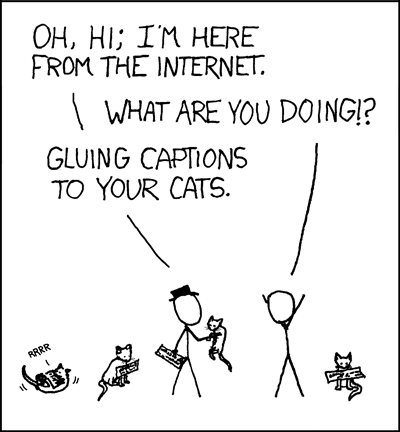
If you want to know why the internet is The Future, you should just read Clay Shirky. If you don’t have time to read all of Shirky’s articles, you could just read Jeff Atwood on Clay Shirky or Cory Doctorow on Clay Shirky, as they all say pretty much the same thing. Basically, things used to be terrible, because there wasn’t an internet. People had to consume mass-market media and professional journalism and had no place to put pictures of their cats. Now, however, we have an internet, so everyone can make videos on YouTube and be a blog journalist and amuse us with cat pictures, hilariously captioned.

And in reality, this is pretty cool. YouTube amuses me at least as often as network TV used to, Wikipedia is far more useful than any dead-tree encyclopedia, Facebook keeps me in touch with family that I would otherwise rarely talk to, I wouldn’t be writing a blog without the internet, and I’ve even been known to LOL at the odd cat every now and again. I don’t dispute the massive utility of the internet, and the advantages it offers over older means of communication. However, when I read the glowing, ecstatic pronouncements of the internet evangelists (and Shirky is only one, and not even the most hyperbolic), I get this queasy feeling of deja-vu. See, we’ve been promised The Future before.

So here’s my prediction: in the future, the internet enthusiasm of the 90’s and 00’s will seem as quaint and misplaced as the plastic enthusiasm of the 50’s.

Note what this does not predict. I am not predicting that the internet will go away or become less important. The people who predicted that plastic would be everywhere turned out to be correct: at least half of the things on my desk right now are made out of plastic, and I suspect that it’s literally impossible to go a day in America without using a plastic product of some kind. In the same way, the future internet will probably be more ubiquitous, more limitless, and more inescapable than it is now. But this very inescapability may destroy our earlier enthusiasm for it. Once the internet has ceased to be The Future and become the present, we’ll become keenly aware of its limitations and downsides, and attuned to the laments over what we’ve lost by giving in to a world of total connectivity.

The problem the present-day internet evangelists is that they believe too fully in the myth of progress, which is what makes them prone to believe that the internet-enabled future will be utopian, or at least a vast improvement over the present. You may find Shirky admitting that the change from the pre-internet to the post-internet age involves some painful transitions (this is his favorite line when it comes to the newspaper industry), but this admission does not cop to the possibility that the pain will simply go on forever, that the post-internet age will simply be objectively worse than the pre-internet age in some important ways. This is abundantly clear in Shirky’s “Thinking the Unthinkable”, which is refreshingly blunt about the way that the internet has vitiated the old model of journalism, but nonetheless optimistic that things will eventually settle down to a newer, better status quo. Little thought is spared for the possibility that journalism in The Future may just be more sporadic, more partisan, less reliable, and less influential than the journalism of the present–that the models which the internet breaks may never be put back together, and a suitable replacement may never be found.

This is part of the myth of progress: any amount of destruction in the name of progress is acceptible, as all is justified as a necessary step towards The Future. And because the myth of progress is so powerful in our society, almost every new technological advancement is greeted with this same starry-eyed adoration, and all criticism of the role and nature of that technology is powerfully marginalized, at least for a while. Only once a technological change is complete, once the handmaid of The Future has proven once more to be merely the whore of the present, do the forces of criticism, reflection, and conservation begin to come into balance with the forces of progress.

Hey, at least I ran out of staples
IN UR REALITY

This is already starting to happen with the internet. Just in the past few months I’ve read an excellent, astute discussion of the social damage of Facebook, disguised as a movie review, a cranky reminder that the changes wrought by the internet are not as massive as we’d like to think, and an impassioned defence of secrecy in the face of Wikileaks. If the internet is plastic, then we’re in the mid 1960’s, when the backlash against plastic was beginning to enter the mainstream but hadn’t yet displaced the previous narrative of plastic triumphalism. And in these critiques it’s easy to see the outlines of a new consensus that may emerge once the internet has fallen out of The Future and into the present: a preference for intimacy and privacy over openness and publicity, a higher, nostalgic value given to face-to-face interations, and a distrust of the culture of the technologists that enable and promote this structure. The geeks will be the new suits, and the creepy guy telling you to go into plastics at a cocktail party will be Paul Graham.

It will be some time before the internet completely loses the sheen of The Future. Give it at least a decade. It is nonetheless inevitable—nothing can remain in The Future forever (except maybe the vaporous Singularity), and once the internet becomes firmly rooted in the present, criticism will become fair game. More importantly, once the internet becomes part of the status quo, the myth of progress will begin to work against it rather than for it, as the status quo is by definition not progressive. The open question, it seems to me, is whether internet enthusiasm will come to be seen as merely naïve, or actually evil.

Quaint is the best bet. The current crop of tech-lovers are certainly not evil themselves, and we haven’t yet seen anything that is both clearly evil and fundamentally tied to internet-enabled communication. Wikileaks, though, gives us an interesting glimpse at what may be to come. If a ponce like Julian Assange can embarrass the most powerful country in the world and get away with it, then it’s possible that someone who’s smart, ambitious, and evil could do something similar in a way that would be really disastrous. Our e-Hitler could easily get the sympathy of most of the world’s hackers and geeks, who would gladly participate in an open-source world-domination project written in Python if it were framed in the right way. And if that happened, you’d better believe that the rest of the world would turn against the tech-lovers right quick.

That’s pretty unlikely, though. Plus, who am I kidding? I’m a geek myself, I work for a tech company and I spend all day on the internet. I’m just part of the problem.