The most popular article I’ve ever written was Romani, Racism, and Romania, which continually ranks among the most-viewed pages here on this blog. And I see that a Google search for “romanian racism” currently has my article as hit #3. So obviously I hit a nerve on something with that discussion. In particular, I seem to get a lot of Americans who have gone or are going to Romania, and want some context for what seems like a lot of racist behavior on the part of the Romanians.
I’m here to fill that need.
I write from the perspective of a white, middle-class North American. And I’m writing this for the benefit of anyone visiting Romania from America or Western Europe, though I don’t necessarily assume that you’re white. (We’ll cover that below.) My view of Romania is an outsider’s view. However, I speak Romanian fluently, I lived in Romania for a year before getting married, I’m now married to a Romanian, and we continue to visit the country frequently.
Romanians and Anglophone whites
If you go to Romania as an American or British person, you probably won’t experience anything that you’d call racism. However, if you actually attempt to engage in conversation with the locals, you’ll find a lot of stereotypes and assumptions that Romanians make about you. This may occasionally provoke some discomfort.

A related point is that you may discover people speaking to you with a certain amount of resentment. Romanians often feel like they’ve been unjustly maligned by history, and that foreigners don’t appreciate their considerable cultural and historical acheivements. As a result they may display a nasty inferiority complex that manifests as the need to constantly put down Westerners, or try to impress them by playing it cool.
Many Romanians are credulous of conspiracy theories and fringe scientific ideas that Americans find ridiculous. An example: I once had the truly surreal experience of talking to a Romanian who insisted that the Jews controlled the banks and the governments. However, he said they were doing as good a job as anyone, so he was content to let them continue.
Romanians who have never been abroad get most of their ideas about America from movies and television. Think about that for a moment. A lot of Romanians assume that America is basically Southern California + New York. And not the actual California and New York, but the Hollywood versions.
Romanians and English-speaking people of color
(I hate the term “people of color”, but I don’t know of anything else that can be used in this situation.)
If you’re a black, Asian, Indian, Native American, or other non-white American, you may be in for a somewhat rougher time in Romania. You’ll find that most of the stereotypes discussed above also apply to you, but with an additional wrinkle: many Romanians will never have meet or spoken to a non-white, non-gypsy person before you. This creates additional opportunities for discomfort.
A lot of people will simply be curious. Try not to take this personally. Americans have been conditioned to avoid directly mentioning or commenting on someone’s race, while Romanians have not. You’ll find that Romanians gleefully trample over the conversational niceties that Americans observe when discussing race. This may come across as rudeness, but it really shouldn’t be interpreted as racism. In fact, you may find that Romanians hold fewer racial stereotypes about blacks and Asians than Americans do, simply because there are almost no people of those races living in Romania and there are no cultural narratives defining what PoC are “supposed” to be like.
The Romanian dependence on Western pop culture without the rest of the Western cultural context can have some surprising and upsetting consequences. I had to explain to my sister-in-law that it’s not okay to call black people “nigger”, and that it’s in fact extremely offensive. She didn’t see what the big deal was: rappers and movie characters use the word all the time! The subtleties of in-group vs. out-group usage were lost on her, and she had no understanding of the history of the word. (Romanians know that black people used to be slaves in America, because for some reason Uncle Tom’s Cabin is quite popular in translation there, but they’re largely oblivious to the complex, bitter history of American race relations following the Civil War.) If you find yourself in a similar situation in Romania, it’s important to be forgiving and remember that your Romanian acquaintances are very likely oblivious to the racist significance of their language.
On the other hand, due to the inferiority complex mentioned above, some Romanians will fixate on any available reason to belittle a Western visitor, including their race. Some people will always be assholes. Hopefully you won’t have to deal with very many of these people.
Romanians and gypsies
Ah, here is where things get bad.
(I’m going to use the word gypsy throughout this section rather than the preferred Roma or Romani, simply to avoid any possible confusion between Romani and Romanian. The two words have nothing to do with each other, and the resemblance between them is completely coincidental.)
Before coming to Romania I thought of gypsies basically the same way I thought of pirates: something exotic and alluring that existed only in distant times and places. I was very excited to see real, live gypsies when I came to Romania. But discovering the actual situation of the gypsies in Romania was a rather rude shock.
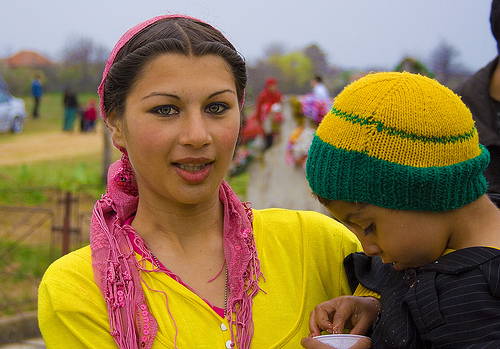
If you’re visiting from America or Western Europe, you’re not a gypsy. Even if you’re dark skinned, even if you actually have gypsy ancestry, even if you think of yourself as gypsy, your Western wealth and status make you Not A Gypsy in Romanian eyes. However, you’re going to see plenty of gypsies in Romania, and you may be very disturbed by what you find there.
Romanians carry lots of stereotypes about gypsies. Here’s just a few:
- Gypsies are swindlers. If you try to make a bargain with one, you’d better watch out, because he’s going to try to screw you over.
- Gypsies are thieves. If you live near gypsies, you’d better lock everything up tight, because otherwise the gypsies will break in and steal it. Keep a tight grip on your wallet if you see gypsies in the market.
- Gypsies practice witchcraft. You can often see gypsies acting as fortune-tellers in the markets. They can work hexes on you if you insult them.
There are basically two ways to react to this situation, and if you stay in Romania long enough you’re likely to experience both poles of this dichotomy. The options are:
Stuff White People Think: Obviously the gypsies are an oppressed people. The stereotypes about them are completely unfounded, and in fact the existence of all of these negative stereotypes is the reason that gypsies are so poor and underprivileged. If Romanians would just open their eyes and stop being so racist, they’d see that the gypsies are wonderful people with a beautiful culture of their own, and the gypsies and the Romanians would live in perfect harmony.
This viewpoint is likely to persist until the second or third time you get followed through the market with a gypsy woman on your tail begging loudly to read your palm, or until the gypsy boys down the street break into your ground-floor apartment. At that point you’re likely to Buy Into the Hype. Everything that Romanians say about gypsies is true. The gypsies are poor because they’re filthy and dishonest. You have every right to avoid them on the street and watch them distrustfully when you see them in the market. And naturally you’ll want to find another apartment further away from those people.
At this point, it would be nice to say that my experiences in Romania disproved the stereotypes and showed the baselessness of Romanian anti-gypsy prejudice, but that would be a lie. In reality, despite my initial favorable disposition to the gypsy people, I rather quickly learned to keep my wits and wallets about me when I saw gypsies approaching. This sort of thing falls into the realm of unfortunate necessity, a necessity that many people have discovered.
So what does this practically mean for you, the intrepid traveler?
In the first place, I’ll repeat the advice that any tourist is likely to receive. Don’t give money to panhandlers (of any race). Don’t go to people offering to read palms, tarot cards, or any other kind of fortune-telling, no matter how fun or innocent it might seem. Keep an eye on your valuables, especially when in crowded public places like markets. Do all of these things double when gypsies are involved. You may feel uncomfortable about doing so—I certainly feel uncomfortable giving this advice—but you’re not actually helping the gypsies any by letting them steal from you.
On the other hand, don’t hesitate to buy from gypsy vendors who are selling handicrafts or homemade goods.
Don’t bother arguing with Romanians about gypsies and racism or anything of the sort. They’ll tell you that you don’t know what you’re talking about, and they’ll be right.
If you actually want to help the welfare of gypsies in Romania, I recommend that you donate to a reputable Romanian charity, or one dedicated to helping gypsies across Europe. You, as a visitor to Romania, are not in much of a position to change Romanian culture or make any real difference in the lives of the gypsies that you meet. However, there are many charities that are doing real work to increase literacy, provide job training, etc., and they’re much better equipped to actually help people break out of the trap of poverty and crime.
One last thing
Have fun in Romania. I love the country, and I can’t wait until the next time my family and I get to go back.
Please read this before commenting: A more positive follow-up. I get a lot of people complaining in the comments that I was overly negative about Romania, so I want to make sure that people see the other side and realize that there are lots of great things about Romania, and I don’t want to discourage anyone from going there.
 J.S. Bangs
As an Orthodox convert, I’ve often been fascinated with life in Orthodox countries. I’ve been told that Romanians are the most compatible with Americans for a host of subtle cultural and historical reasons. I’ve even wondered what would be involved in moving there.
I’m curious why they would have said that Romanians are the “most compatible” with Americans. I’m plenty compatible with my wife, but that doesn’t mean that we never had any cross-cultural issues.
In any case, Romania was a wonderful country and you’d enjoy visiting it. I recommend you go to the region of Moldova/Bucovina, where my wife is from, and visit the seven Painted Monasteries and the cave that the famous hermit Daniil Sihastru lived in.
Romania is almost like any other country, you’ll meet poor people but also very rich and a middle class. For example I live in a very small town but it’s like a vacation city :))) many bars, restaurants, banks and so many cars…we don’t have where to park them anymore and we have every side of every street to do that. And usually romanians are very pride, too pride and most of us don’t need pitty from foreigners, even if we don’t have always money we don’t consume rather than have others to pay for us. But there are people who take advantage like in every country. Try to live in Romania and meet as many people as any other romanian does and then you’ll change your opinion. Compared with similar level countries Romania is actually less violent or racist. Hating thiefs is not called racism but normal. Small percentage generalize gypsies, but again, in every country happens this phenomenon so nothing unusual. As cities I recomend mostly Brasov, Bucuresti, Iasi, Timisoara, Cluj, Oradea, Sibiu and the order is irrelevant. There are many more but just to name a few.
Hi,
I am sorry but your ideas of Romanians are mostly wrong. I do not know with what type of Romanians you had the chance to build a friendship but for sure they were middle to low class.
1. Romanians travel a lot into Europe (West of EU). Those area are among the most advance on the planet, from a technological pov as well for their mentality. So what you are saying about “Seeing Westerns as rich people” would instantly fail. It’s not like we cannot make the difference between a normal person and a rich one. If you would been rich you wouldn’t stay for drink with middle class people…
2. In Bucharest (Capital of Romania) you will see loads of foreign people, including a lot of blacks. If you go to the City during a Friday/Saturday night you will have 20%-25% foreign people. Yes, we use words like “Niggar” but that’s because in Romania it doesn’t matter, we do not use it in a racist way, a negative way. We don’t look at black people as being different, we see them as people! We also call each-other whites… it’s exactly the same thing for us.
3. We hate gypsies because they are Lazy, they do steal because it’s easier then working for money. It’s not the fault of youth gypsies but that’s their culture, they have a different one and they keep it very well. Only now a few (Smarter ones) started to change their life style, they are called Romanised Gypsies. They are better seen in society only because they behave different then the rest. We hate them because whole Europe has a problem with Gypsies, and they call them Romanians because of their Romanian passport.
Is this the same as in USA? No, because USA was build from foreign straight, we have museums in Romania older then USA as a country so yeah, our hate grows deeper. I could go into this a lot longer but im tired from work.
You should do a lot more research before jumping to conclusions.
First, this article is several years old, and things have changed a lot since it was first written. In particular, since Romania has joined the EU a lot of people have gone and worked in Western Europe, which of course has radically changed the way that Romanians think of and relate to Westerners. So you’re right about that point, but this is a recent development, something which has changed in the last several years.
Secondly, Bucharest is quite different from the rest of Romania. There are a lot more foreigners in Bucharest than in any other part of Romania, so comparing Bucharest to the rest of the country is sort of pointless.
I wonder: you re a Trump or a Clinton voter?
Actually, I am a principled non-voter.
Dear Friend,
Do not move to Romania. I have lived here for a decade! It is a downright awful place. I really want to help you not make a big mistake. I don’t think you will remain Orthodox if you come to Romania — as you will see the priests are VERY corrupt.
There are some great exceptions but as the majority are money-focused machines that will put America’s best TV evangelists to shame..perhaps not on how money they raise but on how they abuse the name God for personal gain. There are wonderful Romanian people BUT and I say this WITH GREAT RESPECT TO THE GOOD HEARTED AND/OR TRULY EDUCATION PEOPLE OF ROMANIA… most Romanians in Romania are disrespectful, arrogant, close-minded, and see you as an ATM machine.
I am not trying to let off steam. I think the author of this site, from what I have read so far has a great understanding of Romania only I would add that it takes YEARS to really really understand Romania. And after years and years, I can tell you that I see God’s goodnes, His mercy in that this country is not a bigger disaster then it is and His justice in that He lets those mean-spirited people live in their filth and think it is paradise. Harsh words, right? Come live for 10 years and swear to me on a bible that you don’t have the same opinion. Everything here is a struggle. The better you speak Romanian the worse it will be because the niceties for the foreigner will disappear.
I am not an expert on the Bible but I know that is says something like ”even the wicked love their own kin.” Even this is not true in Romania. You can talk very nicely to people..sentences starting with ”I kiss your hands” and anything can lead to a slammed door in your face and nasty insults. Nothing is easy.. buy pretzels — ”What kind of pretzels do you have” ”Can’t you see them” ”Yes, but what is in the one on the left.” Window slammed in face as women curses you for taking her time.
Electric company — credits money to the wrong month. No one knows how to speak on the phone..come talk to them three towns away so they fix their problem. Yes, they messed up but you have to pay for it. Something entered in a computer has no way to be modified. No apologies. Ask a question – get cursed.
Rude, ignorant, uneducated, IMMORAL people. Not a good place to make a nice impression of Orthodoxy. I studied the religion, sounded good on paper, saw the people who follow it and said ”better stay the h-ll away”.
Andrei, from my point of view you might obviously be a pour isolated romanian soul that couldn’t find his purpouse in Romania and always thought tht you could find your own kinder abroud. It’s not unsusual for romanians to do this in the last 20 or so years because of the misinterpretated idea about the west, especialy the US, since we have been told that they are corrupt and shit and we’ve seen from other sources that it might be wrong and maybe that’s what freedom is, to be free to ”do wrong”, to have fun, to be yourself.
The author is right about many things when whriting about Romania. Yeah, we are chilled, yeah, we are tollerant and friendly but of course we have our prejudices and things we don’t like even if we know we are wrong. Somethimes it’s best to stay aware about gipsys, but always it’s best to be aware to stay aware about strange people. And us, being a people coming out of communism, with our own unique background and history, we are always aware of people talking our language and coming from abroad, at least as americans are about south americans coming in the US… or maybe more because we always know that someone coming from the US, why not, is someone coming here to make money for most of the parts, and that’s not something you take around so easily. Just think about all the debates aboute illegal emigrants taking US jobs and all the debate around this. It’s nothing too different, it’s just the same thing and a different place.
Joe, you said you have lived in Romania for the past 10 years, right? If you have such bad opinion about Romania and Romanians, why in the world are you still living there? I really can’t understand.. There are so many more elevated countries out there to live in, and you chose Romania? I am Romanian and I truly love my country. I live in the US now but I wouldn’t trade the education that I received in Romania for anything in the world. Because of the education that I received there, I am a successful business woman here in the US. I live in Seattle, Wa and it’s full of successful Romanians over here. I am just proud to say out loud that I am Romanian. Here, in Seattle, when you say ‘I am Romanian’ it’s a big deal. That usually means you either work for Microsoft or you have a good business. I don’t understand your frustration..really! If I wouldn’t love America, I wouldn’t live here. Why be a frustrated resident of Romania? I bet nobody withholds you there..
@Andreea.
Hi. I just saw your reply. You make great points.
There is one point where I respectfully disagree with you; education in Romania. I would never, not with gun to my head, send my children to a public school in Romania. Now, listen, I am sure that the education in the US is lacking but there like in other countries, children are children. In Romania, I see five year old kids that seem like they are learning wonderfully — at an accelarated communist China style approach — and I’ve seen these kids by the time they are 10 be totally drained and unable to think for themselves or take anything lightly. I think the greatest root of all evil in Romania is the educational system… but I am glad it worked well in your case.
I was actually in the US with an entourage from Romania and everyone was treated very well, like you say. America lacks the stupid racism of Europe. Yet Romanians, together with their unbelievable antisemitism have become over the years anti-American, prefering second class citizenship in Italy to aspiring to something better in the US. I know Romanians who lived in Canada — I knew them there — they had everything they needed, help from the government with business and they came back to Romania and now do not live very well. As one confided in me ”I must be a fcking idiot.” The Bulgarians, Croats, even Germans and Brits were all happy and content in a country that appreciated them (Canada) but the Romanians uniquely were not content. My opinion is that (most) Romanians are unable to accept ”foreign rule” and feel a need to live apart where no one has an opinion or way of life other then the one they have. Those who aren’t like that — are people like you who are successful and enjoying their life. 110% it is great to be proud of your heritage ad Romanians in Seattle deserve any and all applause given them for what they have accomplished. However, are you a Romanian in Seattle or are you a Romanian-American/ in-the-making..? Where is your loyalty ultimately?
If you are not sure, let me tell you this — it ought to be where you are actually appreciated and valued for who you are.
Where is your culture America or Romania? If you say Romania, then you must think that despite your success in the US that the States should be against small business, that it is proper for people to impolite to people who are polite to them, that you shouldn’t help people who can’t help you or won’t help you in the next 5 minutes and to see everyboy as someone you can profit from.
I have been stuck here because of business and because I care about the people who invested in the business and insist to win over the Romanians at various levels who ran scams on the Company. When I finish what needs to be do , I will leave.
My friend sold his apartment in Toronto, violated rules on is immigration and returned to Romania with dreams of going from the good life to a dream life that doesn’t exist in Romania. We don’t talk much anymore, he is genuinely upset with me since he left in 2000 and I had already lived here for several years in 2008 when he moved back that I didn’t tell him the plain hard truth about what Romania and most people in Romania are like (nothing to do with ”culture” or financial standing but issues of the heart of the people being sick). So now I just tell it like it is..
Hello everyone, I’m gonna sum up, fast list 24 years in romania.
for 5 minutes try to sum them up again, think just for the sake of god that is true, don’t pre-judge. I won’t be a negativist.
till 90′ comunist romania – has all, economy,pride,gouverment,
romania exported cheese and wines to france, cars in germany, fridges and tv’s in china.
every citizen had shares at state company ( any company was state’s ), + 90′ shares are close to 0 as value, gouvt ppl get them as bribe for getting down comunism, they turn up milions,
90′ +, new gouverment installed by … 🙂 nothing has change since 90’s for romania in better.
you can walk the street and end up in a coffin just because some dogs eat you alive ( happend numerous times)
gypsies, thieves, foreigners come in romania to have ‘fun’ , you know what ‘fun’ is right?
1. Criminality is property related, thievery, burgulary, economic frauds, etc etc.
of course :
you can have a walk in the park and some football supporters from another country beat you do death.
walk into a srynge, hole in the asphalt, open sewer( they seem like jokes, but these are real and they all contribute to romanian lifestyle)
you can get out of your house and someone throw a brick in your face.
some people here are in extreme poverty, something that you just cannot mentally imagine and cope very hard with the situation,
2 .The System
in romania no.1 disease is depresion which is generated by a neverending struggle, constant living struggle.
there are numerous people in romania that are smart,handy,artist ( in the true sense of the word), singers, movie directors, theatres, writers, poets,.. so on .
they all suffer from depression, noone can be kind to you, due to the fact that they struggle every day beyond an outsiders can ever know, imagine, feel.
there are rich people, richer than richer people that you’ve met before, for sure.
poor people,.. no middle class, no working class.
let’s say medical system helps with lifecare, in romania medical system doesn’t nullify it’s meaning, it’s completely the opposite; you go to hospital = surgery for nothing, new diseases, food poison, alot of money wasted on bribe for doctors nurses doorman, anyone there, no bribe = complete and absolute ignorance.
police and forces for safety are mindnumbing for someone that didn’t had any previous contact with a state like that ( for usa/non-lastcountrieslisted )
ex: citizen to policeman – I am robbed, not my duty ma’am, I’m from traffic control or I’m guarding this public toilet ( fact, happend )
if you walk down the street, and there’s a car on fire, noone comes with the extinguish , that costs money,
if you are robbed in broad daylight, have the unfortunate to be brawled, etc , noone pays any attention to you.
noone = nor police or people
if you have a tax for ….(romania has alot of taxes, some of them ridiculous, some of them illegal, some of them just prolonged from other taxes that you already have paid) you spend at least one full day going to every institution in the city, and they just close the door, plain and simple. noone has the 20 seconds just to tell you where to go, to pay something for nothing.
education is worse every day, i-phone kindergarden kids, tests are easier each year for highschools and they are still unable to pass. university is just whom to sleep with, where to pay for future job/license etc.
what more? wage?
3. Economy is at a experimental level
average wage is less than 200 dollars a month… and to cap that out.
renting a small flat or a studio, one room anywhere is more than that.
1 kg of cheese is 10 dollars, 1 gallon of diesel fuel is 9 us dollars.
let’s say you have a job paid twice the average salary,
one room flat + car ( tax paid ), just gas. gets over your salary.
in romania children are small mature people, grown-ups are milking cows for govt and others, old people are not people.
as far as you consider, english is no my native language and I hope that you all understand that I’m not media, I’m not obama, I’m not christian god, I’ve just shared my experience of my past 24 years spent here.
move to romania if you have large sums of money, and if you are rich indeed.
you’ll have the fun of your life, you can buy university masters degree like you order burgers, get drivers license, house in the middle of the lake,in woods, 20 story building in 1500 yrs old unesco site.
YOU cannot change romania, you cannot teach people to take good long term decision on their money , things won’t WORK like in your books. like in your life.
I hope you get my point. in romania is like a jim jarmuch movie, dead man.
and of course I’ll lace a challange.. come to romania , get a job, a house, car, wife, childrens, and by the time you do that, don’t end up in jail, don’t die, and don’t get all these in more than 10 generations 🙂
Have a great evening, your respectfully romanian friend.
Sounds like projecting your own bitterness unto the whole of Romania and Romanians. I have lived in my home country for 35 years (minus one spent in the States) and I have known many Romanians who developed this bitterness, not to call it hatred, of Romanians. Still, I can’t accept them, even if I understand them.
I know so many good, talented, hard-working Romanians I couldn’t but disagree with you.
as an immigrant from mexico, i find this very relieving to hear, so now i see the way americans feel. Big difference between both is that americans are leaving a well developed country for international travel with business interests, mexicans are fleeing a country across a borderline in order to survive from such corrupt government. So thinking they’re taking our jobs and making money out of our resources, is not well justified here in the states. Ive been raised here and this is my perspective, please respond with educated opinion so i can read more, thank you for your time.
Hi Guys!
I’m stunned by the arguments and the topic.
At least, the Romanian kids don’t risk to be shot, knifed and massacred in Romanian schools. Does ”Columbine” rings any bells?!?
Have you heard about the Romanian lawyer practicing at Old Bailey???
I’ve got no time for your rubbish and my examples can go on and on for days!!!
Have a good day! Whatever is left….
:))) yeah..pretty much how I feel about the country I was born and lived in for 25 years. 😦
I respect your opinion.But remember is simply yours .And to be honest I do not agree with it.I em Romanian and what I can tell you are wrong.I live in Italy and al the dispriction that you said about Romania looks more the Italian way .I live in the amazing Chatolic Country and what I can say is the same what you did describe in your coment.Have nice day Peace
Hello there, Mr. David Dickens!
I’m from Romania, and I’m currently living in Canada.
First of all, God bless you, my friend, I hope you’ll find your way through Orthodox Christianity, and live a wonderful life!
Let me tell you that most of the things written in this article are true. Especially the gypsy part. Thing is, I do not recommend moving to that country just for pleasure. I do recommend though, visiting the country often, with friends and with a guide. If you visit Romania with Romanian friends, which I recommend, try to convince them they don’t see their families, because you’re going to spend a lot of time of your vacation that way, and are not going to discover the country! In the worst case, bring your spouse, and/or children, and/or other friends to visit the country and hire a guide. Those are not very expensive, and speak very well English. You are going to notice that many young people in Romania speak well Shakespeare’s language, so if you run into any trouble, just ask around! Don’t forget to tell that you’re simply a tourist, so that they won’t believe you’re just trying to show off your English skills, haha!
For someone like you, I highly recommend moving to Romania if workplace gives you the opportunity to do so. Look around, ask people around, I’m sure you’ll find permanent and/or 3-year or another term work contract in Romania. People there are more religious than in the West, and out there, openly speaking about religion is not a bad thing, especially if you’re an American convert.
This being said, I wish you all the best and I hope you’ll be able to one day, fulfill your aspirations.
Doamne ajută! 🙂
I will be honest, I would never ever recommend a black person to go to Romania, it is one of the worst country a black person should go you will be scared of your life. I’m from the Caribbean where it is paradise and took a trip to see friends I have in the US, i was so
excited going through customs they were very welcoming. When I reach the area Bucharest everybody was looking on me I was thinking It will get better, I started my trip to Sanaia every single person were looking at me they stop their cars to stare the women would laugh touch each other to tell another to look at me. I’ve never been so humiliated in my life. In my country we know nothing about racism and I’m proud of that. Decided to go to Brasov omg it’seems like its the worst mistake I made old ladies were coming in my face to look at me I almost run, it gets better the people started looking at me in disgust, I remember one old guy saw me and look with scorned and spit. I honestly thought they were civilized they stopped my friends to ask if I’m from African I not even that dark skinned not that I’m saying something is wrong with been an African I just trying to say how uncivilized these people are they have no idea what’s taking place in the world. Besides most of them look like there are aliens I didn’t judge, before I end this im not being one of those person who makes trouble going to someone elses country to talk about the real bad becuz every country had it ups and downs but Im scared for my life.
First let me start off by saying thank God for my beautiful island I appreciate my it more I’m From the Caribbean where some of the most iconic people are from, everybody dream vacation is to come to my country where we have no form of racism we love the white, black, Indians etc. Romanians are one of the most racist place I’ve ever been to i wouldn’t advise a black person to go Romania I’ve never been scorned and humiliated in my life. I have romanian friends in the US we decided we will go Romania for vacation it’s the worst thing I think I’ve ever done, when going through customs the guys were very welcoming, I travelled to Bucharest everybody was looking at me I didn’t pay it any mind I thought I would get better it got worst, I went to Sinaia omg i thought these people were crazy everybody was looking at me the babies the grandma the old the young. I thought they would have an accident the women were touching each other to look at me they would laugh loudly some of these people looked so uncleaned as if they have never seen a shower, I didn’t judge because I believe in we are all one if u cut me it’s the same blood coming out its not like I have something else coming out of my veins. They would stop my friends to ask if I’m from Africa and I’m not even that dark Im just saying how uncivilized these people are, however went to Brasov thing got worst the older people were looking at me with disgust coming in my face i thought they were going to bite me, one particular Old guy when he saw me he looked at me like he saw his face looking like germs he spit in the public area where there were hundred of people but I don’t think he knows if u spit in the sky it wI’ll fall right in face. I’m not paranoid are one of those person who loves to go the another people’s countries and talk bad stuff about it because I do believe every country has
It struggle it’s just the people and how dirty minded they are. Right now I’m scared for me life and what tomorrow will bring i will close by say on ONE LOVE ONE HEART!
I am from Romania and I would like to tell you my opinion about your story. Firstly, it is true that a lot off people in Romania will probably stare at a black person, or an asian person but it is simply because they probably haven’t seen a black person or an asian person, in person, before. Some may probably realize themselves that they are staring, but as long as you don’t look back at them they will continue to stare, just because you look “exotic” to them. This will probably happen everywhere in romania and it’s not that they look down on you, it’s because they are extremely curious about you. Secondly, about the girls you said laughed at you… Sinaia is a place where people go on holidays, they like to have fun while they are there with their friends. The girls were probably already talking/laughing at something else when you popped into their visual field. I’m not trying to find excuses for them but things like this also happen to romanian girls. Other girls are laughing while looking at you, but you might not actually be the reason of their amusement. If you are, then, it’s mostly because they find you fashion style strange/ different/outdated/too futuristic,etc., but these type of “mean girls indirect bullying” can happen even between friends, not only based on race. I don’t think they laughed at you because of your skin colour, even thought they did point at youprobably because of that reason. Asking if you are from Africa… again it might seem rude to you but romanians don’t learn a lot about black people in school, so they know mostly from the media that black people are from Africa and some from the U.S. because they see them in american movies/music mv. Actually those people that asked you were probably trying to start a conversation with you. And lastly, and this I can clearly say it’s a misunderstanding from your part, is the story of the man that spit “when seeing you”. It happened to me many times before and actually it is very disgusting. Some men do spit on the streets, and they do it mostly when they are alone/not with friends, because they are usually judged by the eyes of passer-byes for spitting. So if they are alone and you happen to be in front of them before they spit, your eyes will meet just because you are the person closest to them and they tend to look at you. Again, because you are different from the persons they normally see, he might have looked at you like at an “exotic” person, but he wasn’t spiting at you. As I said it happened to me many times and I am always grossed out by them. Also, there is a scenario I lived some time ago, when a crazy person without shelter was cursing everyone on the street and looked dangerous, so I can see that type of mentally ill person spitting at you for looking different, but this is not something a normal person would do. Finally I would like to tell you that I am sorry that you didn’t enjoy your vacation in Romania. I, myself am a very sensitive person and I did have instances when a lot off people where staring at me and I didn’t find it comfortable at all. I realize what you went through. I wanted to visit some asian countries, but because I look different from an asian person and heard I will be definitely stared at for looking different , I avoided visiting them until now. Your country is great and it is a place where everybody on the planet wants to go, but honestly speaking, maybe the main reason why your country is not “racist” is because of it’s history of tourism. Your country has a beautiful landscape and makes a lot of money from tourists that come to visit, so it’s normal that you are welcoming of tourists of all races. Countries like romania that don’t have a lot off contact with foreigners, don’t make a lot of money from foreign tourism, do tend to look at foreigners with curiosity. Racism is something that develops between two ethnicities that usually have direct contact with each other, so I don’t think romanians can be racist of black people, for example, just because we don’t share a common history with them, we don’t know stereotypes about them and so on, so we actually don’t have a reason to consider them inferior to us. But, I’m not trying to deny, we might look at them with curiosity because their physical appearance is different and this might be interpreted by them as racism. All in all, I wish you all the best and confess to you that I do dream of a world without borders, where people can travel where their hearts lead them without facing safety or racial problems. I hope you’ll visit many countries in the future and have only great experiences 🙂
I suppose they were speculating on temperament and the mix of eastern and western culture. There are a couple of Romanians at my parish who I get along with very well, but we’re a big mix of cultures so there really isn’t anyway to speak about such things from personal experience. My limited knowledge about Romania from photos and travel information is very positive. You might be interested in Raoul Pop’s video/interviews I really enjoyed them:
“Romania Through Their Eyes”
At the end you’ll find exactly what you are looking for and what catches your eyes, ears and feelings, this is what you’ll find and resonate with.
Romania has a lot of ancient history, but not as Modern Romania, often named as Dacia, Wallachia, at the end it’s a mixed of Dacians, Romans, Slavs, and Illyrians are the predecessors of the modern Romanians, Aromanians (Vlachs), Megleno-Romanians, and Istro-Romanians and was always located at the crossroads of Central, Eastern, and Southeastern Europe.
It’s a mix culture. Modern Romania start to build it’s own personality, after 1859 after the French Revolution 1789, that changed all the old world and the quid pro quo establishment.
What tried the last establishment: Communism/Bolsevich from ’47 to ’89 era was to erase everything, but this has tried Roman Empire year 98 to 117, Goths, Huns, Gepids, Avars, Bulgars and Slavic subjects until 8th century, Ottoman Empire from 1453 to, Austrian Empire for the last 2000 years.
When you do look and understand the history it’s changes your perspective.
What it’s important is the level of education of the people you allow to be around you.
gypsies have been enslaved in romania for 600 years, not all gypsies dress like gypsies, all tanned people living in romania have gypsy ancestry;pale white romanians steal and do more illegal things than gypsies but usually they are regarded as gypsies(adjective); if you are educated(college etc) as a gypsy nobody would admit or accept that you are gypsy even if you say that you are one;most discrimination is at an institutional level and that’s a big problem;the cause of envy is that while some gypsies live in extreme poverty and pick up scrap metal or steal to survive, many live better of than the general population but that’s because traditional gypsies inherited alot of gold from their ancestors and have hidden it;in comunism tons of gold have been confiscated from gypsies by state and secret service;gypsies have been mass murdered, killed and hunted for about 800 years (official decrees in all europe)in europe for their gold, pope inventing stories saying they are followers of satan,sons of cain,hamites, etc get your facts straight upon maybe the most persecuted race in the history of europe.
@albert wohn: i was just about to say many of the things you’ve mentioned there 🙂 however, just a few amendments: gypsies were not slaves in romania, but serfs (serfdom is quite close to slavery but with some important differences). and i wouldn’t say they were THE most persecuted, i think they come second after the jews (who suffered a lot more than gypsies especially during the fascist period of romania). but indeed the social stigma is a lot greater nowadays towards gypsies while in the case of jews it’s pretty much extinct.
still, a VERY good article. i’m romanian and been living in romania most of my life. the author really nailed it on many points 🙂
i would’ve have maybe rephrased it a little towards the end, the article leaves the impression that romanians’ hatred towards gypsies is in fact justified.. Many gypsies in romania are completely assimilated into general society, but many of those won’t openly admit it for fear of social stigma. differences and problems are indeed more visible in the case of traditional gypsies who are also easier to point out. unfortunately, romanians see this as a race issue and not as an integration policy failure (or lack thereof).
I don’t mean to leave the impression that Romanian hatred of gypsies is justified. I do, however, want to poke a hole in the condescending, uninformed way that many Westerners think about the issue. The gypsies don’t “deserve” their status (what would that even mean?), but neither is it the case that Romanian prejudices against gypsies are completely unfounded and irrational. To deal seriously with this issue, we have to grapple with both the unfairness of group prejudice and the social and cultural realities that created that prejudice in the first place.
Relevant link.
I’d say selling people in public places counts very much as slavery. Also this article (Romanian only, unfortunately) gives a good image of the sexual privileges that the feudal nobles had over gypsy women.
Sometimes i wonder if my lowlife host (ex gf) was a closet gypsy. Though she was pale bit often talked badly about gypsys. Though one of her good friends lived in a community full of gypsys. Wish i could show you her picture and you tell me if she was romanian or a closet gypsy.
Gypsies were slaves (robi) in Romania. Slavery was abolished in waves, but abolition was completed by 1956. Incidentally, Kogalniceanu was a great abolitionist
lol.. is this is joke? Gypsies are all across Europe..who is their slave master?
Who compels them to steal.
Come to Romania. Find me 20 hard working Gypsies in 5 days. If you do, I will pay your airline ticket and $5,000. Let me know if you are interested.
You know very well that is a lost bet from the start, don’t you, Joe? Tell me, don’t you care at all of the injustice you’re trying to make to some people? Shame on you for all your racist prejudices and lies! A shallow mean dishonest ignorant you are! Pfff…
JOE is not racist, he is right. In my whole life I met only 2 good working gypsies: Mateias and Ludovic – my hats of to them. If you you find a working gypsy, please let me know, I’ll chip in for your ticket :))
Hi, Joe. I was born in Romania and lived there until I was 18. I am currently an attorney for a prominent personal injury law firm in Seattle, Washington, and my wife is African-American. I agree with everything you said. Living in Romania brought me nothing but misery and unhappiness – I do not identify with the culture, the mentality of the people, the national religion. I am 25 now and ever since I left home for studies I have worked diligently to forever leave Europe (especially Romania). Glad to be a US permanent resident and am ecstatic to become a citizen. I am happy to have left that hellhole in its self-sufficient arrogance. That includes my family, who did nothing but belittle me and misunderstand my ambitions and my way of thinking. I love Western Culture, especially the US, I am a reformed presbyterian protestant and loathe the Romanian Orthodox Church (due to its many abuses with which I grew up and am familiar and false theology). I feel very uncomfortable when talking about my place of origin and have very few Romanian friends – typically younger and Westernized also. I’m glad some people do not fall for the country’s apparent hospitality and beautiful sceneries and see it for what it actually is.
Not all tanned people in Romania have gypsy ancestry, they may also have Turkish ancestry. Yes, some gypsies inherited gold but a lot of them have built “palaces” for themselves from stolen money, or illegal stuff like begging in London. There have been some documentaries about this and you’ll see that they aren’t that nice people. Nowadays, gypsy is more a cultural classification, not a strictly racial one. Also, there are some gypsies that are fair-haired with blue eyes and look more like scandinavians or russians than indians.
My mother, from East Prussia told me they watched out for the caravans because it was believed Gypsies would steal good-looking children to add to their clan.
So in this light it appears so-called Gypsies may be very ethnically diverse, with bloodlines from anywhere and everywhere.
This is not a distinct ‘race’ at all. Culture and behaviour define the Rom.
I am a Romanian guy that doesn’t hate foreigners, I actually like to interact and help them find the best places to visit, eat, sleep and talk about my history and explain some of our habits and traditions, etc. I am not a racist and frankly, racism disgust me. I, like every other Romanian, have gypsy friends, but sure I hate some gypsies, not for their skin color or language or culture, I hate them because they steal from foreigners that visit our country and worse, they go to other countries and commit crimes.
It’s not racist to call a gypsy. I know this because I asked one if he’s offended by me calling him a gypsy and he responded: “I am not proud to be called a rrom (RROM – is the <> way to call a gypsy), I am proud when someone calls me gypsy, because this way that person recognizes my heritage, my garment and my tongue”.
Oh, and I don’t assume that foreigners are rich, visiting Romania does not imply that you have a shitload of money, if you had, you would’ve gone to Turkey, Austria, France and even Italy. Romania is a cheap country with a lot to offer regarding tourism, history and food.
If you want to have a good time in Romania, avoid Bucharest (a lot of wannabes) – even thou the night life is above a lot of other country capitals in Europe, go to Brasov, Cluj and Sibiu. Visit the Transfagarasan and Transalpina, visit all the monasteries from North Moldavia (the region, not the country). If you happen to be in Romania in the winter holidays, you MUST go to Maramures!
And if you are black or yellow or goddam purple and someone stares at you, don’t take it the wrong way, they are just curious (a lot of Romanians never saw a person of color before).
As always, you’ll happen to find racist morons. They are simply stupid and if you confront them, they’ll always back down.
I just recently discovered a Romanian ancestral link through DNA research. When I read the results of the test and read the words “Romanian” I was shocked and completely taken by surprise. I had never even had an inclining of a clue about this connection me being of African American (or Afro-Euro American) heritage. I asked myself “how did this happen?” I was never drawn by the Romania culture or had any reference points other than the famous gymnast Nadia Comaneci who was owe inspiring during the Olympics of 1976. Now that I know that I am part Romanian, I have started reading what I can on its people and history. Despite the obvious hesitation, I am very curious about this nation and its people.
That’s really interesting, Cara. I wish I knew a good book about Romanian history to recommend you, but alas, most of my knowledge of Romanian history is really piecemeal, and doesn’t come from any one source that I could recommend. Still, I think you’ll find that Romanians are, for the most part, very friendly and hospitable, and they’ll be happy to get to know someone with previously unknown Romanian ancestry.
Dear mr. J.S. Bangs,
I am Romanian, by birth, because I was born in Bucharest, otherwise I’m 80% Hungarian, I know History as well as many other Romanians(and I’m talking about general History, That you obviously don’t handle that well). You might know that between the Hungarians and the Romanians has been for centuries this huge grudge, but I personally, really don’t mind. I am living in Bucharest, I always have and, I’m sorry to say that I find your opinion about my people( because I embrace gladly my citizenship) rude, unkind and abominable. You make us look like a really poor people and we’re not. Also, you generalize and imply that we are some pagan lunatics that believe in witchcraft,wizardry and , OH!, you forgot to remind the world that we believe also in the Easter bunny, Harry Potter and , for us, The United States are a marble and that we think Usher is the president. You , my friend, are so wrong. I believe that your wife is from some poor village, otherwise I must say that you were blinded by your own stereotypes. You see, not all of us are materialistic “whores” waiting for our rich friends to pay for us,we actually have monies of our own. Not all of us hate gypsies, and not all the Gypsies are considerate bad. There are some, and you must believe me when I say, that are absolutely monstrous, that commit all sorts of felonies and there are some sweet and nice ones. But, as we are at times, a bit racist, so were you in your post. It is too bad that you made such a shamefully description of a country you are related now,and you obviously don’t know well enough, but it’s your call anyways. I hope you’ll change your mind, the next time you’ll be here.
P.S. We don’t consider all the Americans, English and God-knows who else, rich or, for that instance, intelligent people, we only expect you to be more open-minded and carefree because, dear, you have lived a life without the terror that the communism inflected upon us all. You were free to know, to learn,to watch TV, to visit and to enjoy, while we were fighting for our freedom. So, I apologize if I’ve misunderstood your words but I don’t think you are in the position to judge and, that, my friend, you did. But ,hey, we are free to say whatever we want so… no preasure.:)
I’m from Romania and I was curious about what someone else thinks about Romania. It’s a bit strange that everyone knows that they have to keep an eye on gypsies.
Gypsies aren’t all-over the country.They’re living in small groups and they’re very poor OR they’re almost like romanians: living in a house (a normal one), going to school,having a job …
The problem in romanian eyes:
-some gypsies are stealing
-gypsies aren’t trying to get over their bad condition of life
-the ‘colorful’ vocabulary (the rude way some of them speak)
-the hygiene(aren’t very clean)
-the fact that parents don’t try to help kids to grow in harmony and learn good things
But also romanians learn since their childhood that those gypsies aren’t like their family and they don’t have a respectable politeness, hygiene and culture level.
Hope you’ve understood something, I’m not that good at English…I just tried to help…
(I’m just a child but I dont like the way google says that all of us are unclean, lousy, thieves, rude…)
I am romanian too, and I came across your article by chance ….I would just like to say that I disagree with almost everything you said about the romanian people…..I do not know what sort of people you have met during your staying here but let me tell you this:
1. not all romanians have an inferiority complex as you said. I, and I believe all the “normal educated people” from Romania , are wise enought to know that just because you are from the West does not mean you are rich. The way you describe how people look at you when you are foreign and how they ASK YOU FOR MONEy that for me is VERY offensive as I do not know anybody who would think that. My opinion is that your view of the romanian people is indeed expressed with a certain superiority.
2. “Many Romanians are credulous of conspiracy theories”- just becouse you found one person who believes in conspiracy theories does not give you the right to generelize….you have spoken like all romanians are naive…I do believe that many people across the globe trust conspiracy theories to be true, so I don’t see why you would mention such a thing
I could find many more examples in the text below but I will not bother….I am surpized that you lived in Romania for 1 year, are married to a romanian woman and yet you write such things about romania that to me seem foreign. Yes , we have a problem with the gypsies, that is the only aspect I agree upon but to say that we are being racist in an “nonracist” way just because we are not used to seeing other races is plain ignorant . I live in a town (not big, nor small) where we have all sort of races: chinese and african people mostly.
Anyway…I hope your opinion has been created after your stay in a small village in the countryside otherwise I can’t imagine why you would portay such an image of Romania especcialy since in all the major cities you can find any races from arabs from every arabic country possible to people from india or algeria, china etc.
I don’t want to sound like I have an “inferiority complex” like you said , but I believe the image you portrayed here is from maybe the early 90’s right after the revoltuion, in any case not of the 2012 romania or 2011 when the article was written .
Cristina
Cristina, I appreciate your comment and wanted to point out a few things. First off, I repeatedly said many Romanians act a certain way, not all Romanians. Things will vary a lot in different parts of the country. I spent most of my time in Suceava, a medium-sized city, and in the surrounding countryside. The major urban centers (Bucharest, Timisoara) may be different. In Suceava there are a very small number of Asians (maybe 2-3 families), and no black people at all, at least last time I was there.
Nonetheless, what I wrote here really does reflect things that I consistently noticed while I was there. I had my Romanian family look over the article before I published it, and they agreed with most of what I wrote, and thought that I had done a fair job. Please note that I’m not trying to insult Romania with this article, I’m just trying to give visitors an idea of what they might encounter. I’d be very happy to hear that things have gotten better. I’ll be visiting the country for a month next year, so we’ll see then.
The part which bothered me the most, and I am shocked that your wife agreed with you , is the ” Romanians and Anglophone whites” part where you did use the word
” everyone” (everyone will assume that you’re rich. And truth be told, you are pretty rich)
You say you don’t want to be offensive and I beleive that, yet you portrey the romanians as being not only extremely naive but also ignorant, it’s almost like talking about how the indigenous people acted when they first saw the” civilized” people…you may say it is a bit much to say that but trust me, it’s not. i really don’t think you realize just how offensive you were in this part of your article and although I know this was not meant to offend , it does.
My boyfriend’s familiy is English living in the UK and they have been coming to Romania since the 70’s and they indeed told me some of the things that you stated to be true about 20 years ago when romanians “have just been released” from comunism but even they say that things nowadays are nowhere near like they used to be. Many romanians nowadays go on holidays abroad, or go to work abroad in the western countries ( especially romanians from the countryside or small towns where the jobs are less payed) so they know what life is in the west, what the avarage life style is etc. so I do think your article or at least the part I was reffering to above is profoundly unreal and misleading for anyone who wants to come to Romania. Let’s not forget we are in the EU now, not “in the dark ages” of comunism anymore…
We might know a lot more about your culture ( the wars, the “negroes” situation etc) than many of the Americans who are ignorant and don’t know or care about their own history not to mention the history of other people, the “average Joe’s” general culture rate is very low in America. ( I said many, not all but still sounds offensive doesn’t it?:).
Anyway, I stand by my opinion and hope that your experience this year will be much better than last year’s ( although if you go to the same places and meet the same people I don’t think much will change) and I look forward to reading another article about your visit when you get back.
Have a nice day.
Romanian perception of Westerners is probably the thing that’s changed the most in the last several years. The last time I actually lived in Romania was 2004, and I was there when Romania celebrated its entrance into the EU. (Which, by the way, was a terrible idea, and I wish Romania had never joined — but that’s a subject for another day.) Shortly after that the floodgates opened and it seemed like every Romanian with two good feet (and some without) went abroad looking for work.
So you’re basically right about that: Western Europe and America have a lot less mystique for Romanians than they used to, and that part of my discussion above is probably out of date, and becoming more so.
You stayed in mother fucking Suceava????????? You didn`t even stay in Bucharest!!! You stayed in one of our poorest and most uneducated parts of our country…kind of like Kansas or Ohio or wherever your rednecks come from!
FYI Jews do rule the world along with the House of Windsor and some other bunch of people-you would know all these things if you knew your World History!!!!!!
But most americans are illiterate, uneducated and fat so why do I have any expectations from the lights of you is beyond me.
ps: the whole world knows all americans are closed cases of stupid! If you didn`t have immigrants you`d starve to death !
Dear Mr J.S, Bangs,
Your review on Romania is very disturbing and unkind. You claim that we are some undeveloped materialistic “whores” that believe in witchcraft and that we have this big problem, we are paranoid. For me, your article is funny and full of errors because I can see how wrong you are but others believe you and that’s not OK.
First of all, Moldova is our poorest regions. Suceava, as you kindly explain for Cristina, is a small town, not a medium one. Have you even visited Bucharest, Constanta, Cluj or Timisoara? I bet you’ve never seen Sibiu, Brasov, and all the beauties our country has to offer. And, my friend, when you say : most of the romanians you do generalize because you used “most of”, not “some” which might have been more suitable.
I must agree with Cristina, your article insulted me deeply because it is cruel and unjust. While accusing us of racism and stereotypes, you alone made this huge discrimination.
1. Romanians know History better than many others because we have to learn it during high school to pass our exams. And I’m not speaking only about our History but the general one. We also know where the black people are, as a mater of fact my uncle is black, and we don’t treat him like some kind of marble.
2. In Bucharest there is a Chinatown, which means that we have seen asians too.
3. YES, we do believe in witchcraft, spells, Easter Bunny, Santa Clause, and , in our opinion, Harry Potter exists, he is a rich short gypsy-wizard from England. Right? NO. We don’t believe in all of this and also we don’t practice woo-doo.
4. We don’t hate all the gypsies. There are 2 different kind of them, those who are going to schools, are living in normal houses, are going everyday at work, like most of us, and there are the poor ones who don’t want to work or to get over their actual state. But we don’t have them, we are just sick and tired of the beggars and thieves.
5. I have lived all my life in Bucharest and I’ve never paid/expected for someone to pay for me or to bring me presents. We are not beggars, we work hard for what we have.
P.S. Romania entered in EU in 2007 , not in 2004 as you claimed. In 2004 Romania entered in NATO. So, maybe you’ll visit Romania again, and stop being so narrow minded. Yes, we expect something from you, the westerns, to be more open-minded, carefree and fair , because after the WW2 , you were free, you could watch TV and say whatever without being persecuted, you were able to choose your president and to fight about it while we were under terror, fighting for our lives, for our future. We have struggled from 1945 until 1989 and that’s a hell of a period. So, please, don’t get me wrong when I can’t step aside and watch how an ignorant foreign offends my country, because you got that wrong mister, we are pretty proud about who we are.
Everybody keep calm. Mr. Bangs is right from the point of view of an first world country foreigner in Romania, pretty much you will encounter what he says.
You can already see how the Romanians jump him because they believe what they want to believe at the moment because of their frustration, and they cannot see it as an outsider.
They still bribe nurses in the hospitals, doctors, priests to do their job and teachers, cops to do not. And cops that will not accept bribe from an “important” man with high relations will be finished by his superiors. This is most of it because of the infected system that there is in Romania since 1990. Traitors sold the country and Romania now is suffering because of killing one of the greatest leader they ever had in this new era.The communism time was the best thing that ever happend to Romania since… (when did the last great thing happend to Romania? im asking the Romanians) If you cross the country, you visit the cities… everything was made by Ceausescu. Everything whats concrete, and you are going to start appreciate when you are going to see a brand new road or building at “low cost” how it looks.
Low hopes mentality. Its depressing when you know an average salary is $250 and their boss spends more on two tires of his car, or better yet… spends a lot more a week on “nothing” actually. And talks dirty, can be brutal… and gets away with anything. Simple citizens of Romania have to face this everyday. Imagine how fulfilled is their temper when rich and poor live together in missery. You never know who shuts you up and when. How your friend of a lifetime sells you out for a “sit” at an unpromised table. After that, seems like nothing doing it to a stranger. Hey, you’re the sucker if you trust just a face.
Romania its a country where you are getting robbed by the bank, the state… in your face! Cannot do nothing about it. Justice is down the hill. But believe me, if justice could be served to almost everybody as they deserved, this country can get up in 2 2-5 years and be the coolest to live in Easter block of Europe. Romania has a lot of potential to grow. Still, now, the conditions can be very inconvenient when you go places and spend a little more and you get shitty treatment and conditions. Romanians make vacations in Turkey, Greece, Croatia because of its conditions and the prices are lower than going to Constanzza, at the Black Sea, for example.
In Romania you can have a nice mountain vacation with a lot of thermal water places that is so healthy and relaxing, you might not want to leave. The mountains and forests are incredibly amazing if you travel through the country. The food with their own specifics tastes really great. You don’t have to eat what you don’t like, it can be some nasty stuff too. They eat with a lot of fat in the country side.
Women are just beautiful. Everywhere, right? They are a little materialistic, a little more perhaps. Its because of the poverty. They all want to live confortable one day.
The main Romanian’s wondering thought is: How would be life with no worries of money?! In God they trust, too!
Yeah! You can find pot in almost every neighborhood, less in the Moldova region which is the poorest. You don’t want to find more than pot, it comes with high risks.
——————————————
What did I say and its not right? I am not evaluating every Romanian person I met, just the majority on a scale.
Luigi, the majority of women are not materialistic, I think if you count all the woman few are only for the money, like in all countries, it’s not good to point only the bad things to describe a country if all the things match in every other place, maybe even more. Everything that you’ve just said it happens in U.S.A., U.K. and in the entire world. I have to say that brutal murders are less here then developed countries, never heard of someone killing her husband/wife for the money, not yet. So it’s a safer place to live than many who object something about Romania. Of course we feel offended if we read lies or half of truth, we try to clear the situation. I saw documentaries about U.S.A. of people who had 3 jobs to sustain their family, so the difference between salaries are accetable here. Talk about pot? We are good in what concern drugs, cause the procentage is low compared with other european countries, not even mention about other continents. You can have a good life depending on the path you take, you can’t not always find the right one or have the luck. I saw many things about other developed countries and I can say here is still good. Coruption? Everywere. But you can walk on the street without fearing to be shot. Poverty? This happens most of the people that forget to stop having kids, or gypsies, or other wierd situations, in every country the boss spends a lot more than the employee, in other countries spend on a dinner the sallary of 5 people. What Romania misses the most is the romanians who help their country, honest people who work before blaming people for what they have, who look the bright side of it, not only the bad things that every country has it, Romania misses the confidence of the romanians. Don’t describe something about 10 % that you know, describe something when you’re aware of it 100%.
Hey Mr. Bangs, Romania entered EU in 2007, you haven’t been to the History classes I reckon…
What can you expect from an illiterate people as Americans?
My comment above was unclear. I lived in Romania in 2004, but I was visiting for a few weeks on 2007 when we entered the EU.
Hold on CHRISTINA ! speaking of offensive..B!÷$ h did you just say NEGROES???! And you are calling the writer ignorant and offensive? We haven’t been “NEGROES” since Dr King was in elementary school. Jeez..read a book. Watch Bet aka Black Entertainment Television. Your defensive comment about being offended was offensive. I think Romanians might suck. I have a Romanian guy chasing my educated, not poor, non criminal,working gorgeous not fat Brown, not gypsie, American@$$ like free bread is in it and he stalks so good i think Romanians must love that Brown but like to fake it. I’ll be the judge of what’s up with Romanians. Don’t knock it til you try it. Christina..get your life !ugh
Well for me is very clear why you have this opinion about Romanian peoples. Let me tell you something ,, Don t go anymore in Suceava …. Please go in Timisoara , Cluj ,Alba and more near in Iasi … Because people’s mentality differs from one city to another . Stay one year in Bucharest , and others cities and after come and tell us what you feel about Romania .
Romania joining EU may have some disadvantages but for the avarage romanian there are a few considerable advantages that directly affect them whilst the political or macro economical disadvantages do not affect them directly.
Such an advantage is being able to visit any European country without needing a Visa . I know for you it doesn’t seem like much because you were born with this “privilege” but I know what waiting for hours on queues at the Embassy for a Visa, (being asked unconfortable questions and being suspected of not being truthfull, that you want to emigrate etc.) means and trust me it’s not pleasent. And not even this would be so bothering if you knew you would certainly get it but in many cases you would’t.( like for Americans…you need visas in some countries but you know there’s no chance of not geting it, it’s a simple formality).
You are right about the work migration but this is both an advantage and a disadvantage as the money sent home from the people working abroad have kept the economy floating for many years and many poor families have been able to work abroad and offer their children an education and life they probably would never have had unless they went to work abroad. I was fortunate that my parents payed for my univeristy studies but I had a lot of colegues whose parents had to work abroad to be able to pay for the fees and rent.
After reading my previous comments I now find them very argumentative but that was not what I intended. It’s just that I did not find myself or any of the people I am surrounded by in the things you wrote because the new generation is miles apart from the last one, and I belive that we can change this country for the better and in my mind I do not consider myself below anybody in this world, being American or Western European , so I felt rather put down by what you said.
Have a nice day!
I have to comment hear as well. The mentality in Romania is very bizarre..very illogical and very unfriendly for foreigners. There are new buildings and people speaking English and eating at Mcdonalds but the heart of the culture is foreign and frankly offensive to foreigners because it is based on a lack of logic and ”no-can-do” attitude combined with a stubborn insistance that this way is the only right way. it’s arrogance meets ignorance. i’ve been in many eastern countries..no where nearly as closed minded as here and foreigners are always stupid when they are different in their way of acting even when they are clearly right. and no one in romania is every wrong.
And I will tell you this from the bottom of my heart, bless you, I know you don’t think is true.. and maybe less true among the Bucharest middle class but nationwide very true.. foreigners are good for one thing money.
bye the way, like the author my wife is romanian and my son is half romanian.
this isn’t racism.
I am sorry you feel this way…Again, I don’t identify with the things you said , and I am not from Bucharest, I am from Baia Mare.
Hy up there ! I would like to make a comment to this article. I do not doubt about the good nature and good spirit of Mr. Bangs ,in judging Romanians, however to compare Suceava with the hole of the country is like judging the hole of USA ,after you lived 1 year in El Paso ,Texas.Prejudgements are everywhere in the world and they are tied up to their own cultural place.
I am myself romanian ,left for USA in 1975 and now I live in Denmark and by the way ,the turks and arabs in western Europe they have about the same status as gypsies have in Romania.
Believe or not ,true or false …you can be the judge but you need time to understand a culture.
All the best folks !!!
Yet in the usa turks and arabs are put high as a result of being ‘exotic’. Still rank above black americans. Its all the same deal. In holland its the morrocans, in the uk its the pakistanians and sometimes the irish. Every society has its scapegoat and pee on.
Am going to Romanian soon it will be my first visit. I hope to have a great time.
how the fuck our u ass holes are going to come to our conutry with ur ideas about how we so act who sould run our goverment or other stuff like and one bigg thing compared to us u ass holes are rich a a america make 100 a hour a romanian 100 a year and gypes are thives dirtty ugly and stupited the steal from trashs and curse everywere the rish one that dont look like gypes stole so much from europe that they live in fucking castles
Because they know how to run their own country in a great way, you stupid mophead… In my opinion, if britons or americans would have run our country, they would have make waaaaay better than etnical Romanians. And you could have give them all our beautiful girls.
I’m very interested in visiting Romania, I’m from Orlando Fl but i was born and raised in Puerto Rico. I find Romanian women very attractive and wanna visit a nice city where i can just tour around and maybe meet my future wife..What are good recommendations???
try Sibiu 🙂
Romania is a wonderful country and almost everything J.S. Bangs said is FALSE. Do not trust a person who doesn’t know a thing about Romania, but trust a Romanian who says that the country is a wonderful place to visit and to live in. 😉
Try Bucharest! 🙂
You are crazy. Your chances of finding a ‘good’ romanian woman is less than winning the lottery. Unless you are rich and like being lied to and used i would stay away from them. But i cqn understand you wanting to find a nice woman. Orlando ranks very low in so many things and finding a normal woman in mind and body would prove difficult there. Its even worse in tampa. There are some romanians and russians who work for the rat. You just have to find someone to get you into vista way. Also check out panama city, they have a huge russian exchange program there. The girls work at local hotels for a few months.
At first I thought you were just being sexist and judgemental about romanian women and wanted to say that no matter the race, country or culture, people will always be judgemental in a way or another. But after reading all you comments I now realise that your opinion of the Romanian women is based only on a certain girl that made you suffer and I can understand your frustration to a certain extend, but being a romanian woman myself I felt offended by your comments knowing that I am not like what you described us to be. Anyway, hope your perspective on life changes and you get what you deserve.
Well after reading your comments it becomes clear to mee that you deserved that whore…If I met many idiot men should I generalize? If so then I’m allowed to say you’re an idiot and a pig. I saw many documentaries about materialistic women who killed their spouses for their money, never happend in Romania. It is true that SOME women abuse their beauty and take advantages from the stupid perverts who only want them for their looks and sex.
I don’t know if you’ll be reading this at all, Cristina, but you certainly feel offended by a lot of things….
Cluj-Napoca, Satu Mare, Timisoara …. no worries
Appreciating the commitment you put into your site and in depth information you offer.
It’s nice to come across a blog every once in a while that isn’t the same out of date rehashed
material. Great read! I’ve saved your site and I’m adding your
RSS feeds to my Google account.
Bla,bla,bla…so i’ll be rude like all romanians are..I’m against racism,i’m tolerant,open minded,but those romanians are really retarded…my name is J.S.Bangs,i couldn’t find an all american pure race woman so i’ve married a racist ,ignorant romanian woman..first of all mind u’re own bussiness,u don’t know either the people or the country that well in order to have an opinion or to do a blog about this fake impression of yours.All the countries in the world have racist people,all the countries in the world have region underdevoloped economically,socialy,in mentality,etc.U’ve been there,if u look on the map to see where Suceava is u can get an idea that is not that cosmopolite.As almost all the ignorant romanians i know for example the south of the U.S.A is racist,religious,retarded,poorer,u don’t know shit and u make a blog to express an idea just like that bitch of yours Madonna that made an appeal to the romanians not to discriminate romanians.We let the gypsies travel in our buses not like u americans that had a special place for coloured people,in the back,we let the gypsies vote for allways,not starting 1940’s,we ended that so called slavery long before u,and when i mean ended u’ve ended it for real not on a treaty only,we although poor gave them money as an incentive for every child born,the only condition for them to get the money till 18 years was to keep going to school.That’s why Romania has so many gypsies because they could manage living only by reproducing.We are the country com gypsy parties.The name of ROMANI was invented in 1993 by the fucking U.E,as we had many gypsies they can take our name too.I was raised in a neighbourhood with a lot of gypsies being as poor as them,the only difference was that i was an only chid,but i also had only one parent,the most of them don’t want to work,the money is not enough so they preffer robbing,singing,asking for money,go to youtube u ignorant,know it all,head of the world american that u are,and look for the gypsies houses,cars in Romania,gypsies receiving wellfare with huge mansions.Because of the name confusion and that love the gypies have for work romanians are seen like the most laziest,thiefes in Europe,see most recently in France,u ignorant,
Sarkozy sent them back,a part of them to Romania,who is intolerant now?I live in the very open minded ,extremely different mentality,lol,western country now,a country that had colonies all over the world,are they more tolerant?they have a word:”the work is for the black”….this shit u’re sayings work with another ignorant americans or western they also don’t even know where we are on the map,don’t know any language besides yours,but u made an opinion maybe in a bar talking with a faggot that didn’t scored in Romania
John delorean was of romanian origin. He designed the famous GTO and delorean auto as seen in the back to the future movie. Romanian men are cool. I truly believe that it is the romanian women who hold romanian men back.
What is it, dude, Nadia Comaneci, Gabriela Szabo, Sandra Izbasa don’t mean a thing, right? They are just some romanian women, they all beat the hell out of the competition during the Olympics so don’t you dare come and offend all of us because some chick played with you and than left you. You are hurt, you want revenge, but stop talking shit about all of us.
I don’t know from what cave you’ve came but you are one judgemental sexist brat and you should get over your big self and stop being such an whiny calumniator.
I think u’re exotic romanian wife is in fact a gypsy,that’s why u defend them…dark hair,dark skin,swears alot,stinks,lazy…u’ve been conned,lol…ignorant people u americans,i’ve met a couple that was almost getting in the wrong plane they wanted to go to Spain’s capital Madrid but they were going to Madeira Islands…i bet after all this years married to a romanian gypsy u don’t speak romanian..grow up man,leave those opinions that u afterwards interpret them as u want(they are racist,but not all ofcourse)aside and talk only after having more life experience.U’re country is hated in the world because of this know it all atitudes,u’re situation with the minorities is different.For example Great Britain was doing the same thing,accusing us of being racists,till some romanian gypsy assaulted a parliament lady,the french before us entering the E.u.said the same,they ended deporting U.E.citizens to Romania,whose the tolerant now?That things u said the romanians teach their kids the gypsy still and stuff it’s based on hundreds of years experience,it’s true
Why would you even care if his wife is ”pure romanian” or not, dear? Because racism blurs your mind just like your writing, isn’t it?
There are so many comments and reactions on this page that prove the great ignorance, racism and unfounded superiority complex that exist in Romania! 😀
We didn’t made reservations for our indians like u nore hunt them down lke u,U.S next idea,nozy as u are is making a country for them,i hope it will be on your territory or some others nazi’s country that know what Romania is territory’s.
I am from Moscow, Russia, but have been living in the US since I was 15 (I am now 30). I was born in the 80s, and lived there through the 90s. We had A LOT of gypsies, and ALL of them were unwashed, swindlers, sent their toddlers to beg in the subway, walked around snatching purses, etc. If you saw a gypsy, you moved 10 meters, cause it was trouble. They all had gangs, so you couldn’t just tell one to get lost: there would be retaliation from the whole group.
As far as Romania: I have never been there, but since it is close in mentality to Russia, I can say that most of my Russian friends think that Americans swim in cash and eat it for dinner. Also, it is clear that Russia has an inferiority complex, because only a person with that complex would concentrate so much on others and ignore their own issues.
NOT all Russians obviously think that way, but a good amount.
PS Back to gypsies: I have actually met some in the US, at a hotel where I worked: they swindled half the gift shop, didnt go to sleep AT ALL, ruined the room, and then left without paying. Pretty much everyone hates them, rightfully so. I am not racist, I just judge things on how I see them.
Hi! Interesting article and comments.
I’m Romanian living in Bucharest.and I want make some remarks.
I noticed Joe’s “negative” comment and I have to agree with him for most of his assertions, but I would say that the situation is not uniform. Maybe Joe lived mostly in southern Romania, perhaps Bucharest, where there are a lot of rude, primitive and immoral people (maybe not the most of them anyway). The situation is better in Transylvania and under some aspects in Moldavia (eastern Romania).
I also would like to say that, refering to most Romanians, not (only) to my case, that Romanians are friendly toward the West, but this may not be apparent in contacts of Westerners with them because of Romanians’ fear.
Romanians suffered a collective and personal trauma during Communism (far more than any other Eastern European peoples, closer to what North Korean suffer), being isolated and deprived of the sources of personal development people in Western countries had. Also during Ceaușescu time they’re deprived of food, heat and many other facilities, they were living in grim commie apprtment blocks (they still live in them but the conffort improved radically) and that lead to their brutalizing.
About Gipsies, most ‘stereotypes’ are unfortunately true for most of them, nevertheless there are good people among them as well.
It seem that the situation is changing to the good, people get more educated, the civil society get stronger and the values of civilty, respect, politeness become more and more important, pace with the economical development which really is on the good way.
This was about Romanians, now I would like to say something about Romania. You have to leave the cities to understand this country, although many cities (in Transylvania almost all) have interesting things to see.
The rural and natural Romania is an unbelievable hidden treasure. Nowhere in Europe there is such a mix a cultures, so many ethnicities living together for centuries, such a contrast and difference between regions. Is like there are several countries, not one, each with their own kind of life, mentalities, traditions, architecture. If you study the history of each historical region, or travel by yourself, you’ll discover this richness and contrast: southern Romania with Byzantine and Balkanic influence, Bucharest with its pretensions of being a little Paris (due to orientation toward French language and culture in 19th century), Dobruja which was inhabited mostly by Turks and Tatars up to 19th century and is filled with historical mosques, as well with ruins of ancient Greek and Roman cities, Danube Delta (a sort of European little Amazonia) where a group of Russian religious refugee lived as fishermen since 17th century, Moldavia that had an original culture in middle age influenced by both Byzantium and Western world through Hungary and Poland, later by Russian empire, Transylvania, where Romanians, Hungarians (half of them being a special ethnic group, called Székely) and Germans (called Transylvanian Saxons) have lived together for more than 800 years but preserved each one their distinctive culture (the Romanians in the form of a myriad of very different ethnographic zones) and leaving an impressive architectural heritage (the German area is a open air museum of medieval architecture, with fairy tale cities and villages having fortified churches and peasant castles), the Banat and Crișana (the Western part of Romania, bordering Hungary and Serbia) where 18th-19th century colonists from Germany, Slovakia and Bohemia have created a different sort of civilisation and where there are magnificent Baroque-Neoclassical cities and towns, Maramureș in extreme northern Romania where Romanians developed a unique wooden civilisation and finnaly Bukovina, the heart of Moldavia, with mirific landscapes and traditional architecture.
Also from the pov of natural heritage, Romania is incredible wild, we have the last primeval (prehistorical) forests of temperate and southern Europe and half of Europe’s bears, wolves and lynxes live in our Carpathians, who are mountains with an extreme variety of geological forms and who surround Transylvania like a sort of giant natural fortresss, crossed by magnificicent canyons that were and still are the main passes between the historical provinces.
Also, Danube is a magnificent river, the biggest in Europe and with the richest history and cultural significance from all European rivers. It has the longest canyon in Europe (134 km) and one of the biggest in the world by water flow (a sort of Yang Tze of our continent) and on its 1050 km Romanian sector has many wild habitates, including the 5,000 km² Delta, a world of water channels, lakes, floodplain forests similar to Amazonia, inhabited by millions of animals, especially birds. Is the most precious complex of ecosystems of Europe and has incredible beautiful landscapes.
What is characteristic for all Romania (except the arid parts of Dbrouja) is the unexpected richness of vegetation, also its healthy condition, the innumerable wild flowers that covers the fields and mountains, something you would find only in very well preserved natural areas of the world, like the alpine zones from Western Canada and NW US. Romania is like a wild garden or unexplored territory, most of the places are unspoiled and the way the land is owned and (un)fenced makes a pleasure to travel, bike or hike almost everywhere, even in the flat areas. It gives you a very “at home” feeling, no matter you’re Romanian or foreigner.
So, with all bad aspects, Romania is a very attractive and pleasantful country and as the road and touristic infrastrucutre is much better than you’d expect (and is getting better by day), visiting it would make an wonderfull impression.
You are correct. I traveled far outside of the city and experienced much beauty. Romania has a lot to offer and its countryside is stunning. The people were nice and it is a different world from the perverted hell found in Bucharest. My host was a lowlife. Her and her mother almost spoiled the day and our time in the countryside. However despite them I still enjoyed the time I spent outside of the city for the most part. I hope my host ( ex gf) rots in hell along with her entire family.
Bucharest can be a mess at times but it’s only because people from all over Romania came here to work. Andrei, i live in Bucharest but I’m 75% Hungarian. And I’ve been visiting my relatives in Ardeal often and yes, you are calm and kind. The only difference is that we are always in a rush. If you take time to know us, Artist, because we are not all like your ex. You people need to stop generalize.
Now this is what i want read….. well put my friend. I could tell through the discription of ” The land beyond the forest”, that you are passionate about this ancient and beautiful country. Also Well versed in all it’s splendor ! This article was just made to inhibit discussions that were a little discouraging, but some true some not. I take it all with a grain of salt …as the old saying goes. My family came from the other side of the capathians in what is now south-eastern Poland to the United States a hundred years ago. As with everywhere else, you get some bad with the good majority. Therefore with what you have typed, you have changed the worlds of these readers as you did mine. I have romania planned in my future travels, now after reading your response to this banter infused article….im going to have to bump romania up to my number two spot to travel to. It’s going to happen soon, based upon your descriptions of a beautiful country that was cut off from the rest of the world. That is making a comeback economically, it might take a while but when it is, it’s going to be amazing. I have a lot of hope for this country. You put my travel guide books to shame, thanks for your perspective. I really enjoyed it…..take care ! 🙂
IM FROM INDIA FAIRER THAN TANNED COLOUR(dark n white somtimes)im going to romania in 1 month to a city called ARAD!!to become a DOCTOR!!!AND everybody here are just SCAAAAARING ME!!!please i need some advice… 😦
Don’t stress out! Romania is really a lovely place, despite what you may see on internet comment threads. I recommend you also check out this article: https://jsbangs.com/2011/08/01/what-youll-find-in-romania/.
Dear Mr. J.S. Bangs, even if you write another article about Romania, it is not going to erase this one and all the bad comments that followed.
I have a request for you. Please, do NOT write another article about Romania because you don’t know a thing and you offend an entire country. You don’t have this right!
I am very sorry for you that your wife gave this impression to you: that we ask for money, we feel inferior, etc. I don’t want to insult her, but you insulted a whole nation. Just to let you know, Romanian are educated people that don’t need money from “western people”. How dare you write such a thing? Is this what your wife did when she met you?
I suppose that you saw how many Romanian people started to write here to defend their country against all the lies you wrote!!! The educated, civilized Romanian people that you were so blind to see because of your marriage with that woman. I really think that she has an inferiority complex if she allowed her husband to write such awful things about her own country. And all her family, too, if they gave their consent for this article. But just to inform you mister, all the other Romanians are not like that! Too bad for you!
Nu sunt de acord cu Oana când spune că omul de rând cu o educaţie medie (adică marea parte a populaţiei) nu simte că România a fost tratată nedrept de lumea occidentală. Adevărul este că România s-a simţit într-adevăr trădată când, după Al Doilea Război Mondial, a fost practic “servită” Uniunii Sovietice în urma jocurilor “din culise” (citiţi pe Wikipedia articolele intitulate “Vin americanii!” şi “Percentages agreement” ca să înţelegeţi mai bine chestiunea).
Totuşi, ea are dreptate când spune că după un articol scris într-un ton destul de dojenitor care, să fim sinceri, nu face deloc cinste românilor şi reacţia înverşunată din comentarii, orice articol aţi scrie va părea a fi doar aşa, un efort palid, ca să mai împăcaţi spiritele, şi cu greu puteţi să spălaţi impresia lăsată şi sentimentul de jignire creat. Practic, sună cam ceva de genul “sunteţi cu toţii nişte xenofobi needucaţi şi încuiaţi la minte, dar sarmalele voastre sunt grozave!”.
The ones with inferiority complexes and who cannot think out of their outraged national vanity are you, Oana, and the lot feeling so overly offended.
JS, I find your articles inspirational and they will help me in what I want to write about Romania (my home country) and Romanians.
Mr. Bangs, thank you for writing this true objective article. Many Romanians need to start caring besides their money and education about their internal values and how they see and treat other human beings, no matter what skin colour they have.
I have personally witnessed racist comments towards gipsy children who were sick in hospitals made by the nurses who had been trained to help everyone get better, especially children. This is the deep humanitarianism and professionalism that exists in Romania!
Sean, you should read more relevant articles like this one for instance:
Don’t be scared, just be careful. Watch your back, especially the women. Romanians have turned lying into sport. It’s just natural for them to lie.
I love Romania /so/ much, and ever since I was little, I’ve been fascinated by it (not just because of Dracole and his/Bran’s Castle), and plan to make a fantasy series (/not/ vampires/werewolves, those are so two/three years ago, lol) based around it, what with the darker times and wars and all. So, just wanted to say that the article really helped with my research on Romania/ns, though I know every individual is different.
Especially Transylvania. Gah<3
– Love,
Aur
Want to learn real stuff about Romania? Here is something more clear, not what you see in a small poor city like Suceava:
Hope this makes things more clear
It’s funny how stereotypical you can be in an article condemning stereotypes 🙂
I am of part black american origin and I resided in Romania for almost two months. I can tell you that much of the material written here is true. I was never treated badly in romania for my color, other than a few cruel stares. Usually from women, however overall my experience was okay when dealing with everyday romanians. I will say that romania is totally corrupt. The romanian people could be so much more. They have a lot of potential to be a significant world player. But they simply cannot break free of being corrupt. Also they are so obsessed with hating gypsies. The only reason why they do not come down on blacks as much is as a result of how much time they devote to hating gypsies. My host lied to me, insulted me, used me and tried to get me to take care of her entire family. As well as pay her college tuition! I had no valie beyond that. Romanians worship money and embrace the absolute worst of western (usa) capitalist culture. They are also into reality tv bigtime and dream of living in southern california. My host’s mother was a gold digger who would sell her own daughter out. Totally corrupt people who somehow believe that they are moral. They make TD Jakes and other american tv evangelists look like saints. I got my heart broken in romania but it serves me right. Many people tried to warn me not to go there. But I did not listen and I got abused and used. I do hope that my host rots in hell, her entire family actually. However, despite my poor experience. I still view the romanian people in a positive way. There are some treasures to be found in their land and I admired their men for maintaining some level of respect for themselves despite all that they have suffered thru. I actually have more respect for romanian men than the women. The women are just a bunch of arrogant, ignorant gold digging prostitutes. Romanian men deserve better. My heart still hurts after my experience in romania. All that i can say is that it was a learning experience. I was deeply disturbed though with the lost dogs and so many broken homeless children. I saw a boy with no feet. The romanians spat on him for asking for money. It was truly the third world horror. Though the situation of blacks in the usa in some places can partially approach that level of poverty. I still will say that romanians treated me far better than usa whites. There was at least a respect for my intellectual/creative accomplishments. Which in the usa are generally dismissed and ridiculed by american closet racists. ie- ‘liberals’ and other two faced american lowlifes. At least the romanians are honest in their hate.
Thanks for your comment.
I’m an Asian married to a Romanian living abroad and while I would love to see and respect my husband’s culture, I am also highly anxious about it due to my experiences with them here (his family hated our union). Reading your comment and the angry Romanian comments here certain do not help. I am also interested in knowing what they think of mixed children. Can anybody with experience in this please reply to the thread.
Did you read my follow-up article about the good aspects of Romanian culture? Despite the negative elements that I explored in this article, I really think that Romania is a wonderful place, and Romanians are generally wonderful people.
You will probably have some difficulties with your in-laws. This is inevitable and nearly universal. However, I think that you’ll find that things are not as bad as you fear, and that it’ll be possible to have positive, friendly relationships with almost every Romanian that you meet. Remember, internet comment threads don’t represent the best of Romania or anybody else :).
Who wouldn’t be angry if reading some false things about their country, culture or people. I think, and I’ve said it before here, in every country you’ll se the same things, If I would go in Asia and marry do you think my husband’s familly would aspect me with the wide open arms? I didn’t think so either, especially old people. But with pacience things will be ok. By the way, many mothers with boys don’t love their spouses cause they think no women is good enough fot their precious little boys, but it’s the man job to give you the right place. Don’t forget when you describe Romania not to mark some things that happens all over the world, there aren’t romanian things but just things.
im romanian as well
and yes we are racist people towards the gypsies and there are many good reasons for that , im not going to explain why now
and we romanians arent that great ether were the nomber 2 in europe as the most corrupted country and the as well one of the most expensive country in europe
Interesting article!
There are some nice fine Romanian people but the majority can be pretty rude, materialistic, envious and ignorant. And you can hardly find genuine or stylish personalities. AND THEY ARE VERY RASIST INSPITE OF THE MILLIONS THAT HAVE LEFT THE COUNTRY AND SETTLED SOMEWHERE ELSE. One would think that this should have taught them some humanity and tolerance. But this kind of experience is not enough for the dear wise Romanian people. Maybe a few centuries from now on…YOU WILL HEAR ROMANIAN PEOPLE SAY THAT THEY HATE GYPSIES BECAUSE THEY STEAL, ARE AGGRESIVE, CAN’T BE TRUSTED, ETC. THAT IS NOT THE WHOLE TRUTH. THEY SIMPLY HATE ANY PERSON OF GYPSY DESCENDENCE OR WITH A DARKER SKIN WITHOUT TAKING IN CONSIDERATION THE QUALITIES OR THE BEHAVIOUR OF THAT PERSON. BECAUSE THERE ARE NICE DECENT HONEST INTELLIGENT PEOPLE OF GYSPSY ORIGIN WITH A DARKER SKIN/OR NOT AND THEY SUFFER DISCRIMINATION AND HUMILIATION ALL THEIR LIFE. In the last years quite a few people of gypsy lineage have become famous in Romania because of their talent, they are good citizens, honest, decent, and even successful but they are still regarded as ‘gypsies’! There are many gypsies that have nothing ‘gypsy’ in them but still there are so many Romanian that despise them for the simple fact that they have a gypsy origin and/or a darker skin. So, no, not all the gypsies are thieves, dirty, etc. But many Romanian people see no difference and feel no difference. Shame on all these wonderful Romanian people who don’t evaluate their conscience and have no healthy objective criteria when evaluating other people.
In my opinion, the country is very beautiful but most of the people are not nice people. They may be very friendly to tourists coming from more developed countries, but their mentality is soooo retarded and prejudicial.
Racist tendencies can be found in many countries but people don’t express them openly because of the social pressure and because we are now learning that racism is bad and unfair but ROMANIAN PEOPLE ARE RACIST AND VERY PROUD OF BEING RACIST!
Sincer tu esti mai mult decat rasista, numai prin faptul ca generalizezi, cel mai rusinos lucru la unii romani dupa parerea mea e ca isi vorbeste propriul popor de rau numai poate ar iesi intr-o lumina mai buna in fata strainilor.
You could start being a patriot by typing in a better Romanian, grammatically correct that is. What do you say, Roxi?
Whenever the Romanians generalize about all gypsies and simply prefer to forget about the amount of honest hardworking gypsies that are in Romania or they just despise them all anyway because of their dark skin or gypsy origin, they deserve the same generalizations applied to them. Many foreigners actually do generalize about Romanian emigrants…and the Romanian emigrants tend to get upset and feel it’s unfair, but well, hopefully, they’ll learn something valuable out of that and become better people. Don’t do to others what you wouldn’t want done to you, they say.
For all of you who think the world would be a better place without Romania…just watch this 5 min. video http://www.youtube.com/watch?v=-dZGDy45ZeI
My ex-husband is from Romania. I am from NY. We traveled to Romania with our son back in 2004, and I really felt like I was in that movie, Meet the Parents, I unfortunately in Ben Stiller’s role. Everything I said and did was misinterpreted. My brother-in-law prepared pork chops for us on an ingenious indoor grill pan I had never seen before. Just making conversation, I remarked what a great pan it was. Well, it was assumed that I was asking him to give me the pan. When I mentioned that my mother-in-law’s cooking reminded me of my German-American family meals, oh was that a can of worms I opened up – the Germans stole everything from Romania…..His family was very kind and the countryside beautiful. But I did feel that sense of being resented the author was talking about. And a bitter pessimism that insulted my sincere good intentions. A popular phrase there is, “Brother, brother…But the eggs must be paid for…” Not to mention the misogyny.
There are cultural and behaviour differences between every single country on this planet. For a certain reason, most of the stereotypes regarding romanians are related to poverty (when they see u as a westerner they think you’re rich, well, guess what: you don’t earn 200 euros a month on average!) , discrimination against gipsies and an inferiority complex which romanians display.
On each point there is a piece of information which is missing from this article:
1. As somebody coming from the western world you could not possibly understand what it actually means for your monthly salary to be smaller than the basic rent for your house.
2. The person that posted this article visits north and north-east Romania. Maybe one of the few places where gipsies acutally behave, resort themselves to selling in the market and other such jobes. He did, on the other hand, forget to mention the south, center and west of romania, where mafia type gipsy clans are terrorising the streets of each major city. You americans have enslaved black people in the past but they were never feared. Romanians have NOT enslaved gipsies but they fear them. Romanians were not involved in slave trading with gipsies and romanians did not bring them in for their own benefit.
3. You will find an inferiority complex in Romania with almost each person you meet. It is due to the fact that international communities treat this country in such a way. There is a lot of unfairness going on in the EU, most western countries talk about “eastern europeans” as a big source of problems in their countries. Given that the average east european is willing to work more and harder for their money, posting as a serious threat for the average “western” citizen, who is not able to adapt to competition. Western media enjoys highlighting corruption in countries like Romania or Bulgaria but turns their eye from the one in their own country. All over the news, Romania is presented as the Cinderella of the EU and the list can go on forever.
My main point is: Understanding the situation of a country before visiting it could be a good way to judge its people.
There are cultural and behaviour differences between every single country on this planet. For a certain reason, most of the stereotypes regarding romanians are related to poverty (when they see u as a westerner they think you’re rich, well, guess what: you don’t earn 200 euros a month on average!) , discrimination against gipsies and an inferiority complex which romanians display.
On each point there is a piece of information which is missing from this article:
1. As somebody coming from the western world you could not possibly understand what it actually means for your monthly salary to be smaller than the basic rent for your house.
2. The person that posted this article visits north and north-east Romania. Maybe one of the few places where gipsies acutally behave, resort themselves to selling in the market and other such jobes. He did, on the other hand, forget to mention the south, center and west of romania, where mafia type gipsy clans are terrorising the streets of each major city. You americans have enslaved black people in the past but they were never feared. Romanians have NOT enslaved gipsies but they fear them. Romanians were not involved in slave trading with gipsies and romanians did not bring them in for their own benefit.
Gipsies were generally brought to the romanian principates by the Otoman Empire which had sovereignty over Moldavia, north Transilvania and other territories. The people that actually exploited the gipsies in these territories were the ones put in power by the turks, not etnic Romanians.
3. You will find an inferiority complex in Romania with almost each person you meet. It is due to the fact that international communities treat this country in such a way. There is a lot of unfairness going on in the EU, most western countries talk about “eastern europeans” as a big source of problems in their countries. Given that the average east european is willing to work more and harder for their money, posting as a serious threat for the average “western” citizen, who is not able to adapt to competition. Western media enjoys highlighting corruption in countries like Romania or Bulgaria but turns their eye from the one in their own country. All over the news, Romania is presented as the Cinderella of the EU and the list can go on forever.
My main point is: Understanding the situation of a country before visiting it could be a good way to judge its people.
Hello world!
First of all, please escuse my writing because i know i write “horrible” in english. So, I was living unill a few years ago in romania, i am a romanian citizen, i lived in a quite intresting city around sibiu. I did had time and whith some eforts the necesary money to travel (working), but in my opinion, and i don`t know how many of “my kind” will agree whit me sayig this but we are a fuckt up countrye, I don`t say that americans are better, i have a impresion that they are idiots and can`t “mind their own bussines” and they are obsesed by weapons, wars and some of them dont know that u.s.a. is not the only place on the planet and other people live here. The fact that made me write a comment on your article started when i needed a lemon to wipe my nausea caused by your article. I think you dont know shit about our country, i think you meet the whorst people romania can have. Like you, other idiots camed and sayd “aa, we know what is wrong with this country, with this part of europe” but the sad fact is that you dont know shit. It was the same when america whent in all thous wars, all the countryes they fucked trying to “fix” . You cannot see the imense pile of shit standing in your “back yard” but sudenly you know the solution for world peace? Everybody is fuckt in his own way, we all have problems but we all have something in comon: we don`t need you. Answer this question, where you feal safer (whithout wearing a gun) in america where a fuckt up kid whit fuckt up parents can go whit a gun in a school and kill everybody, a place where everybody diferent is seen as a potential “next bin laden” , a place where when you walk on a street and you might be hit by a lost bullet from a gang fight for drugs or in romania where we have problems whit everybody because everybody whants to steal from us, a place where good people ar shadowed by the bad ones? Can you be onest and answer that? You say romanian know americans only like “hollywood version of california and new york” and you are wrong again, some people know your “violent history”, some people can see you as who you are not as you pretend to be. You want to find more about gypsyes and why romanian hate them so much? try to tipe in google or on youtube “tiganii” not gypsyes and you will see not the “fabulos” culture and how pore they are but you will see that is no place in the world where they have been and dindt make us look like “monkeys”. Reed about the real gypsyes not the one you see on tv, poor with no education and so on, see how many of them are going to school, see how many of them work for a living insteed of stealing or beging for money, how many of them are not involved in human traffic or prostitution…you have a big list to see so for the future, if you meet 10 persons, dont hurry to judge a entire country. If you have real things to say, say them but if you dont, like they say in “your movies” : shut the fuck up!
No, No, No… I’ve lived in Romania (in a very small village in the Carpathians) for almost 5 years now. The Romania above, and listed in so many comments is NOT the Romania I know. Yes, paperwork is terrible and it seems like the one computer that every office does own is a 486 with dial up access, but with joking aside. I love this country more than my home of Canada. Yes, I’m asked for money sometimes, and just like any other person who asks to borrow money from me, I make it a personal choice based on how well i know that person. When you say Romanians are “Corrupt” what else do you expect when you’re given a salary of around $200 USD a month? Of course a doctor will see you faster if you hand him 100RON of course the city will enter your paperwork without any problems if you give them a gift bag with some wine and chocolates. But wouldn’t anyone, in any country?
The gypsies, at least where we are, are fantastic, some are wealthy, some are dirt poor, but every single one knows us, knows we’re good people, fair, and hard working. They are NOT out to steal your stuff and would rather work for you doing odd jobs or work off a loan than have to beg in the streets. Many migrate to Italy to work in agriculture, and many gypsies are very proud people. The few that you see give the rest a bad name, and even the gypsies have a name for those ones.
The countryside, and people and traditions are facinating, rich and very proud, the culture and thoughtfullness of the people are awe inspiring, and the hospitality, save a very few is over the top especially when you consider a family who has you for dinner affords a feast on less than you spend on a pair of shoes.
I’m my humble opinion. Americans are arrogant, they have been brainwashed into thinking they have the answer to everything, they believe their culture is the greatest on earth and that the rules and mindset that they live by should be the rules and mindset that everyone should adhere to. Westerners are foolish, ignorant, arrogant, haughty and they think their shit doesn’t stink. Trust me, I’ve seen some Americans pass through here, They were the same narrow minded assholes I left behind.
If you decide to come to Romania, leave your opinions at the gate, and come with a clear and open mind.
I actually agree with basically everything you say here. I love Romania, or else I wouldn’t have gone to live there for a year, and I wouldn’t have married a Romanian. But apparently NO ONE reads the followup article that I posted, in which I mentioned all of the awesome things about the country.
Nice comment Dale but i wonder if you are of romanian heritage? if not you said pretty bad thinks about americans which are not totally true. An American he would not call someone with an accent “hey eastern european” like in canada. an american he has more patriotism than canadians (check olympics for the national anthem how they tear down and stupid canadians they’re laughing) and guess what – canadians new generations are all from eastern europe or arabic countries which are the most racist people and they don’t or never like the canadian system or the economics they will never integrate as true citizens and they will look back to the country of origin. ( i can see this in myself I’m not proud of that but that is the true) this cases you don’t see in usa and when i travel to seattle like every 2 weeks i really enjoy my time. they never asked me where i am from because of the my accent, but every single fuckin’ canadian asked me that. FYI i live in bc for the last 16y and i love my country but don’t tell me that BS about gypsies, they’re all fukin the same crooks.
BTW you didn’t see arrogant and ignorant romanians ??? i think are more than americans and they think they are smarter too, even than you Dale , where are you living now ? in a small village , just take a train and go to the big cities or even Bucuresti than you’ll see the real arrogance.
Thank you for posting this. I’m a Filipina American, born and raised in LA, and am going to Romania next week for a quick vacation for 10 days. It will just be me and my sister and we’re a little worried about how people will react to us. We know we’ll stand out, of course, but we’re hoping the reaction of the locals would be of curiosity rather than a complete negative reaction towards us. We’re staying in Bucharest for the majority of our stay and will be taking a side trip to Brasov as well. Is there any advice you have for us in regards to safety or what to expect? Neither of us speak the language and we actually don’t know anyone in the country. Any advice is much appreciated. Thank you.
Your expectation is pretty accurate: you’ll definitely meet a lot of curiosity, but I doubt you’ll meet very much hostility. Bucharest in particular is a lot more cosmopolitan than the more outlying areas of Romania, and I doubt that many people will treat you poorly. If you stayed in the country for longer you’d probably see more of these attitudes in action, but I don’t think that you’ll have a lot of trouble for your length of stay.
Enjoy your trip! Brasov in particular is gorgeous, and I think you’ll really enjoy it.
don’t worry, nobody is going to treat you badly , I feel weird just saying that because I never thought that somebody will feel that they are going to be treated poorly in my country ….enjoy your trip, keep an open mind and let us know how it went! LOOKING FORWARD TO HEARING FROM YOU
Thank you for your comments. I really appreciate it. I didn’t mean anything by my post and hopefully you didn’t think I was stating that I’ll be expecting to be treated poorly in Romania. I’m just being cautious seeing that when we do travel, most people don’t know what a Filipina looks like and we get mixed reactions, especially since we have purely American accents and it’s somewhat unexpected when looking at our faces. I’m excited to go and can’t wait to meet some fun Romanians!
make sure you visit the old center where all the nice cafes and bistros are …and if you decide to leave Bucharest do go to Brasov and if by chance you get to Baia Mare ( N-V part of Romania , near the hungarian border ) i’ll be more than happy to show you around 🙂
Am Zambian, am scheduled to be in Romania next year February for a whole year. Ill be in Valcea County, what should I expect? I must say some comments on this post are scary, I ve been watching documentaries on Romania, I think it’s a beautiful place, it’s just nerve wrecking for someone who has stayed there to say “you may be taking a walk in the park and you will be beaten” .
Nevertheless am looking forward to my 12 months in Romania.
Those were a lot of comments to read man. So … here’s my point of view : I guess I fucking hate my country when it comes about certain things but when I hear a foreigner talking shit about Romania, I get pissed. If a Romanian would say bad things about his country, I’m pretty cool with it. Because a native Romanian knows all the upsides and downsides so he’s allowed to say how stuff really are.
I do want to leave somewhere else because of the corruption and lack of support coming from the government side. It’s not my fault that people who have the power are corrupted and greedy. It’s not my fault that the wages are small in Romania.
Despite of all that, I still have a moral values system. And just like me are a lot of young men. Most of them. As you may see, a lot of Romanians are replying on this post using your native language that should make you see that you are talking with people who got educated. And education means civilization. Please keep in mind that English language is not at all alike with Romanian language. How many languages most of the Americans know ? You got the idea ?
It’s normal to have these reactions on your article because Romanians had enough shit from others and we can’t take it anymore. We’re fed up ! We feel that we are always treated with superiority by the western culture.
If you are a person who plans to visit Romania, you are more then welcome to do so. You’re not coming in a savage country, we’re not cannibals, we don’t have rules that could harm you like in the Arab countries. You could have the same life in Romania just like in USA or any other country. Most of us don’t afford it because the damn wages. The economy sucks but that’s an advantage for you as an outsider. You get a lot of cheap stuff here.
PS : Germany can suck my balls with their nazi mentality towards Romanians and Bulgarians ( feel free to delete this last part if you don’t want it post it on your website ).
Cheers from Romania mate ! You got a nice place here !
Pasagerul:
Am invatat si eu limba voastra, deci sa nu vorbim aici de capacitate cu limbi straine. Eu apreciez foarte mult tara voastra, altfel nu as fi petrecut atata timp acolo. Totusi, ai demonstrat foarte bine in comentariul tau faptul ca multi romani se simt jigniti si nerespectati de catre tarile din europa de vest, si aceasta atitudine se dovedeste in interactiunea lor cu oameni straini. Cat despre mine, sunt pe partea voastra: Romania este o tara minunata, care are o imagine proasta in strainatate care nu o merita, si vreau sa-i incurajez pe oameni sa mearga acolo, sa invete cate ceva despre o tara mai necunoscuta. Dar tema acestui articol este sa le si spun ceva POZITIV dar REALIST, fiindca este foarte probabil ca daca stau mai mult timp in Romania se vor intalni cu atitudinile descrise aici, si vreau ca ei sa fie pregatiti. Daca am fost prea negativ, poate ca oamenii vor fi surprinsi in mod placut ca lucrurile nu sunt chiar asa de rele.
Sper ca oamenii citesc si celalalt articol despre lucrurile mele preferate din Romania. Probabil ca ar trebui sa fac link-ul mai vizibil.
Don’t try to worm your way out of it, you have said what you have said and it’s there for all to see. You are a fiction writer, so unrealism is what you’re used to. And why do you keep blaming Romanians for getting offended? Just by looking at the many comments on this page and your article, I can see you think your shit doesn’t stink and you are innocent as newborns so that you air your ignorance and be moralistic. The offence Romanians take at behavior like yours (and many have had to deal with much worse) is justified, since they have to deal with it on a constant basis. Do yourself a favor: stop worrying about Romania’s image in the world (you gotta give it to every non-entity Anglo, you all want to be unsolicited PR specialists) and start worrying about the impression you make by writing such drivel.
I think the real asshole , is the arrogant , Beta male , middle-class North American , who thinks his western morals are holier than thou. The guy is ready to brainwash his entourage with his marxist PC bullshit ideologies.
The term ”Alpha male” started with the study of the gorillas, Ghita, and that’s where it belongs.
Lucian, I’m Andrei, the one you addressed (don’t know how my name will appear at this new post).
21 years ago (in 1992) me and my brother (I was 20 back then)have obtained the right to emigrate in Canada at our father’s request (he was living there). My brother emigrated and I remained in Romania. Now he (my brother) regrets his decisionand me, I don’t. In fact, even if I had the papers to emigrate made by my father, I never thought to do this, because one year before that (in 1991) I had stayed a month in Canada and didn’t liked at all.
As I refused their acceptance, I had problems afterward in obtaining a visa for visit.
The rest of your message (like mine previous one too) is redundant :).
I think it’s great that you chose to comment on an issue many Romanians sweep under the rug. The mere fact you got so many hostile comments is proof of the inferiority complex you were talking about and the huge chip on their shoulders. Yes, I am a Romanian, but I choose not to pretend these problems don’t exist, like so many people do.
This attitude is not just visible in dealing with foreigners but also among Romanians. There is a Romanian saying “sa mai moara si capra vecinului” I’m sure you know what it means but for the others, it means something like “I hope the neighbour’s goat dies too”, as in, everyone is getting ahead, everyone else is better, why don’t I belittle them a bit so they’re at the same level or below me? instead of trying to improve their own condition, they put others down. Classic low self esteem behavior. This is borne out of the age-old condition of the Romanian peasant, being a serf to the feudal lord (a practice which only finally disappeared around 100 years ago), thus, seeing people get ahead is a cause for major frustration and makes people have the exact same behavior, because it’s supposedly “their turn” to be rich.
One of the best examples of this is how Romanians behave in traffic, especially in Bucharest or on the main highways. If you ride a bicycle or motorbike, you can kiss the right of way goodbye, because some people who own cars (especially 4×4’s) like to vent their frustration by behaving like the kings of the road. The mentality is “I am opressed and put down everywhere, at least on the road I’m king, look how I cut that little bitch off, I’m so awesome”. This sullen bullied kid mentality extends almost in all walks of life: those who differ from the norm are sometimes met with hostility (LGBT parades as just one example), minorities who ask for their culture and way of life to be preserved are ignored and thus leave the country en masse (Germans), or are actively put down regardless of background or political opinion (Hungarians).
The fact that some girls (almost all of them uneducated) are very attracted to foreign money only serves to feed this resentment. On this note, another opinion I hear sometimes is that “nowhere is it worse than in Romania”, I heard it said about Russia, Serbia, Bulgaria, Hungary, Turkey, just to name a few places where the situation is similar to here, Spain and Greece, where apparently the economy is doing very well even compared to Romania (sarcasm) and obviously with the rest of western Europe. Probably the most ignorant opinion I’ve ever heard, expressed mostly by people who have never been in these parts (or have been there only as tourists) or who have never even spoken to a Russian, Turk, etc.
There is still the situation that most people in Romania (I would say around 60%) have never actually discussed or had any meaningful contact with a foreigner. That’s why some people are completely oblivious to other countries and cultures or even what goes on in the world at large. There are jokes about Somalis being skinny and people laugh about it, but if you make a joke about Romanians being poor beggars it’s not okay. And if some Romanians would see a news title that says “90% of Italians scientifically proven to be retarded” they will laugh it out. But if they hear the same about Romanians, suddenly it’s not so funny anymore: the inferiority complex again. To this day, it’s difficult for me to fathom how offensive some conversations sound if they would be translated in English, it would probably provoke hostility or at least make any decent Westerner’s blood boil, these mysterious people Romanians aspire to be and be paid like. What these people don’t realize is that first there was the mindset, the behaviour, then came the money and welfare as a direct result.
And to people who complain about the witchcraft part, everyone should remember the case in Oltenia from just a few years ago, where some villagers actually thought a guy who recently died came back from the dead as a vampire/evil spirit (strigoi), exhumed him, drove a stake through his heart, burned his heart at a crossroad and drank the ashes mixed with water. That’s just one of the most extreme cases but these kinds of behaviors are everywhere, in the countryside especially but also in the city folk, yes, in Bucharest too. If witchcraft and magic weren’t that popular here, then why are there actual ads in the newspapers (some even have websites) for witches and healers?
And I disagree with the person who says that these issues are all over the world. Another slice of the Romanian belittling mentality: so if racism and laziness is everywhere, apparently that makes the problem magically go away? that is exactly the opposite mindset of Western society. We may have these problems but we can fix them and be better than the rest, if we choose not to act because it’s the same everywhere, we would still be in the stone age 🙂
I think the best example is the following very sad but true conversation you’re bound to have if asking the “right” persons about this issue:
American/Westerner: Do you consider yourself racist?
Romanian: Me, a racist? Never!
A/W: What do you think about blacks?
Romanian: I love blacks!
A/W: What about jews?
R: Sometimes, yes.
A/W: Secui? (Ethnic Hungarians with Romanian nationality)
R: I dislike them.
A/W: What about gypsies, do you like them?
R: KILL THEM ALL!!
It’s true, the Romanian Gypsies are not always the best examples of how to behave in society. But the Romanians are not innocent either, and only by building friendship and contact between ethnic groups would it be possible to have a united society where everyone can coexist for the greater good. To that extent it’s very important NOT to give money to beggars (of any ethnicity or age, anywhere) but to assist established charities in actually helping these people get good food and education. There are tons of them in Bucharest alone.
Thankfully not all people are like the ones I described in this post, but like I said I choose not to sweep these issues under the rug. Major cities like Bucharest, Iasi, Timisoara, Constanta etc. and most of Transylvania are quite modern and cosmopolitan, and are genuinely nice places to live in, with a few rough areas where even most locals won’t go.
Great Post Bucharest Born and Raised!
Oh boy..This have been one HELL of a read! I’m Chinese born in Vietnam,raised in Texas since the age of 4.On a good day I can managed to speak 6 languages.Point being is..I’m pretty rounded and a total independent thinker.
My wife of 18 years will be celebrating our anniversary in Romania! absolutely will visit the Carpathian mountains with a Romanian guide through out our trip.Hopefully visit a friend in Constansta.
I ‘ve gotta be honest…The “Asian” comment kind of blindsided me.I’m really looking forward to see the beautiful architecture of Romania!
P.S.I truly commend on BOTH sides of the fence for this blog.
You all speak about gypsies like that because you have never been mugged by one or beaten to a pulp for the mere reason that you looked at them in a “particular” way! yes we are quite racist, but keep in mind that, like back people or “color people” we have been oppressed in the past by Secui and Turks, and for this reason some of that hate has been passed from generation to generation. Look at this matter for our point of view! They all say that white people are the racist ones but is not true… in America (USA) for example, black people call white ones “crackers” and nothing happens or there is a small chance to offend someone by calling him this way, but if you call a black person “nigger” you have a big chance to stay in the prison for the rest of the night. And please keep in mind that we are not the racist ones in Romania, try asking a secui about us like a people or a gypsy – we simply respond with the same amount of hatred towards those who hate us.
I am not offended about your article, but please try to get the facts right! We are not always the bad ones in this equation. As you said, some people will be assholes because that’s their nature, but the big majority or Romanians are kind and warm people.
We, sometimes get frustrated because we are confused abroad with gypsies because the official nomenclature: they are official called ROMANES and we are ROMANIANS. And there is no stereotype that gypsies are thieves and hustlers (search YouTube!) – at least 90% of them; and if you have that much of a courage try going at the down on a walk trough Ferentari (a neighbourhood from Bucharest) – that will change your opinion about gypsies FOREVER! :))
PS: Sorry for my bad English, and I hope I didn’t offended anyone reading this comment, or the Author.
Mister J.S. Bangs Let me ask you a few things about gypsies.
Did you know that our passed president Ceausescu gave them houses to live in and they took their horses and stabled them inside those houses while the gypsies slept in tents?
Did you know they receive a lot of help from the state generally because they make 5 to 10 kids that live in poor conditions because their parents like to gamble and drink the money they get?
Did you know some of them break their children’s legs so they can “beg more convincingly”?
Did you know a lot of them do not pay any electrical bills but instead steal electricity or they simply never get it cut down by the authorities because they’re afraid to enter a gypsy neighborhood?
Did you know gypsies can rob you blind or beat you on the street if they don’t like your face?
Did you know that most gypsies receive no education because their parents simply won’t allow it?
Did you know that racism towards gypsies does not equal racism towards any other race (Romanian perspective)? Explanation: We don’t tolerate them or their behavior, we fear them.
Did you know there is a large quantity of gypsies that have a driver licence without knowing how to read?
Did you know a gypsy might throw his baby on your slow moving car and then mug you for money because you ran over his child?
You might think I am inventing these things, think again. I admit that I hate gypsies but not because they are black, yellow, red, green or blue. I don’t hate a race based on color, culture or religion beliefs. I judge a race based on the individuals in it and I have yet to meet a good gypsy, take in consideration that I have met plenty.
Where I am trying to go with this is that I’ve been living in Romania for over 20 years and trust me when I tell you, they are extraordinary to say the least. You will rarely find a decent man that is gypsy. The stereotypes that you mentioned are in fact true and in no way a misconception formed out of ignorant minds. Almost all Romanians had a quarrel with gypsies at least once and 90% of the time not started by the Romanian himself. You might say that I’m an ignorant prick, but I live near one such neighborhood and you wouldn’t believe your eyes of the things I’ve seen them doing. Most Romanians are indeed trapped in a long forgotten era and they can’t cope with the present that well, most of them (specially the ones from the rural part of the country) are uneducated individuals that only go about their daily lives, but at least they work hard to bring some food to the table. Gypsies will generally procure money and then waste them on gambling or drinking, but never on raising their kids or rising from poverty. The wealthy gypsies which literally have palaces are the ones that either have a singing voice and made a hit in this country with commercially, not so smart music, or the ones that are in political roots.
I’m afraid Kain Alin and socialgameshack are right in most of their assertions, Mr Bangs. You should watch any of the many documentaries carried out not by Romanians, but Western television companies about gypsies and their lifestyle to see it for yourself.
Indeed, it’s very easy to assume we’re all a bunch of narrow-minded racists hating them for their skin color – if, that is, you don’t know how stubborn they are as a group to preserve their backward habits such as those described by Alin above me, with any efforts to fix the issue being condemned as “disrespecting their cultural identity”. You know what’s the really sad part? The gypsies who are indeed honest, hard-working and strive for a better life for their kids, as well as gypsy kids who are respectful, hardworking and bright students are all lumped together with the more criminally-inclined ones, to use a euphemism, and are all hated and discriminated despite being at no fault whatsoever. THAT’S the real drama, Mr Bangs.
So, unless you know the issue in-depth and only have a narrow insight into it, you should not be so quick to show up with holier than thou principles and order Romanians to be more open minded, since – not gonna lie – it comes off as hypocritical.
I don’t think that Romanians are narrow-minded racists. Quite the opposite, there are very good reasons for Romanians to feel as they do, and I pointed out some of them in my article. This may have been overly subtle, but the reason that I referred to the holier-than-though Western view as “Stuff White People Think” was to satirize that view (alluding to Stuff White People Like), since it’s typical of the way that American liberals think about racism, especially other people’s racism.
In fact, my main goal in writing about the situation of the gypsies in Romania is to point out that the condescending purity of thought which is so treasured by Western liberals is essentially useless in both dealing with Romanian attitudes and actually helping the gypsies.
Well, now that you put it that way, I’ve reread that part in that light, and indeed it starts to makes more sense and I can see your point better now. I apologize if I came off as caustic or abrupt.
Unfortunately, most readers here didn’t get the subtlety and like I said in another comment somewhere around here, it’s very difficult to wash away their bitterness. On another note, you should read the Wikipedia articles on “Vin americanii!” and “Percentages agreement” to get a better view of why Romania felt betrayed and mistreated by the West.
Anyway, thanks for your quick reply. And congrats for your command of the Romanian language. Vă descurcaţi destul de bine. 😀
I find some of the comments ridiculous. I come from India, lived in Bucharest for 7 year, and have had the opportunity to study in this beautiful country. Yes. there are problems, some people might be greedy, some might want money and laptops while some Romanian women might not be that nice. Great deal! Tell me one country where all the natives are so so nice that flowers bloom themselves. Romanians are an amazing lot. They make good friends and are decent to core. Of course, their women are adorable. You have to live there (for as long as I have done) to get the essence of its culture and people. Its unfortunate, to make small comments on smaller things on this site and abuse each other of human weaknesses we all have!
Gypsies are not Romanian natives. They actually got kicked from your country.
Not “kicked” but migration would be the right word I guess.
I replied onto this page back in February before my 10 day trip to Romania. I didn’t know what to expect and by the end of my trip, I was crying dramatically to my sister at the airport telling her I didn’t want to return to LA. I fell in love with Romania when I was there to the point where I booked a one month trip this August. I’m a Filipina American, born and raised in LA, and yes the “exotic” face definitely grabbed attention, but not at all negative. The attention was actually quite overwhelming at times, but it never crossed the line of making me feel uncomfortable. It was even comical sometimes seeing the reaction of people’s faces when I spoke to them in English because they assumed I would have an Asian accent. The people there are so warm and incredibly hospitable to tourist. I even met with a CNN photographer who took me to the outer parts of the city to meet with a gypsy to get my cards read. It was an amazing experience and I can’t wait to return. This was my first trip to Romania and my first trip to Europe in general. No one understood why I chose to visit there, especially the Romanians when I could have chosen the typical European countries to visit like Italy or France. But, after my trip, I’m telling everyone to visit Romania. The country and the culture are amazing. I can’t wait to return this August!
Thank you Melanie. Say this to my wife too. The returning part to Romania 🙂
Roxi pointed out something important
“”What Romania misses the most is the romanians who help their country, honest people who work before blaming people for what they have, who look the bright side of it, not only the bad things that every country has it, Romania misses the confidence of the romanians”.
I think its a problem with any country dealing and dwelling in the imperfections of capitalism…
I`m glad you find Romania interesting and exotic, anyhow its myriad problems obscure by far interesting things and people.
No, no, I`m not talking about almost general filthy manners on the street and not only, littering and poverty – this is common to I think 2/3 of this world and this doesn`t make those places not (even very) worth living there. Left apart funked agriculture.
I`m talking about:
1) poor funked infrastructure – Romania has the population of two large cities in China (if still), but everywhere you go in China (in the urban area, but not only), infrastructure is very fine. I`ve been living in China for several months recently.
2) Very poor education and health funding, which makes many Romanians very proud in comparing themselves with peoples they hardly know everything about (“Nigerians”). Everything that is stupid and underdeveloped in Romania is simply not Romanian, but Nigerian-like. How funny.
2) Arrogance – totally dazing and with no real ground – O.K., if you are a person with remarkable professional accomplishments, than it can be acceptable and, if you are such a person, maybe you`ll also be arrogant in a very subtle way. But people with no
real merits in this life and world are actually just frustrated that they pretend from others to give them priority even when they clearly don`t deserve it – on the street, in traffic, standing in line, etc. They think standing in front of you (until you simply kick them off your way, literally or not) and insulting your family are attributes of a “civilised”, “European”, “superior” people – this is actually their way of trying to get attention, because they lack other qualities. Nowhere in Hungary, Austria, Germany, Israel, countries I know quite well is insulting one`s family a habit, as if an attribute of superiority and intelligence.
3) Only some of the Romanians advertising Romania abroad are gipsies. But it`s Romanian culture (in general) to blame others and find scapegoats instead of being responsible and taking initiative. If Romania had e.g. a Filipino minority, maybe they became no1 to blame.
4) Romanians, horribly many like to tell many stupid and dirty things about people from Western Europe and not only, even if they were given a chance there, a loaf of bread, a shelter, a chance to make more money than their lousy jobs in Romania. Lots of people think that Romanians are more intelligent and cultivated than other peoples. Many, quite many Romanians are not honestly hospitable, believe me, they are just in for some money and easy gain and ready to do that with everyone. I`ve also been cajoled and when refusing to do a favour, ignored afterwards as if I never knew those people.
5) Show-off mentality: rather ridiculous than purely annoying, this is something Romanians have maybe borrowed from Russians and share with most of our Balkan United League. Why – because it makes you not “fraier” and fancy.
6) Hosting dogs inside blocks and feeding them there until they empty their bowels in pure joy there. It is not something of religion or symbolism like in India and I could bet Indians don`t shelter cows in their homes.
7) Where are the money from FMI?
8) There was a crime recently last November in central Bucharest. A 29-year old KILLED for asking a shithead politely to appologise for insulting his girlfriend. In the centre of a developed, European country. How nice. Where was the police? Where was Europe (I guess too far). In awfully many countries this would be inconceivable in such a place.
9) Women are frequently harassed and aggressed in public transport, on the street, in some companies. This would not happen in another part of Europe or in an Islamic country, e.g., and not only.
10) Romanians are so poor at commerce, no offense and no surprise Bulgarians (not much better overall) attract much more tourists. If you want to gain money without offering quality instead, then go beg on the street in another country.
11) Why did Brancusi and Grigore Moisil leave (to mention only a few)? They were very intelligent, gifted men who… were not considered really important for their country.
12) Why is it so hard to change a context for the good in Romania – because of laziness and scapegoat-finding mentality.
Correct me if I`m wrong, please.
Comment was erased. Dear friend (I mean the word) sorry if I upset you in any way. If you think what I said about Romania is wrong, I will still stick to my opinion and not argue. The shit is shitty enough around here, anyway., in Romania. I wish you a fine time everyday and, just as a suggestion, you might also want to visit Hungary (and Austria) and compare especially the former with Romania. There is still quite a difference, comparing just Budapest with Bucharest. And screw people who blame it on socialism yeah!!!
Vlad: Your comment wasn’t deleted, it was just held for moderation. Both of them have been released now.
Romanians’ racism runs very deep. They don’t only reject Gypsy people for being dirty uneducated thieves, because there are many honest decent and hard-working Gypsy people who suffer the same discrimination just because they are tanned or they may not even be tanned actually.
British newspapers published at the beginning of this year racist comments made by Romanian people about other nationalities living in Great Britain. Those Romanians were all interested in emigrating to GB but even before stepping out of Romania they were rejecting and giving offending names to people of other nationalities that according to history are more entitled to be given a chance for a better life over there. Yes, India, Pakistan, etc., have been British colonies for many years and those people tanned or not, have more right to emigrate to GB than Romanians could ever have. Ridiculous, isn’t it? That’s how Romanians looked like when all this was published, especially because several international campaigns were made at that time for allowing Romanians to emigrate to GB.
Racism is bad, ugly and unfair. It’s retarded. It’s against everything humanity has learnt throughout history. It’s never justified no matter what.
Romanians are very critical, even towards their own families. It is not necessarily out of hate towards a certain group. In communist Romania the motto for schools was “never tell them they did good, so they will always strive to better themselves”. Now we know that this is not necessarily true and actually encouragement is better to improve one’s self esteem. But unfortunately there is still a generation which is educated in the old ways. That does not necessarily make Romanians very racist. Because they are critical towards everyone with no discrimination.
No, ALTUL, Romanians are not critical. They are judgemental, selfish and narrow minded. Nice try though!
After reading all the Romanian remarks to J.S. Bangs, alot of AMERICANS are reading the things romanian people are saying and are shocked…you guys seem mean and un-willing to accept anyone elses opinion.I am 22 years old and I have been to Europe many times! I know alot of romanians in america too and they are nice (the ones I know) but he is not saying “all” Romanians.
Another thing, some of the things he says are true (as we have PROOF from some people on this site that it can happen) it has happened! to american people that I know. But romanians are very beautiful, romantic and can be good friends if just stopped letting “some” make it our opinions. I love Romania, I just wish the Romanian people reading his article, do not get offended.
My first time in Europe “some” people werent nice to me, but now its “Buna dimineata!” and sometimes “salut” and I love it!
well,I haven’t read all yet,but I have to tell you how romanians really see themself(yes,I’m romanian)
first,about the racism:
we really hate gypsies,a lot,because most of them don’t pass the 5th grade,and if they do,that’s cause the teachers let them pass,even if they had only Fs,and that whould NEVER happen to romanians,and as someone who met many gypsies,I can say that they are shitty
and then,we dislike hungarians,because they keep saying that the Ardeal (Transilvania)is theirs,and if you are from Transilvania(just like me)that grinds your gears
then,we dislike french,that’s a fight that started much time ago,because french make a confusion about romanians(half dacians,half latin)and romas(the gypsies,which came here from india,from the 14th-15th century)
about black people:no.we don’t dislike them,but you only see them in bucharest,or another big cities,I like black people,like dr dre,snoop,many others
and about the peoples asking for moneys,yes,we are friendly,and we assume that if we help you,you should help us too,cause that’s what friends are for
and another thing,in a city from austria/croatia,there was a group of burglars,and the news papers assumed they are romanians ’cause they were speaking something on the phone that sounded like romanian,and they keept saying they are from romania,but the cops got them,and found out they are russians,actually,but NONE of the news papers wrote something to apologise!
I have many things to say about these comments here. first of all I am a Romanian living in USA since over 20 years ago. I think that there are good points on both sides and that’s what makes it so difficult to come to an understanding. first of all all the westerners have NO RIGHT to accuse the Romanians. you have no idea what it means to live in a communist country and just when you think things will get better the whole political system gets highjacked by all the immoral opportunistic bunch of people who sold the country for a fist full of dollars. as of now entire factories have been systematicly dismembered and sold for scrap metal. most of these factories have been bought by foreigners which have no compassion for the Romanian people. and on top of that they expect all the Romanians to behave like an ideal citizen. yes Romanians have very low self esteem. they have no production factories no more. people have to go outside to work in demeaning jobs for the west. most of those people have degrees in medicine science etc. Also they are surrounded by people who given the opportunity will destroy them in heart beat. Only Israel knows what that feels like. Romanians always had to make deals political wise and economical ,that were not beneficial for them. As a result the economy suffered greatly. As of now most minorities have rights in Romania. Go to Hungary, Bulgaria, Serbia,Greece, Ucraine and see if you even are able to find a school in Romanian language or any kind of Romanian representation on their political arena. There is none in all those countries. And Romanians have been a minority in those countries for centuries. But in Romania you will find representatives for all minorities including gypsies. Not rroma. And another thing, nobody asked us Romanians if the name rroma should be accepted. Those people who chose this name for gypsies were not even gypsies themselves. But this was done on purpose to create a confussion and to denigrate the Romanian people. Yes Romanians have had it. They hardly seem to see a better future for themselves. And just when they thought to finally be accepted by the European community these gypsies come along and pretty much destroys any opportunity for the Romanians to be seen as a civilized people. Think about it. A gypsie goes to any country in the west and commits a crime. He or she is send back to Romania after entire news stations create a sensation around the crime. The criminal cannot be tired in Romania because he of she did not commit the crime in Romania and the authorities lets them free.They keep applying for a visa to go back to a western country and the authorities cannot say no out of fear that this person will scream discrimination. And they travel again abroad and the whole cycle continues.It is a problem created by the west not Romania. Yes there are many good gypsies who are integrating into the society. But unless most if not all gypsies try to integrate and become upstanding citizens this problem will continue and it will affect all western countries…
I am an American, and have visited Romania twice. I thoroughly enjoyed myself, and I think Romania and it’s people are wonderful-I hope they can build a feeling of pride in their country. We must all realize that every country has bad and good-things to be proud of, and things to be ashamed of…….and also, we all like to complain about our own land, but don’t like it when others do. I was as surprised to learn about some Romanian’s view of Americans as they were of my preconceived ideas. What a beautiful country Romania is, and so much history!
It is very easy to laugh and to talk bad about a country and its people. Please you all americans and europeans come here and live with minimum or average payment and then talk about us. Your govs distroyed our economy and make us slaves for life. We were a rich country, with good economy and agriculture. Then US involved in our business and all ruined. American gov did that to many other small countries. Your govs came here and gave bribes to our stupid leaders and they fucked this country without thinking a second. And now you americans come here and judging us. For what? We try to struggle every day and you want us to welcome you and to treat you like kings maybe? Europe and America distroyed our economy and now selling their shitty products here. The romanian products ( as much as we have) are all going to export and we are forced to eat your shitty products full of chemicals and expensive. You all should thank us for being your trash bin and not to judge us. But ask yourself why we accepted? Because we had no choice. We are a small country and how can we say no when great America and Europe ask for something. If we would had said no then we would had been attached like other countries from Middle East. Yes we are the dust bin of America and Europe, many of us are greedy and behind the money, many of us are poor, many are very proud, many are racist and so on but i think similar you will get in your countries too. So if you want to exercise your skills in writting better write about you, your countries, your people and let us live the way we can. I don’t have such a great life in Romania but i will never go to work and live in America. At least here i work for me and my people not for some stupid racist that are hating me and my birth country.
Foreigners are lacking the knowledge required for proper understanding of gypsies “culture”. Below we have a small part from a gypsy song which should guide you as to why Romanians don’t like most gypsies.
“Cine m-a-ndemnat pe mine,
Si nu m-a-ndemnat la bine,
M-a-nvatat sa fur de mic,
Si sa fiu mare bandit
Intr-o seara eram beat,
De prin vecini am furat,
Truda lor de ani de zile,
Sa pot trai si eu bine.”
Albatros vol. 4
Translation:
“Who was it that advised me,
And did not guide me to do any good,
They taught me to STEAL since I was a child,
And they taught me to be a great BANDIT.
One evening I was drunk,
And I STOLE from my neighbors
All their goods that were earned over many years,
So I can live good.”
There is no need to look anywhere else, just listen to the lyrics of the gypsy songs; using music, the gypsies themselves are expounding their “culture” of thieves and bandits. Now according to westerner/foreigner logic, it would appear that gypsies themselves are RACIST…
Your opinion on gypsies is complete bull. I am from britain and in the past 5 years my country has seen mass migration of gypsies. I can tell you that every stereotype is very real. From my experience All gypsies are eithrr beggars, thieves, or prostitutes. Their culture is not beautiful but quite disgusting
Now you can understand why Romanians don’t want to be associated with gypsies especially in the UK where there are upfront campaigns against Romanians (please do not deny it ). Yes, some gypsies are like that. Not all, but the majority of them, and unfortunately they are the reason that Romanians got a bad name. I know plenty of Romanians working in the UK who suffered because when they said they were from Romania, people would think they are gypsies who steal and beg , and I am telling you this is not the case with most Romanians. How can we not be angry with the Gypsies when all they do is make a bad name for Romanians abroad. ( The main confusion was made when the gouvernment let them change their nationality from Gypsies to Rromani – which is not the same thing as Romanians but sounds very much like it thus the confusion with Romanians. )I lived in UK for a while and my boyfriends family is English and I did not have any problems regarding my Romanian heritage but I know lots of people who had.
Come on, Cristina! I’ve lived abroad for a long time and I see and hear many white Romanian people who make me understand why so many countries don’t want to have them there!
Well, many British people who decide to live abroad engage themselves in some kind of illegal business, but that can’t be what all British people do, don’t you think? I’ve personally read more articles in newspapers about felonies committed by British emigrants than by Gypsies or Romanians and I don’t need to open any history book to read muuuch more about the same.
So then in Summary we are ALL guilty of Xenophobia.
(A person unduly fearful or contemptuous of that which is foreign, especially of strangers or foreign peoples.)
Dear Mr. Bangs,
You are making some terribly sweeping statements about Romania, Romanian culture, and Romanians. I’m certainly not going to argue with your experience in Romania, but please keep in mind your experience was limited – by time, circumstance, and place. Roma people do carry a very heavy burden of prejudice and racism in Romania – that’s a fact that can’t be argued with, but the rest of your argument is tenuous and simply reflects your own circumstances and the Romanian social and economic milieu you’ve married into. Not all Romanians take their American cultural cues from hip-hop songs and super violent movies. Not all Romanians expect gifts from ‘rich’ foreigners. Not all Romanians have an inferiority complex. Not all Romanians think Roma people are witches. You pass judgement from a position of superiority you simply don’t have – although you may come from better circumstances – social and educational. I don’t know if you do this with your Romanian acquaintances but a slight superiority complex does have a negative emotional effect on an audience. And you may also be correct to a certain degree – but only in your own Romanian social circle. Please remember your social circle, as wide as it may seem is not Romania, it doesn’t fully represent Romanian people, and you only have a very shallow, colloquial knowledge of Romanian culture. In fact, you’re just as guilty of misinterpreting Romanian culture as any Romanian is guilty of misinterpreting Western culture, with one glaring difference – you’ve been immersed in both. Frankly, your blog post is both disappointing and revolting.
Thank you, Heliana, I could not have said it any better!!
I think the author need to have a peek outside of his fairy floss kingdom at the REAL WORLD!
Ended up here by chance… and can only say this… I am shocked.
Never in my worst nightmares have I imagined shallow impressions combined with unchecked preconceptions in such a form.
I can understand the anger and unfortunate past experiences… since most of you are on the topic of generalisation, when was the last time you read a book about anything that connects in any way to the romanian culture.
How many of you can say at least 20 things about us without a google search, what we like, where do we live, what are our major cities, rivers, mountains, neighbours, history…
If the first thought that crossed your mind is who cares, you just proven my point. Ignorance is not bliss.
I’m not sure who you’re directing this at, but I lived in Romania for a long time, my wife is Romanian, and I speak the Romanian language fluently. I probably know as much about Romanian culture, geography, and history as you do. I’m not speaking out of ignorance, but giving an honest impression. I will grant that some of the things here are out of date, since I last lived in the country in 2004, and things have changed a lot since then.
That is the bitter tragedy, that you are probably one of the few americans that actually know something about us.
The unfortunate thing is above all this you learned so little and shaken so few of your preconceptions even after you “tried” to understand us.
I don’t know about american trends but basic human relations and attitudes don’t change in a decade. If we where so bad in 2004 we can’t be that good in 2014.
I wouldn’t have bothered with a reply but surprisingly I really did felt offended. And ironically not by your words… even if most phrases contained cliches spread with “typical”, “everyone”, “all”…
I felt more offended by you trying to justify your words with things being SO different 10 years ago something even more disrespectful. We are who we are “people” not the new re-imagined iPhone.
So no, trying to bring your wife in to the equation hasn’t really helped you to better understand us. Unfortunately it’s not the get out of jail free card you hoped.
Usually this kind of remarks followed by arrogance is annoying. And romanians will tolerate things that others may consider intolerable, but arrogance they will not usually tolerate. I suspect at first some of your opinions where just as bold in public and you got some remarks that made you feel bad. It’s like when people ask stupid questions about dracula, make confusion between budapest and bucharest or ask if we are called romanians because so many go searching for work in rome. What is the expression… “they had it coming”?
In the information AGE it’s two clicks away simple to find out something about someone before he/she makes an assumption that can insult. If he/she is to lazy for the two clicks, insists on coming here and insists on behaving accordingly, what would he/she expect?
PS: I have nothing against you, you are probably a nice person. Many cheers to you and your wife.
One last remark on the positive trend. If by chance you really want to shake your view about Romania you will find out just how little this culture has been studied, perceived and understood in the states. And not saying as a frustration more as a possibility for YOU. The best way to understand romania and romanians is in romanian, an edge that most americans don’t have and will never be able to comprehend when studiying them.
PS: Your work looks interesting.
I think you are perfectly right!!!
I am a Romania and this is why I do not stay with Romanians .
They are extremely rude, nasty and they have no respect at all for anybody and anything.
However yes they are very racist even with the gypsies and they speak Romania too they don’t even like each other even though they grow up in the same country.
Every single Romanian I meet they were racist. I speak, I was born and I grew up there and I know exactly how it is. They love to receive thigs from you all the time no matter what you are! Romanians only wants things from you.
Now you all know that I am a pure Romanian and my personal opinion is that they are very: rude, disrespectful, nasty, ugly, selfish, racist, greedy, they only like to get things from you, love to copy, trick people, and most very poor and always like to put you down if you have more than them.
I can only say I feel very sorry for you. Are you never asking yourself how you only got people who wanted things from you, ugly (mind you, that’s not a choice), selfish, racist, greedy and disrespectful ones?
Are you a rich person? What education you have? Which is the last book you’ve read and the last relaxing thing you’ve done?
Cheers from a Romanian you have never met and your chances are very dim.
Sad but true…
Have you ever heard of the Rothschild, Goldman Sachs, the federal reserve bank of the US and central banks of the world, control over media and information etc.. Pretty Jewish!
Don’t be ignorant ok
i found the commments to be true & also false! my race /black! i moved to romania almost 4 years ago after i met my wife, (did not give up my u.s. citizenship & still maintain home in u.s). i have found live living in romania to be strange, different, scarey…but quite wonderful & full of suprises. i brought a lot of negative but also positive ideas with me but most of all i tried to approach it as new start, a chance to experience something new in my life. i am retired. a week after being here i had to have back surgery (found out sunday & had operation on wednesday), after care was entireley different (than what i would have gotten in the u.s. =..there was none)! lost my dad (u.s.) in 2005 but i traveled half way around the world to find another another set of extremely wonderful parents! i have found that life is too short to think small & be a slave of your past… romania like any other country does have its problems. i am sometimes amazed at the things i took for granted in the u.s., but they are lacking here (..which is ok), [like being very afraid when ever i venture out to ride my motorcycle, or just drive in traffic, misssing a lot of the fast foods, (& especially NO BAR B Q), do people stare, are they rude…yes to both but, often times the stares they are because of curiosity,rude…not always just there way of doing things. …remembering the first (only) time i was stopped by a police (heart was pounding 100+ beats per miute:>)… but it was just a routine stop (officer was just as shocked when i got off of motorcycle & took off helmet…ha ha! …if you have noticed my spelling, grammar, & punctuation in this note has been terrible… but yet i have communicated my message (no i am not uneducated / 14 years of school, jr.colledge, served in navy, 25 years a fireman & worked many partime jobs. married once before, have son & daughter in u.s, lost a daughter (accidently shot by a friend)& i have a daughter here in romania… in conclusion (a read a short poem (s) when i was a young child: 1-..everything i need to know to have a happy life is most times learned in child hood= watch young kids as they play & enjoy the moments of thier lives…2-there was this poem /story about a caterpillar that wanted to find the true meaning /true happiness of life so it set out on this dangerous journey (leaving behind his best friend)…he never completed his quest because the danger became greater than getting the answer…he found it just as hard trying to return & when almost there…he saw the most beautiful creature, but it also looked so familiar / it was his friend…now a butterfly…the whole idea of this fable is that the seeds of happiness & joy are almost always there within us just waitng to grow… life is life, you will always find good and bad moments… not much matters until you eventually come to the end of your life…THEN IF YOU ARE FORTUNATE TO KNOW THAT THE END IS NEAR.. but to smile knowing that the quality of your moments greatly out weigh the negative ones…that you have few regrets…you have had a good life. romania is indeed different…but u.s is also, but we carry happiness & adventure within us… experiences can be good or bad…but we ultimately have a choice to view ALL those moments as good or bad!! nick
I’d like to share a direct English language class experience I had once. Nine adults of five different nationalities had to prepare a description of their best friend that could be real or not. A Romanian woman from the group specified ”white skin” in her physical description and obviously that comment wasn’t made from her need to practice the new vocabulary. No one else needed to specify something like that in their descriptions and besides, one of the students was a dark-skinned Brazilian. Draw your own conclusions!
Here’s my conclusion: ONE Romanian woman mentioned her friend has white skin. May have meant ‘fair” or “porcelain” but didn’t have the vocab resources.
There was a certain emphasis on the ”white skin” term, Heliana, that lacked in the other elements of her description. She wouldn’t have had any problems in simply asking how do you say ”piele de portelan” or anything similar, because asking the teacher for different words or expressions was a normal part of the class.
Here is my conclusion: as long as Romanians hide their deep racism and superiority complex beneath the false declaration that they hate gypsies because they steal, cheat, etc., when they actually despise any person of gypsy origin even if it’s perfectly integrated in Romania, honest, educated and hardworking, Romanians deserve to face racism and rejection, despite their good intentions and efforts, when looking for a better life abroad. Having a taste of your own medicine is only fair.
Wow, Marta, you are so bitter against your own, and so unwilling to accept any explanation or circumstance… How is that making you any better than the girl in your example?? And, for your information, there are many Romanians, but not only, quite fascinated by “white skin”, as in porcelain/very fair skin, just like many people are fascinated by blue or green eyes, simply because in not very common and it’s seen as special.They even have a term of endearment for this in some parts of Romania – “balan”, “balana”. I prayed all my life for a child with blue eyes, and I was always very vocal about it, even though my husband and I have green eyes. I was lucky enough that my daughter inherited her paternal grandfather and she does have blue eyes!, but are you now going to tell me that I hate or view as second class citizens any people that do not have my preferred eye color???
I am so tired of people putting down the gypsy people. In every race on earth you will find good and bad people and so it is with the gypsy’s. I am a gypsy I live in the USA and I am very aware of my culture and the gypsy’s who are ashamed of their heritage I say shame on them. All you Romanian’s all you do is gripe about the Gypsy’s and call them lazy. You country Romania has in the past centuries enslaved them and used them very cruelly and even violently by raping the young women. Beating them and even murdering the insubordinate. Just like the black community in America the majority of the whites do not like them and are very racist against them. Even devising ways to keep them in their place as to not wanting them to break out and become somebody. Now we have a black president and still racism thrives in my country, the only reason they allowed Obama to become our president is to embarrass the black community through his failures and he is failing to the point of no return. But this doesn’t mean that the Black community should suffer because of his failures, just like the Gypsy’s in Romania should they have to suffer for a few bad apples. IF you Romanian’s would stop suppressing them and help them I’m sure the vast majority of them would love to be educated. Why don’t you put high schools in their communities as to educate them. I see you Romanian people have no right to complain about them because you are doing nothing to help them. Well its your fault for suppressing them into slavery and always trying to find ways to belittle them and keep them down. Shame on you for your hatred for these people ( my people ). You have the nerve to call them lazy and you do nothing to help make the life of a fellow human being better. How dare any of you who have the audacity to complain and yet sit on your behind eating the foods you like while they are starving, who drink clean water while they thirst. If a man steals to feed his family he is doing so out of pure desperation and nothing else. You have created their need by your suppression for my people. John 3:16 For God so loved the world that he gave his one and only Son, that whoever believes in him shall not perish but have eternal life.17 For God did not send his Son into the world to condemn the world, but to save the world through him.18 Whoever believes in him is not condemned, but whoever does not believe stands condemned already because they have not believed in the name of God’s one and only Son.19 This is the verdict: Light has come into the world, but people loved darkness instead of light because their deeds were evil.
God believes everyone is worth saving even the Gypsy’s. In Gods eyes there are only 2 kinds of people the Israelites and the Gentiles and if you are not an Israelite then you belong to the same group as the rest of the world and yes even the gypsy’s. Shame on all of those who discriminate against them. What man wouldn’t do all he could do to feed his own family. What they do is not out of greed but out of obligation to feed and clothe themselves. Why not help them, why do you consider them to be like a disease but consider yourself clean. For you are not as clean as you think you are. the Lord Jesus says if you hate anyone in your heart then you have murdered him/her. All have sinned and fallen short of the Glory of God. So stop your complaining and do something to help them and if not them keep your lips sealed and do not speak a word against them for you then you have no right!! I pray that God would lead you to help my people. I was born in America as was my father. But they are still my people regardless.
I was surprised by last comment ”I was born in America.. as my father.. But they (Romanians) are still my people. That squarely means Americans are not your people. That is a sad choice.
As someone who has spent a lot of time in Romania, I feel like I am being kind by saying that 10% of the people there have good souls, even though a lot less then 10% think ”normally”.. So that is like 2 million people with good souls. Good-souled Romanians. Then there are 18 million who have dark souls. Some of them are not beyond redemption but the culture poisons them.
Romania is a dark, dark place. You could be rich there but as a friend of mine warned when I came to Romania ”Remember, the King of the Pigs, is still a Pig.”
As Nobel Prize winners and poets have said the destiny of Romania is a sad one. There is no denying this. One can not say that the Romanians do not deserve this. Whatever they have is a gift of the Almighty through his kindness, unearned by them as they make fun of the true values of humanity.
These words may sound harsh. They are not the words of a hater or a racist. They are the words of person who came to Romania with an open heart and saw how one by one, nearly even turned out to be liars, cheaters, thieves. I thank those few people who were exceptions. They were rare but beautiful.
What drivel! Again, your tiny amount of experience in a country does not define that country and people. Speak for yourself, clod!
I am an East Asian girl who’s just been back from a long stay in Romania. I was in Bucuresti, Brasov, Sibiu and Sinaia, and unfortunately I have to concur that there’s a lot of racism there. There were plenty of warm, friendly Romanians, but I was stared at literally everywhere I went and called names like ugly slant eyed monster by the teenagers in every town/city I was in – and we were just walking down the streets. I’ve never had to deal with such blatant racism before, and I live in the UK, been all over Ibiza, France, Germany and most of West and southern Europe in general. It’s a very hostile environment for tourists and I’m sorry to say that it does not reflect well at all on the country.
I am writing a blog about my experiences in Romania and was wondering if I could cite your blog? I happen to agree wholeheartedly with everything you’ve said. Thanks very much!
Sure, I’d be happy to let you cite me. Just make sure you provide a link :).
Just out of curiosity, what happened to Jaspax.com? I used to love the ‘Antichrist tool’. I actually found this blog looking for jaspax.com/antichrist. Any idea if that site will ever resurface, or if not, will the Antichrist tool? Is this blog author the same person from Jaspax?
I am “jaspax”, and I still have the source code for the Antichrist tool around here somewhere. I just have to find a place to put it up again.
A cousin and his wife just left Bucharest and they’re disgusted with the racism they experienced even at a place like JW Marriott where they were troubled just because they were from India. People in trains actually asked them for their tickets and then requested the conductor to change their seats. Unbelievable!! This happened a couple of days back so, NO, things are not better at all. I will make sure I spread the word as much as possible and will never ever visit the rubbish country.
Hey! let’s talk about bulgarians, or ukrainians, hungarians or… you could be surprised about this… let’s talk about russians, or other country from east Europe. We are not racist but we sure are defensive. Our long history is a statement on how we were f****d every time we opened up to outsiders.
Some of my best friends are italians – they are not a perfect nation either (remember when they invaded US in the 40’s to 70’s – and they brought mafia with them). And if you want racism, go to a northern countryside region in Italy – let’s say that you’ll be amazed in a very uncomfortable way – and they mean it :))
I truly despise romanians and gypsies that steal and kill people there, or any country for that matter. I know for a fact that gypsies from US, when they get arrested, they tell the authorities that they are romanians – well they are not.
Let’s talk about stereotypes: we are a country full of lying, cheating bastards – almost true – but that is a stereotype.
In my country freedom of speech and freedom in general is a new thing. We do not want to be rude when staring, we are a curious nation, and when we make displaced remarks, we don’t want to be rude, we just lack the english vocabulary to express our true intent.
I don’t want to come up with an excuse for them but when you meet a true Romanian your experience will change – you’ll see the good side of Romania.
And remember! If you want to get a glimpse of romanian beauty, try to keep out of Bucharest (lived there for 4 years- crowded and smelly :)) )! Go to Brasov, Sibiu, Cluj, Oradea – and if your want to visit touristic objectives don’t go to the big ones – you’ll be disappointed – go off grid – go to the small ones and you’ll be surprised how beautiful Romania and how worm the romanian people is.
And when you decide to judge another country and it’s people, REMEMBER THIS: Each nation has their goods and bads – you can’t see yours because you just got used to them.
PS – sorry for my bad English
Dear Mr. Bangs,
I stumbled upon this web page by pure accident. The title amused me and made me wonder about your column’s content because i couldn’t fully grasp if it advertised Romanian racism or described a personal experience.
Personally I find the concept of a guide written by themselves-visiting persons about such a topic as racism in a foreign country utterly ridiculous and more akin to the realm of fiction. Funny thing, that is what you do for a living, isn’t it? Since you said it up front it is perfectly fine by me.
“Don’t bother arguing with Romanians about gypsies and racism or anything of the sort. They’ll tell you that you don’t know what you’re talking about, and they’ll be right.”
This is very much the essence (as well as the demise) of your “guide”, a true and sensible thing to realize on your own, thus separating yourself from the great mass of the people who believe everything they see and hear in mass-media and using it to decide upon their own realities (and directly affect yours, in a good and well established democratic manner).
Everything else classifies as your personal experience and should be taken as such and be deciphered and interpreted according to each and everyone’s own intellect and understanding.
I, for one, would like to commend you for your curiosity and openness and to thank you for conveying your feelings of joy and consideration upon finding normal, common people instead of your choice barbarians as it was and continues to be generally advertised. Moreover, you appear to be pleasantly surprised and somewhat enriched by your cross-cultural experiences and this would be heart-warming for any Romanian, provided one does not find himself lacking any means of logical analysis or reading comprehension as betrayed by the majority of the comments that your column has gathered in its wake.
Although you state your fluency in the Romanian language, (which is another highly commendable achievement given it’s degree of difficulty), few are those who actually understand that this doesn’t necessarily mean that you fully comprehend and correctly interpret everything you experience (as you very well said it yourself attesting your common sense). Most chose to feel offended for being “judged” even when it was glaring that you lack the means and understanding to engage in such even if you tried. On the other hand, your poor choice of presented comparisons intended to facilitate understanding end up as being confusing and misleading, deteriorating the quality of your account as well as its level of seriousness therefore honestly earning it’s reprimands.
Otherwise, as a Romanian, I would like to thank you for your sincerity and for trying to point out in equal measure the good, the bad and the ugly.
Dear Mr. Bangs,
I stumbled upon this web page by pure accident. The title amused me and made me wonder about your column’s content because i couldn’t fully grasp if it advertised Romanian racism or described a personal experience.
Personally I find the concept of a guide written by themselves-visiting persons about such a topic as racism in a foreign country utterly ridiculous and more akin to the realm of fiction. Funny thing, that is what you do for a living, isn’t it? Since you said it up front it is perfectly fine by me.
“Don’t bother arguing with Romanians about gypsies and racism or anything of the sort. They’ll tell you that you don’t know what you’re talking about, and they’ll be right.”
This is very much the essence (as well as the demise) of your “guide”, a true and sensible thing to realize on your own, thus separating yourself from the great mass of the people who believe everything they see and hear in mass-media and using it to decide upon their own realities (and directly affect yours, in a good and well established democratic manner).
Everything else classifies as your personal experience and should be taken as such and deciphered and interpreted according to each and everyone’s own intellect and understanding.
I, for one, would like to commend you for your curiosity and openness and to thank you for conveying your feelings of joy and consideration upon finding normal, common people instead of your choice barbarians as it was and continues to be advertised. Moreover, you appear to be pleasantly surprised and somewhat enriched by your cross-cultural experiences and this would be heart-warming for any Romanian, provided one does not find himself lacking any means of logical analysis or reading comprehension as betrayed by the majority of the comments that your column has gathered in its wake.
Although you state your fluency in the Romanian language, (which is another highly commendable achievement given it’s degree of difficulty), few are those who actually understand that this doesn’t necessarily mean that you fully comprehend and correctly interpret everything you experience (as you very well said it yourself attesting your common sense). Most chose to feel offended for being “judged” even when it was glaring that you lack the means and understanding to engage in such even if you wanted to. On the other hand, your poor choice of presented comparisons intended to facilitate understanding end up as being confusing and misleading, deteriorating the quality of your account as well as its level of seriousness therefore honestly earning it’s reprimands.
Otherwise, I would like to thank you for your sincerity and for trying to point out in equal measure the good, the bad and the ugly.
My head is so full…I am with a Romania that has lived in the US for 25+yrs, and will be moving back to his country. I am a black women that LOVE..Her man with all my heart and soul, and at a cross path to let him go or go with. All that i have read i am more confused as ever. I have never traveled out side of the US so this would be the first for me. I just needed to no if i would be in harms way, not to say he would not protect me things can happen. He is not a young man anymore and just wont to go back HOME…
You are making a small mistake. You are saying that gypsies have never been slaves in Romania. They actually were slaves before of the birth of the modern Romania. This is the key o their developed counter culture that makes integration so difficult today. This is the reason they have trapped in an underclass status. See details here: http://en.wikipedia.org/wiki/Slavery_in_Romania
I am really surprised by all those extreme comments about Romania, the Gypsies, the racism and bla bla. I am a proud native of Africa married to a very beautiful and intelligent white Romanian lady that I met in Denmark years ago. We are happy and never really bothered about what people think of us good or bad. We just don’t give a flying mother fucking fuck what people think of us whenever we visit Romania. We owe nothing to no one, no one pays our bills or feeds us. We just live our lives. And you lot should also just do the same instead of being nasty to one another. Romania is a beautiful country and Romanians are wonderful people, of course there is always just like everywhere the exception of the retard and narrow minded mother fuckers.
Good evening Sir 🙂
I have one question: Is your opinion expressed on this post changed or is still the same? Please don t think I judge in any way. I m just being curious about your perception,
With respect, a Romanian reader living in Belgium
Well, my wife and I are moving back there later this year, so I’ll let you know after we’ve been there for a while.
Thank you Sir 🙂
I will start off by saying this, Romanians are beautiful, proud people still recovering from years of oppression. I am a native Romanian who has grown up in the US. I recently went back to Romania after leaving during the oppressive rule in the late 1980s. I reunited with family and got to experience three months in my home country. Although many things are different, the good outweighs the bad, and I can’t wait to go back.
The people are very welcoming and friendly. The food, (home made) is amazing. As a man in his 20s, I have to say this, the women are beautiful. They take care of themselves and most are very friendly. They are some of the warmest, caring people I have met. They are much more open, and will not brush you off. Perhaps this is because I am Romanian and look the part. Still, it is a nice change from most American women.
Many of the people I had met had never spoken with an American before and knew only what they saw on television. Many of them think that life is easy for anyone who lives in the US. Yet many of them had resentment towards Americans, because of high level corruption between American companies and Romanian authorities. Right now the Exelon Corporation is drilling much of the last oil reserves left in Romania. I spoke with several hard working Romanian men, who were furious that an American company would come in and take advantage in the same way that Nicolae Ceaușescu did during his tyrannical rule. The worst part is that in this example Exelon is not putting any money into the hands of the people. But eliminating jobs, and an important trade resource.
As far as the Romanian view on Gypsies, they treated more like Mexicans are treated in the US, but more extreme. They do not like them at all, and have no tolerance for them. In some ways it is understandable. When I was there I would see them large multilevel homes, which I was told were Gypsy houses. This confused me because I saw so many homeless gypsies who had nothing but a horse and cart for 6-10 people. I was told the income for the large homes comes from Gypsy men who use their wives/girlfriends and children for begging and modern slavery throughout Europe. Yet, I could not help but feel for the women and children begging on the streets. They are doing what they can to survive in a environment where they are look down on, not given a chance to be educated or work.
Romanians are very good at making do with what they have. You may see an apartment building that looks so rundown you would not think someone lives there. The halls may be wet and exposed to the elements, but when you step into a Romanian home, it is a stark contrast. They keep their homes very clean and have very warm feeling residences. They are very proud of what they have, and it shows.
Most Romanians are hard working, honest, good people. There are some who turn to fraud or theft and so on, but that is a very small part of the population. Most people will go out of their way to help you and expect nothing in return.
For an outsider coming here things may not look so good at first, but there are many wonderful people to meet and rich culture to take in.
I personally loved my time in Romania. I can’t wait to go back this year.
I think at this point, taking in consideration the fact on how UKs media propaganda slowly damaged the image of Romania, what you say in the article adds to that.
Romania also have a corrupt government that influenced the system and hope for future therefore classifying Romania as a second poor country in Europe, and that’s a true fact.
Adding to that, recently finding out the true origins of Romania known for years by the well respected anarchy,which of were hidden for years.
These factors had an impact Romanian people, lost hope for a better life and its own identity. So far media from Europe managed to take our self esteem, that last thing left, and at this point People of Romania had enough.
This article is several years old, even to this days Romania is still been attacked from every corner. Also some affirmations of this article are not true. I wont go in details, as I will waste my time.
Give Romania a break! The human kind is the most evil kind, no matter of the race, what do you expect!!!!
So, Romanians exploited the gypsy people as slaves from the 13th century to the 19th…They had a strong fascist movement during WWII…When entire families of gypsy people were gathered in villages, taken away and never seen again…They had a concentration camp where Jewish people were sent and there was even a mass execution when thousands of ill Jewish people were gathered in stables and were burnt alive…Hmm…There hasn’t been much of a responsibility admitted by the old or the modern Romanian State for these abuses and crimes…
Shame on you for hiding or conveniently ignoring so much of your proud history and the harm you have done to these people. Maybe if so many generations of wonderful Romanians hadn’t been so greedy (and lazy too?) as to keep generation after generation of Gypsy slaves, they wouldn’t be there nowadays…But, you see, greed is one of the seven capital sins and there is always a price to pay for enslaving people for centuries…It’s called karma or moral debt and you have brought it on yourselves with your own hands, well, your greedy ancestors did actually…Maybe you should stop blaming the people that have been abused for centuries and start admitting the role the real abusers had in creating the demographics of Romania?
The ”gypsy problem” has been created because of greed and cruelty and abuses of many generations of proud and wonderful white Romanians people. Please remember this, take more responsibility and blame less. Enjoy!
Hello Mr. Bangs,
I’m a foreigner, married to a Romanian. We go to Romania every year and will soon move there for the second time around. I truly identify with what you describe in this text. We’ve travelled the world, and Romania is not the only place where I/we’ve found ourselves in various passive-racist-situations. But it is true that I feel a mild discomfort when evoking colored people or gypsies with Romanians. I’m a white European and I blend in pretty well now, but I do feel a lot of frustrations linked to what you describe above. Also regarding the expectations that Romanians have towards white foreigners. There are a lot of great things about Romania, but just like all the places in the world, there are always things that you see differently as a foreigner. Thank you for pointing them out so clearly, it all makes better sense to me, and I’m glad to know I’m not the only one experiencing these cultural gaps. Until now, I constantly felt the need to “educate” my Romanian family and friends, and fight, and argue with them on how to speak, or how I think they should think… But you are right, it’s not my role. Who am I to judge what they think or why they think this way? One thing that I am very happy about though, is that, in the first few years of my marriage, I was shocked to hear my husband speak and joke about gypsies with other Romanians. And today, he’s a bit more careful of what he says. It’s not only because he knows it bothered me, but mostly because he’s traveled so much and has seen how so many other minorities are being treated elsewhere. And also being a minority ourselves, in some countries make us rethink how we say and take a lot of things for granted, and that it’s not so fun when fingers are pointed in your direction. I’m sorry to see so many Romanians seem offended by what you wrote. I really don’t think there is anything to be so angry about. I even find your post quite positive and understanding of the reality.
After an extensive conversation with my (Romanian) husband, I realized that I’ll have to come back on my last statement. I still agree with points 2 and 3 (colored people and gypsies). But as much as I identified with the article on the first point (white foreigners), it was more of a unique and isolated case for me with close relatives there. It is true that I cannot say nor think that all Romanians, or even most Romanians see white foreigners as wealthy and expect money from them. I’ll have to completely disagree with that idea because, if it is something that I have personally lived with my close ones in Romania (probably just like you have, with your wife’s family in Romania), I have never experienced this with any other Romanians. Nor friends, nor acquaintances, nor colleagues, not even more extensive family in Romania.
After speaking of this subject with my husband, it became clear to me that the money-related subjects we have treated with our close Romanian family are not due to the fact that I am a foreigner, nor that my husband is an expat. It is simply due to the fact that in Romania, like in many other countries, the ones who make money in the family, even little money, help the ones who make less money, or who don’t make money at all. It’s just a basic family habit and not at all linked to one being a foreigner. We support and help our close family there, just like my husband’s siblings do, although they are Romanians living in Romania. Most families in Romania are still modest, and children are usually raised with the idea that they need to help the elders. Family ties are important there, I think. And financial contribution is part of the helping.
In comparison to many other countries where foreigners are literally treated as jackpots, Romanians really don’t have such attitude towards foreigners. Curiosity yes. Clumsy was of expressing themselves about foreigners yes. Bias opinions or conditioned stereotypes, perhaps. But never have I felt that any Romanians I’ve met, interacted with, worked with, or lived with were the least interested in obtaining money from me. Nor did they ever even mention money. I have never felt they pictured me as being rich, or better off. And I’ve been traveling to Romania, living there and working there on and off since 2004.
In my experience, I’ve felt most Romanians very cordial, educated and cultivated, in the cities as well as in the provinces. Of course there are exceptions, but in general, people there are well behaved, have good manners, are respectful, kind and open to foreigners.
That’s all for the small rectification.
If you married a gipsy i understand your point of view (this is revange lol).You will have a good life with her, make 10 kids, sell few of them and have a good life ,send them to beg, dont forget to give the drugs, special to the little ones they will start crying and ruin your bussines when they are on the streets with they’r mother (fallow the tradition of a gypsies ethnicities).
As you say you’re telling the strory as a outsider, right?
Well, Gypsy is the real name of this etnic group, Romanian Guverment gave the name of “Rroma” in 2004 as a right
And about this “I had to explain to my sister-in-law that it’s not okay to call black people “nigger”, and that it’s in fact extremely offensive” “negru” mean black in Romanian language, when you pronounce “negru” it can easily be interpreted as if you say nigger, and if you say “the Black dude” i really dont see were the proablem is? We Romanians we talk directly if you didnt notice!
ADY, you have no real arguments, do you? You’re just bitter, feel the need to be offensive on a normal basis probably and do a lot of cheap empty talk in general. I know the type too well. You fit well where you are. Do the rest of the world of a favour and don’t emigrate and keep living among your people, who in general are full of hatred and like blaming others, especially an unfortunate minority they abused and kept slaves for about eight centuries, for their spectacular failure in building a prosperous and evolved society.
As a previous poster said, maybe if your ancestors hadn’t been so greedy, lazy and cruel as to keep so many generations of people as slaves, you wouldn’t have the demographics you have nowadays and so many gypsy people wouldn’t have suffered so many injustices.
If you still feel the need to criticize, why don’t you read a bit of history and see what your proud ancestors made themselves responsible for in front of generation after generation of gypsy families? Do you have even a tiny bit of imagination? If you do, try to imagine eight centuries of slavery, and then open again your cheap bitter mouth and talk – Who knows? Maybe it’s not all hope lost for you and you’ll get a bit smarter little by little.
P.S. You are such a perfect example of pure empty racism. Congrats!
As an academician, I have a general interest on Romania, particularly on their economics & social issues (e.g. I am interested in the Buchuresti-Danube Canal be finished — that might bring more prosperity). I also study about their Universities that should also prosper, and I was planning to travel there on my own in the near future. However, reading your lucid story on Romanian Racism, I am terribly upset and feel bearish on Romania. May be friendship via some ‘fora’ could help me forget about all that attitudinal matters.
Prof A.K.Banerjee
Kolkata, India
Asis, the “fora” you should be looking for are the websites for the international departments at universities. They’re constantly looking for new collaborations and they don’t care if you’re “fair and lovely” 🙂 or dalit, just like I’m sure you don’t care about those things either.
I’m from suceava…Joe was wright ,its a shit holle… 🙂 true…it is a bit rough and xenofob but it is like that because Romanians from there developed a strong self defense side towards others since suceava was part of Austria . thank you …va multumesc
ADY, you have no real arguments, do you? You’re just bitter, feel the need to be offensive on a normal basis probably and do a lot of cheap empty talk in general. I know the type too well. You fit well where you are. Do the rest of the world of a favour and don’t emigrate and keep living among your people, who in general are full of hatred and like blaming others, especially an unfortunate minority they abused and kept slaves for about eight centuries, for their spectacular failure in building a prosperous and evolved society.
As a previous poster said, maybe if your ancestors hadn’t been so greedy, lazy and cruel as to keep so many generations of people as slaves, you wouldn’t have the demographics you have nowadays and so many gypsy people wouldn’t have suffered so many injustices.
If you still feel the need to criticize, why don’t you read a bit of history and see what your proud ancestors made themselves responsible for in front of generation after generation of gypsy families? Do you have even a tiny bit of imagination? If you do, try to imagine eight centuries of slavery, and then open again your cheap bitter mouth and talk – Who knows? Maybe it’s not all hope lost with you and you’ll get a bit smarter little by little.
P.S. You are such a perfect example of pure empty racism. Congrats!
It’s hard not to read this comment and laugh. First, because I’m not actually of Romanian descent, so I don’t have anything to apologize for with the gypsies. But secondly, because your comment about “pure empty racism” is such a beautiful example of pure, empty thoughtlessness.
See post. My comment was for ADY, not directed to you, the author of the website.
I’d appreciate if you deleted your comment and my replies because you made a confusion.
Anyway I posted a proper reply to ADY’s post now, hope this clarifies things, even if it meant creating a double post.
You seem to see no need for taking in consideration a polite correct request from a visitor on your website, Mr Bangs. Well, I see no reason to visit your site again either.
Very interesting and informative commentaries. I learned a lot reading them.
No country is black or white but many shades of grey. So one can make any argument by choosing the examples the fit the situation. I’m a dual citizen (US and Romanian) and find equal pleasure in the positives qualities of each nation – and equal concern for the negatives. Of the latter corruption is the most debilitating and exists in both countries though in Romania it is seems more shamefully raw and visceral. But what makes Romania different is in part the cultural insularity of its language. Because Latin in its Romanian form it is not spoken or read widely outside the nation, historically this has caused an inward looking attitude. Some would call it ‘provincialism’ and with it a particular sensitivity to what the outside world perceives as being ‘Romanian’. This, of course, has changed enormously since 1990 as the volume of travel for work or pleasure by millions of Romanians to the outside world. Such insularity is no less in America where, due to its size and diversity, large numbers of people, educated and not, know far less than they should of the outside world. This becomes quickly evident when asking the simple question: “Where’s Romania?”
hmm…. what should I say ?!! … i am mad…..and i am happy that my romanians give you some good answers…. anyway….gypsies / tigani … SO maybe if you , the “first class world” …the “ATMs” …will read a bit more about TIGANI / gypsies and about daciens ( the real romanian blood) ….maybe you will find out that us , the romanians , are a great old LATIN nation….and , i think we are a very generous country because we hosted the nomad indian TIGANII ….a few hundred years ago …FOR FREE… 🙂 So ..tell your kids that ROMANIANS ARE NOT GYPSIES…. and we are trying hard to acomodate them but …..is not that easy , Maybe someday they will act like everybody in this world ..like : paying taxes, fees, fines, gloceries, etc etc…. racism or not …. whatever … I have black fiends , white, red , blue ….pink …. so i don’t care about your color …. But i want you to respect my county , my law, my tradition , and my kids… So my friend ..if you don’t like Romania…..don’t f…..ing go there. !!! Just go in the f…king library and read …READ …., beacause you know shit about my country. I apologize for words spoken in anger, but unfortunately I am tired of being offended continuously by people like this guy…
I am a black female. Due to visit Romania for work purposes and found the above very useful. It seems the general feedback is that I may incur stares or get called a nigger but this would be due to ignorance as oppose to racism. The real issues/problems seem to be between Romanians and Gypsies.
This may seem like a blunt summary. However Im quite excited for my trip and am not fearful.
Good luck, Janet, and all the best to you and yours! I hope your Romanian experience is going to be wonderful!!
Hello Janet my name is Frank,
Before I go about my experience understand that : By TRUE AND NOT FICTIONAL FACTS I means: – NO LIES – In my education harsh comment goes with harsh truths. I am a Black, Brown, Darker, Colored Very Honored about his pigmentation Man from my own Black land of Caribbean beauty, …, born in Paris.
I have 10 important sentences for you:
1) Change your plan. (But of course you won’t do that, so just read on sister.)
2) Stay away and no matter what you do, do not quit anything, – Anything at all – for this country. 3) At the end of the experience: everybody regrets it – everyone not from Romania loose, some big, some small but that’s everyone… { white }… now let’s imagine that your decent is rather more noticeable..
4) Like I said, this goes for Black, White… and if yellow stand for Chinese? Even.
5) It’s just not worthy. Neater for a matter of time (more then 2 months), and the absolute less for business purposes.
6) At the end, you will loose E_V_E_R_Y_T_H_I_N_G that you have invested. Be it time, spirit, work, money, youth, love, children, assets, health, happiness.
7) READ VERY, VERY CAREFULLY THE ABOVE “JOE” COMMENT (CLRL+F +Type: JOE), but get ride of the religious part. As true at it is, religion is not the object nor the reason of the systemic poor behavior of Romanian peoples.
8) Anti bias discipline = Do not mix the Indies minority in your analysis, as the most assumed and popular behavioral pattern of this community comes with a contextual/environmental/cast and class rational attached to it. All of this, purposely, very badly documented on the travelers subject.
9) As tolerance, fairness, impartiality, unbiased, unprejudiced could stand as an antithesis of Racism and absolutely lack in Romania, the most relevant antonyms that I shockingly and badly found missing here in Romania has to be: humility,… backbone abroad for all of us people of the world, freedom lover, traveler and risk taker. Before you travel here, known that people simply have none, or if it seem that way, it is never genuine.
10) My recommendation? Beware of all of the above or get ready to truly experience sadness in all different shades.
——————————————————————————————————–
MY OWN FACT Q&A Style..
For how long are you in Romania?: We are the 14th of August 2015, I live in Romania for over 14 years, I am getting ready to leave soon in September of this year.
Why did you come in Romania?: Family Union.
What do you mean by family union?: (Contextual answer): My partner is a Romanian woman. When we first decided to have a child, I was leaving abroad, she was leaving here. Like every planned father and mam to be, we then started to make arrangement for reunion. But you see, Visa issues and none EU member mandatory insurances and working permit are science that I was unaware of, I had always heard story about it but had never experienced it personally in my life. Baby will be due soon, time is pressing, administration are slow, employment in Europe are all time low.. and if you from Romania.. multiply the ratio of difficulty by X to find a decent one for a none English speaker and Internationally inexperienced woman. I decided to move in. Been there, done that, and considering my wife and kid as first class citizen in their own country as it should be, was my main motivation to land here, there was far to much criticism about Romanian people abroad, purely racist and unfounded for me at the time, so I cut a deal abroad and got a well paying job here.. from what I get at this stage, money is the only issue preventing people from full happiness in Romania.. how bad could it be if you have it wright?
How did you two met?: I have met the “White”, “Romanian”, mother of my kid during a summer in France 16 years ago. We were work colleague and became friend. From then all went classic, the story when crazy fast, at the time we both have a good job, both have a good education, I have money on the side, I am working the Int corporate fuss, I live abroad since 12 years, I’m rather fit, she’s no lesser then a bomb, I am late in the 20′ and so is she… very soon after, dick will attract my attention on a child matter… and the first one came around.
Are you two separated? No, we had 2 more kid together.
Does she approve of you talking down on Romania like that? this is her country..: Of courses not. Whenever I tried to tell her the”incredible of the day”, she has always remind me that I was warned before, that it took me that many years to finally realize that what she was saying was true. True.
What was she saying?: Stuff like: Romanian people are no good, You won’t achieve anything in here, it works different, they will robe you, you spending too much, people think I’m with you because of your money, everything is corrupt in here, “this is Romania”.., very often asking me in what world do I live in… ect and much, much more..
What’s say you? Me? Yeah you.
I tell you this: It’s all bullshit, pure and simple. If corruption there is, you don’t feed it and it will eventually die. The problem is not corruption itself, the problem comes from the many millions of people here that think its a way of life, the many millions of people that think there is no better ways of doing things unless you immigrate abroad to find better land. You will often get the classic ” This is Romania” if you happen not to agree on some of the way people are doing things.
This is coming the fact that people intend to denounce this system for as long as it doesn’t affect there personal interest. Corruption is in the mind of the people at every single possible layer of their leaving experience, be it the “flashy” one with money or the one with less.
Weird feeling and experiences will get you in almost every circumstances, at work, in holiday, expensive moments of life (birth giving that is), school, sport, everything. Just a rotten way of life were one has to look over a shoulder constantly, constantly beware of bad surprise on everything that involve a cost and almost constantly on matter that does not have one.
This is a life style that every single Romanian person complain about, but one were every single Romanian person maintain “a” connection of some sort in order to escape a normal scenario should this happen… the list is extendable indefinitely but foremost indefensibly.
This is mass cultural erosion at its best, some mad twisted psychological contract that people obey to instinctively, this has very little to do with poverty, it has everything to do with people will of laziness.
In any comment made by a Romanian person on this page, go and find one that doesn’t mention some sort of conditional, relativism or attenuation. You will find none. This is defined by one single word: hypocrisy, the practice of claiming to have moral standards or beliefs to which one’s own behavior does not conform.
However, the place as change a lot in 15 years, any local will tell you that.
But what does changes means in Romanian society? Read on, don’t come.
Im very surprised with this article is so subjective, full of stupid things about Romania, Things like “The first and most obvious thing: everyone will assume that you’re rich.” very funny, please don´t believe everything that you can find in internet, but well the author is “SCIENCE FICTION AND FANTASY AUTHOR” probably this is only one essay!. Mi wife is from Romania and i love to visit this great country, beautiful places and worderful people, i really recommend to visit Romania.
Surly, but this isn’t about your wife loverboy, isn’t it..?
“full of stupid things about Romania” says you ?
Some like me won’t even argue with you kind of guy that spend your 3 weeks annual leave to meet “the family” and get back home all bonafide to “know the country very well” ..
I can see how one might think from aspects of the article or comments that foreigners are being racist towards Romanians but in extensive experience in the country Romanians are a rather racist people especially towards Roma, Jews, and all foreigners.
Of course this is not true of everyone. Of course there are wonderful, beautiful, incredible, intelligent people in Romania. However those people deserve credit for being quite frankly an exception to the rule. One has to wonder why so many people would stumble upon articles related to rude behavior experienced while in Romania? I could be wrong, but I don’t think you will find as much on the internet about other countries. I’ve worked and lived in 8 countries. Nothing quite like Romania. There seems to be a collective cultural disdain toward non-Romanian mentality that is kind of cult-like. This extends to foreigners who speak the language so long as they don’t change their underlying mentality. Nearly every day in Romania , while trying to be nice, I found peopl were just so super rude in return. It was very disheartening.
Part of this stems from less value placed in Romanian culture on people’s time and right to live a happy existence. I think that many Romanians disdain seeing someone who seems happy and fight it offensive. I remember sitting at a cafe next to a Romanian-Canadian family that were visiting family. The parents said to their child ”you have to speak Romanian with your grandmother” and she replied ”I don’t wanna!” and explained whenever I do all I hear from everyone is (now speaking in Romanian) ”no, no, you can’t, no, you don’t have permission.”
I don’t know if the girl was just talking about simple things but I would say that those words and phrases are of the most used in the Romanian vocabularly together with ”it’s not my fault.”
There is zero personal responsibility..that’s a whole other topic.
Let me give a personal example. I went to a box store. There were two lines open and lots of people in them. An employee came over and said ”I can take you over here.”
The people behind me quickly cut in front of me and were first in the new line.
I’ve never seen anyone who is not a school child do that in another country (but in Romania you have to be very careful..fast food restaurant, bank, etc. everyone is looking to slip past you)
I didn’t say anything. That person decided she didn’t like the color of something she bought and went to change it. Over 10 minutes and she returned. No ”sorry about that” anything as would be customary. I said nothing and waited my turn. When that turn arrived the sales clerk said ”you’ll have to wait, I have to handle a return. I said ”Maám, you called me over here, I’ve waited, the people who came for a return just came please serve me and one my one item, it’s my turn.” She just walked away. I waited a bit. She knew them and began chatting. I told her I want to see the manager. She disregarded me. I told her again in a very loud voice ” get the manager.”
The manager came. He is immediately confrontation why I am not waiting my turn.
I had to insist to explain to him what happened. He kept cutting me off.
The entire experience (which is an example of many many had in Romania) is so very different then one in other countries. The people in the line would’t cut, the store clerk would value customers, the manager would be apologetic. But most importantly, the situation wouldn’t happen. You can stand in long lines in Romania and they will tell you for something that cost the equivalent of 17 Euro , they can’t give you change (in local currency) for 20 Euro and be nasty about it. I said for example not to long ago after standing in such a line ”I’ll pay with a credit card.” “”No, you won’t . We don’t take them.” I said ”You really should be able to make at least small change.” Sales clerk ”I can! but if I make it for you I have to make it for everyone.”
Meanwhile the lady behind me starts chiming in ”I don’t know why you said that.. it’s the same everywhere. You have to have exact change!” The Romanians (on average) it’s like they want things the way they are..they are kind of sado-machosist and frankly have a kind of North Korean inspired view of the world based on all kinds of false facts like things that are wrong in Romania are the same everywhere. It’s like a type of brainwashing.
Whatever it is… it isn’t wonderful and great … Romania is not a very nice country.
Mike, here s my 2 cents for you: FUCK YOU AND GTFO ROMANIA!
You are right in some things…but so wrong in others…so wrong:) I will not tell you in wich…figure it out yourself:)
Actually your view about Romania and Romanians is quite right. Of course, gypsy subject is something we can discuss for months and never find a common point of view. No matter how we saw them or how oppressed foreigners think they are one thing its clear: we are different from them in any possible way. For me as a Romanian the most upsetting is when a western or american citizen thinks THEY are Romanians. They are not. And the right term is “gypsy” not “rrom” or any other ridiculous name. Real gypsies are proud of their heritage and their traditions, language etc and you’ll never meet a real one preferring to call him rrom.
About black people what can I say? I never heard any of my friends, coworkers or somebody I knew using the term “nigger”. This is the point where you are wrong about us. That term is probably used by kids around the blocks trying to be “cool” but not by an ordinary Romanian. Yes we find black people exotic because they are not something usual for us but other than that they are not different for us. I think Romania is one of the least racist country in the world.
I don’t know what kind of people you met by if you are a foreigner doesn’t mean you are rich. Romania is not one of the wealthiest country but no one automatically assume foreigners are rich by default. Sure, some will try to take advantages like taxi drivers for example but please…”everyone will assume you are rich”? And who asked you a laptop just because you know him and you are a foreigner? There are some facts in you article which makes me think you met people with poor education or no education at all.
Romanian people don’t only hate Gypsies for their bad behaviour because deep down they despise anyone with a darker skin. People can have Gypsy ethnicity and be fully integrated in the society, hardworking, honest, but they will be looked at as second or third class citizens.
Most of the Romanians are rather limited and full of hatred…You can speak with people of different social condition, intellectual level, young or old, married or single, and it’s almost a guarantee that in the first 15-30 minutes they will speak about Gypsies, make a racist comment about them… We’re talking about a country where most people are proud of being racist and exteriorize it very often. If the comment is not about Gypsies, it will be about Asians, Africans, homosexuals….But they will have to attack some group of people, because…I don’t know why really…Maybe it’s because of their big ego combined with poor social skills, lots of ignorance and a big lack of empathy. It makes them feel good about themselves probably and it’s also a way of having fun and simply socialising. Other nations speak about weather, politics, travelling when they meet with friends or have a simple social conversation with someone, but Romanian people will create atmosphere and entertain themselves by making lots of racist comments and criticising. That is the level one can find there….
Most Romanians have at least one honest hardworking Gypsy neighbour, workmate or even friend or a simple acquaintance, and in the middle of a normal friendly conversation with that person, they will start making racist and offensive comments about Gypsies. Their hatred, racism and hypocrisy is that deep. Pretty sad people really…
Not a word is ever said about having abused so many generations of Gypsy people, parents and children, as slaves for centuries… They think they were simply entitled to causing so much sufferance and humiliation because they are ”the great Romans of East Europe”… Oh, well, the rest of the world doesn’t seem to care so much about their noble origin, it’s more about the society you develop in time and when millions and millions of Romanians leave their country to go abroad, it’s obvious that these noble people still have a long way to go and much to learn at personal and group level, before they start seeing themselves as some great heroes that the rest of the world doesn’t want to make justice to.
There’s is always a price to pay for harming so many generations of people and it’s only fair. Look at Germany, how much effort they make trying to change the way they are viewed by history… Roumania doesn’t have the condemnation of history (yet), but Romanian people have to deal in another way with the consequences provoked by their greedy, lazy and cruel ancestors. Unfortunately, racism is still part of the Romanian way of life and the general mental, but life has its own way of making justice.
Even if you think some remarks are racist doesn’t mean you’re right. Sometimes, in many conversations those remarks are just jokes. Also this entire philosophical lesson about racism coming from a westerner is way too hypocritical don’t you think? Americans for one, almost wipe out an entire race (native americans) and put in slavery another race (afro americans). Germans killed over 6 millions of jews. Dutch people invented apartheid and I can keep on with many other examples. Who is more racist now? Us or you?
@ MARIAN
You say: ”Even if you think some remarks are racist, it doesn’t mean you’re right. Sometimes, in many conversations those remarks are just jokes”.
Nope, it’s poor humour born from ignorance, racism and often a simple desire to offend someone, because most of the times there is a Gypsy person present when those ”jokes” or ”remarks” are being made. It’s human maliciousness and poverty of spirit, it’s the prison of your own mind and soul, which finds its roots in a profound lack of respect and lack of kindness for other human beings.
You also say: ”This entire philosophical lesson about racism coming from a westerner is way too hypocritical, don’t you think?…”
The crimes against humanity committed by other countries are being admitted, public apologies are being made and an effort for integrating minorities. Romanian people, however, have never felt the need to address the fact that they kept Gypsies as slaves for centuries, their personal and collective consciousness has had not problem with that selfish, unfair and racist past…Maybe, Romanians simply haven’t evolved enough for something like that to occur yet…
I should also point out that I know that many Gypsies have a deplorable mentality, attitude in life and behaviour. They are either still quite primitive human beings or lack the internal qualities and values for making a change in their lives, or sometimes they lack opportunities too, but when people are made slaves for about 700 years, from the 13h-14th century until it was abolished in 1840s and 1850s, when so many generations of people are being forbidden access to school and used for labour only, often living in underground houses, simple holes in the ground, well, it seems that their progress was actually obstructed on purpose by the selfishness and the greed of the Romanian people. Sure, it would be nice that now, when they live in a different world to adapt to it right away, but the fact is that they have to catch up with a few centuries of personal development that were stolen from them. They have of course a personal responsibility too and it’s a shame if they don’t step up to it.
There are many Gypsy people who have evolved though and they are good honest people as hardworking as they can be in a country where it is not easy to find work, hence the millions of Romanians leaving abroad, but despite the fact that they are totally integrated in the society there is a profound disdain for these people and they are often looked at as second or third class citizens and they are often offended on purpose with the kind of ”jokes” and ”remarks” you tried to deffend in your post. It’s in the relationship with these people where you can see the deep racism Romanians suffer from, their unfair and ignorant attitude, the prison of their individual and national Soul, when they simply hate someone for being of Gypsy ethnicity despite their personal qualities, behaviour and contribution to the society.
Link to Wikipedia Article – SLAVERY IN ROMANIA:
https://en.wikipedia.org/wiki/Slavery_in_Romania
Hi Greg!
I am not saying and of course not defending malicious remarks and bad jokes addressed to gypsies. All I said is many times what you see as a racism is not. We are still joking one with another and make fun of our faults. They make fun of us and us of them. Sure there are also situations when these kind of remarks are offensive but those are quite rare. You people are so obsessed of that something you called politically correctness. You are afraid of saying the smallest joke to some other person of different race or color. I feel sorry for you and your society. You see this as a development or a superior human condition but from my point of view is just a huge guilt trying to be covered with an oversized so called tolerance.
Let me tell you something. When I see a black people I call him black. When I see an asian people I can make the statement that is yellow because he is. When they see white people they can call us white people or whities or whatever they want to call us. These are facts not racism. When we go at that point when we can’t tell out loud what is obvious I think we are doomed. As a romanian I don’t care you people have something to “repair” and also a crime against humanity even if its admitted it’s still a crime. The fact that an entire race is almost extinct or 6 millions of hebrews were killed by germans in WW2 are still facts, crimes which never can be washed away by just admitting. Meanwhile in Romania gypsies never been in slavery. They always have the same rights as any of us. They have never been forced to work on plantations, they always have the freedom to travel wherever they wanted to travel and so on. I am sorry but they had a hole different situation compared with black people in America or american natives.
Personally I do not have anything against them and I do not seeing them as a second class of people. Their condition bad or good is not our fault. They have the same rights as we have. They can send their kids to school but many of them choose not to do that instead they send them to beg, they can have a job but many of them choose to still or to make illegal “businesses” and I can keep giving you tons of examples like that. Sure, its easy to come in Romania to give advices and be philosophical about something you know just from some books, media or wikipedia. We have a complex relation with gypsies, they are part of our history and also part of our present and to be able to understand all shades of this relation you have to live in our country more than a year or two. You have your point of view but its just an emotional one based of shallow informations.
From my point of view the liberty of saying what you think, what you feel and what is obvious without be afraid to be tagged as a racist is part of the foundation of freedom.
Have you met most Romanians to reach your conclusion, or do you have an axe to grind? I guess the latter, since you are obviously not the brightest bulb in the tree.
J.S your article needs update as it’s totally realistic and practically speaking. I’m planning a visit to Romania, having lived with, worked with, associated with Romanians hands down this article might have been the best I’ve come across. I do believe my dear Romanians needs to focus more on building their self esteem and I would so love to see more educated man and women who actually take pride in themselves and the knowledge they’d possess as knowledge is power not defending too much history and a little higher ‘moral standards’ I’m done justifying people to look at them as persons not just ‘body’.
As a multi-ethnic American who has spent significant time in Romania I agree completely with your assessment. It’s a beautiful country and for the most part I found Romanians to be warm, friendly people who could not quite fathom why as an American I wanted to be there, but were very proud of their culture and always willing to share their views or experiences. Given that I didn’t “look” American many assumed my parents were from France or Portugal. A few times I was called “Black Gypsy” or “Obama” – which I found quite funny and not really offensive. They were often cynical or suspicious of certain things, in particular the government – a trend I noticed in many post-Communist countries – and felt that the same corrupt people were still pretty much in charge.
I heard people say awful things about every other country, race, religion… the list goes on. But as you say most of the people had very limited, if any, interaction with the people they were disparaging. It felt almost like an automatic reaction, and I found that they would impulsively say odd things about black people, but then were excited to actually meet some. Once I better understood how much of their history has been marked by oppression and how the country is young still and striving for a national identity, I saw it all a bit differently and concluded the answer is obviously more nuanced than just saying: “How can you be so racist?” In Transylvania, the complexity of interactions between ethnic Germans, Hungarians, Romanian and Roma made me appreciate how rich their history has truly been.
I felt myself both confused and yet understanding of how the Roma were treated. To start, we in America have no community like them to compare. No doubt there is widespread discrimination but I also noticed countless examples of Roma people perpetuating the negative stereotypes. I’ve studied Roma culture and a recurring theme is their own prejudice against non-Roma people and subjugation of women. So I was left asking how, particularly in a poor country with some of the European welfare mentality, do you deal with issues of discrimination and integration in a group of people who often are discriminatory themselves and avoid efforts at integration? I have no clue, but came away feeling the most sadness for the Roma who did want to buck those stereotypes and play a “normal” role in Romanian society.
On the 25th of May 2016, Romania and Congo played a friendly soccer match in Italy which ended 1-1. On the 26th of May, two Romanian radio presenters made several racist remarks about the national football team of Congo and their supporters, calling them ”monkeys” many times during their show on the radio.
When they were asked to explain what happened, they apologized and said that they were ”joking” and that they were actually trying to make jokes about the Romanian team…Yes, sure…
LINK TO ROMANIAN ARTICLE ABOUT THIS EVENT
http://adevarul.ro/entertainment/tv/buzdugan-morar-reactie-fost-acuzati-rasism-regretam-sincer-e-greseala-vom-plati-1_574d57c75ab6550cb87d1cf2/index.html
ENGLISH PETITION SITE ASKING FOR THE RESIGNATION OF THE TWO RADIO PRESENTERS BECAUSE OF RACIST SHOW
http://www.thepetitionsite.com/650/962/415/resignation-of-romanian-morning-radio-program-djs-morar-si-buzdugan-for-racist-show/
This is the kind of racism you find in Romania and worse, in fact. But, you can see, even when it’s only a friendly match played abroad, some people won’t be able to respect footballers that are African or have a dark skin.
This kind of hateful disgusting and stupid jokes against Gypsies are the norm in Romania, and they are often made when Gypsy people are present.
You could have a few students having a coffee together, they could be classmates, enjoying a moment together and they could start making general racist comments or ”jokes” about Gypsies, while one of their classmates is a Gypsy, is sitting right way with them and they know it.
Or you could have a few adult friends having a dinner together and since racism is such a common conversation topic in Romania, they’d soon start making hateful comments about Gypsies, even if one of their friends sitting next to them at the table is a Gypsy. That person could be someone they appreciate for several reasons, because THERE ARE GOOD, DECENT AND HARDWORKING GYPSY PEOPLE, but their hate for Gypsies is so profound that when this topic would appear, they’d need to express their hate – I suppose hating Gypsies makes part of their national and personal identity and overcomes friendship, good manners and simple humanity sometimes. Pretty sad, isn’t it?
I was in the country when i heard about those “jokes” made by those two radio hosts, as I am a Romanian expat, living and working in Finland, I was appalled to say the least and so where all the people I met, friends, family and acquaintances.
We as Romanians are very cynical and we don’t care too much about a lot of things , hence, our jokes will ALWAYS be inappropriate and down right wrong. But we don’t do it out of racism (which is present) and more out of a sense of “holier than thou” feeling because we didn’t extensively use slaves and for many parts of our history were slaves ourselves.
Still, it doesn’t change what has been done and said, and I on behalf of my country would like to apologize for such backward behavior, especially on national radio. I hope sincerely that those two fuckers don’t get to work at a radio station for the rest of their lives here on Earth.
Romania is a country worth seeing and especially Horezu city which I like very much!
“gypsies are so poor and underprivileged.”-they go to school for free even if they dont pass exams
“If Romanians would just open their eyes and stop being so racist, they’d see that the gypsies are wonderful people with a beautiful culture of their own,”-yes…selling girls at 9 years old for gold
killing the girl if shes not a virgin
beating wife in the middle of the street if she dares to talk over her husband
calling white people names because they are white
gypsies also have this saying:”if you work all day long when do you have time to make money?”
obviously who wrote this article was either a moron or an ignorant
My contention exactly. The guy who wrote it is a complete dolt. And he is smarmy and sanctimonious to boot.
You’ve missed the point. He wrote that part to show what most foreigners think(hence the bolded writing), people that have no idea what’s going on with the gypsies and how far it is from the truth. If you continue reading and pay attention, you’ll notice how the attitude of the writer changes; that paragraph encompasses his opinion about the whole situation.
I’m sorry to say, but the author doesn’t seem to have married into a good family. As a Romanian myself, I’ve never heard any of my friends, families or even acquaintances refer to a person of colour as “nigger”, because we know it is offensive and we’re not ignorant. He should get out more while he’s in Romania. He’s brought all these negative responses upon himself so I understand why you were so quick to misjudge what he wrote.
I am amused to discover that I haven’t married into a “good family”.
I think that the main problem is that this article is ten years old and desperately needs an update, but I’m waiting for the time to actually do the update.
I’m sorry if I’ve offended you with my previous comment. I think your reaction to it is very similar to mine regarding this article. I could read between the lines that you were baffled and disappointed with the behavior of romanians and the truth is that some of the things you wrote are true, even now, years after the article was posted, but others are new to me. I admit that I was somewhat hurt, as someone who has tried all their life to get away from this stigma, trying to forget to some of the negative aspects of this country. Your article was a wake up call, in which not only did you accurately summarise most of what is happening on a daily basis but also added some very depressing things. I probably thought that the aversion I infered was yours, when in fact it was my own. Again, I’m sorry if I’ve caused you any distress, it was an action-reaction kind of thing.
:))) wow. so i was feeling guilty that i also jumped down the writer’s throat and when I got an email with Georgiana’s reply to others, I thought it was a reply to my post, cause i’ve been thinking about it so much.
I know I jumped the gun a bit. I read the article at night, after a long day. I came back to reread it the next day, but the reality is that people don’t approach a blog post with the purpose of making a pertinent peer review and I got ticked off (hence the lag in editing my post; i’ll come back to it, probably), seeing that there is insufficient disclaimer around the article to discourage people who already hate us from cherry picking from this with the intend of reinforcing their hatred. The likes article doesn’t counterbalance this at all for me.
The conspiracy theory generalization is just about at the fringe of stupid. I bet you if I’d go anywhere in any part of a Western country I’d find nutters who believe in such theories, with the social conservatism and stereotype confirmation to boot. If I were you, I’d be more careful in emitting such blanket statements.
Man, you are such a hypocrite. Americans are reserved about making racial remarks? Perhaps in your head that’s the case, not in reality. Just your article itself is a mess full of stereotypes and dumb generalizations. Funny thing is you complain about stereotypes gypsies encounter, and then you develop one yourself.
Romianians (“whites” and romani) are considered 3rd class Europeans in western Europe and are to be found in the prostitution, pettty thieft, low wage employment sectors so to imagine a Rominian being racist to a darker skinned person is somewhat surprising. I have always considered romanians as not having the qualities you will find in a typical white Western European, they are basically a laughing stock to many whites I know.
There are many darker skinned people in Western Europe with better social standing than a typical Romanian and many Romanians are quite uneducated, and backward to I’m not surprised at what I’m reading here!
How Romania joined the EU I still don’t know till this day!
I have read many of the comments here and I will not condone or condemn any in general except to say two things: firstly, everyone has a slightly different experience to the next person. What is a reality for one person is fiction and lies for another. So in many cases, both sides can be the truth and both can be false. When one person has an experience or set of experiences, be they good or bad, almost always will they preach that as the “truth” to others. However in the case of Romania I would tend to listen more to those people who were not born there but have lived there for many years.
Secondly, I am very surprised and also disappointed at how virtually every comment I read was so poorly written. Obviously some are written by people where English is not their main language, but many others that are, just cannot write properly or else write carelessly. This is a sign of the times, people do not take enough care or time in what they do, and the poor writing is a reflection of how they live their lives – impatiently and without thought.
I am an Australian with a reasonably broad world view and I know that Australia is one of the best countries in the world to live, however we have a lot of people born in our country that do not deserve respect due to their stupidity and bad behaviour, both in their own country and in others they visit.
Salut. First off, thank you for taking the time to share your experience in our country with others and I’ve read the follow-up so as to not take this too much out of context. While studying in the West, I was the target of what I didn’t realize at the time was mobbing,due to xenophobia and sexism. I now have to live with 2 wonderful auto-immune disorders from the stress, but it’s a matter of DIGNITY and INTEGRITY to me to not paint a full country to what one group did. In fact I went back for 2 more months just to beat my PTSD and to replace the bad memories with happy ones. It worked; I met wonderful people and restored my objectivity. So I really urge you to have a more sociological approach to the topic and to not make Romania sound like a monolith. I’ve seen it all and heard it all on both sides of Europe, just expressed differently. Remember that Romania’s literacy rate is almost 100% and remember that PoC sometimes just pushes behavior under cover. If i were to approach things the same way you did, i’d have to say that in the west it’s ok to be racist and sexist as long as you publicly profess the opposite…after all, subtleties are lost on many and their peers don’t notice… would you find that fair of me? of course not, because what i’ve said is just an emotional reaction born out of the treachery of the human self-defense (often self-deceiving) mechanism. btw, it’s really unusual and not ok for someone to ask you to buy them something…in fact most of the things you’re describing are beyond red flags..more like who on Earth are you hanging out with? There are millions of Romanians who would get extremely uncomfortable if witnessing what you’re describing. Try getting or keeping a decent job if you use the word gypsy instead of rrom.. Otherwise, I want to thank you again for having the bravery to open yourself up to public scrutiny for the purpose of building bridges.
Romanians ARE racists…and liars. too. There are many people of Gypsy ethnicity who are honest, hard-working and they know it, however, you’ll never hear them mentioning those people. They are their neighbors, workmates, classmates, but they are ignored when Romanians speak about Gypsies. Besides, despite their total integration and contribution to the society, Romanians still look at them with certain despise and see them as inferior. Why? Because some of them have a darker skin or simply because of their ethnicity? Doesn’t honesty and humanity and other values we share make all people equal? Isn’t that enough? I suppose it isn’t when people are full of hate and ignorance.
The problem are not the Gypsies who are making a decent life for themselves but encounter rejection. The problem is in the people who continue to prefer to lie and generalize despite knowing many honest and hard-working Gypsies. And believe it or not, there is a price to pay for lies and hate in life. We all do it at personal or national level sooner or later.
The slavery of the Gypsies which lasted for 800 years or so and someone mentioned it on this forum is also an aspect which is ignored when Romanians speak about Gypsies. One can only think that they either don’t know their history or they simply prefer to omit such a great injustice and its consequences. It’s so much easier and enjoyable to manufacture their own convenient and incomplete truth, isn’t it? Gypsies are all bad and horrible…bla, bla, bla…We are all so wonderful…bla, bla. bla…Lies and cowardice, ladies and gentlemen, but there is always a price in life for treating others unfairly. We are all children of God and we all have to answer in front of Him.
What you’re saying is somewhat true. I have a colleague at university and she is, indeed, a nice person. But, unfortunately, that is no the case with most people. After almost being robbed multiple times, after they spat on me and threw paint on me, tried to force me to give them money..what I feel is not racism, it’s caution. And that is the case for most Romanians. The majority of people here have respect for other countries and races, we tend to be self critical most of the time and that’s how it should be; things could be better and we know that and we know it’s our fault, we have wastrels, dissipatong our potential as a country. Why do we despise Romani people? Because we think that we’re “wonderful”? No! Because they go around Europe claiming they’re Romanian, because they’re disrespectful and after all that, they earn more many in a month through begging than most earnest people in this country. Do you live here Joe? Have you seen their houses? Their lack of respect? I don’t discriminate in any way, I’m just calling it as it is.
Georgiana, thank you for admitting that you know a nice decent person of Gypsy ethnicity living in Romania and studying at university. You are the first person on this forum to do that and for having the courage to tell the truth, I congratulate you. Note to the other Romanian readers: watch and learn from Georgiana.
I have lived in Romania for several years and I have known many people of Gypsy ethnicity who had a decent job and lived a normal and correct life. They were just simple people making a modest living in a country where it’s difficult to live a decent life because there are so many difficulties, salaries are so low, but things aren’t cheap. I have also witnessed the profound hatred Romanians have for Gypsies, the very frequent offensive comments they make about them, even in the presence of people of Gypsy ethnicity while they were all having a friendly gathering. And I’m not talking about beggars, but as I said, people who were their neighbors, workmates, classmates. Racism against Gypsies is even present among children and teenagers, they learn it from their dear parents most of the time, obviously, and they practice against their peers. I’ve also seen Romanian adults being racist towards children of Gypsy ethnicity and all this being done very naturally, with no shame or restrain at all, as if it was the right and the normal thing to do. Maybe it really was the right thing to do in their screwed-up disgusting personal reality.
I’ve also met the same profound hatred Romanians have for Gypsies after I left Romania. As a foreigner, when you meet Romanian people abroad, you can be sure that they will very soon start mentioning Gypsies in a conversation and making offensive comments abut them. It’s almost as if they were obsessed with them because I’ve known several Romanian people who can’t have a bloody coffee without speaking about Gypsies.
Of course, they never mention the 800 years period of slavery, or they brush it off very quickly and change the subject. And they don’t mention that there are decent people of Gypsy ethnicity who they’ve known in school, at work, etc., either. As I mentioned in my previous post, generalizing like that is lying, hurtful and unfair, but Romanians don’t have a problem with that. They have a problem with foreigners who generalize about Romanians though, people who had a bad experience, maybe they were robbed by some Romanians once, or they heard about some Romanian girls doing prostitution and they speak bad about all Romanian people ever since. This bothers them profoundly…Oh, the irony of life.
I understand. The conclusion to all this is: discrimination, whatever form it takes, is a source of frustration and hurt feelings that makes a lasting impact on one’s life. As a nation, we suffer from that sort of frustration and self-deprecating attitude. It’s difficult to judge without being in that situation, but the truth of the matter is that we’re paying the price for the behaviour of the less than decent gypsies almost as much as their own people, those that are respectable human beings. We’re associated with them and that’s that; it’s high time we moved on. Let’s focus on our own personal growth and, perhaps, that’ll lead to less prejudice and discrimination.
I forgot to mention that there are many unemployed Gypsy people who would love to have a job, but that is not something easy to achieve in Romania, hence the millions of people who have left the country and are now living and working abroad. Many Gypsy people don’t have a preparation or superior studies, but they would prefer to do a low profile job instead of starving. There is only a minority of Gypsies who live in huge houses and drive a Mercedes, most of the beggars are indeed begging for their daily bread. Is the terrible situation many Gypsy people find themselves in their own fault? It is in great part, but it’s difficult to break the pattern when so many generations have lived a poor limited life. It is also due to the economical problems that exist in Romania and the scarce opportunities. Besides, being a Gypsy makes it even more difficult to find a job sometimes, because people don’t want to give them a chance. I know about a team manager who fired a Gypsy who was a good worker simply because he didn’t want to have Gypsies in his team. A dark skin doesn’t look good on a CV photo or when applying for a job either in Romania and this is not rocket science. Things like that would be reported in another country maybe, but in Romania racism towards Gypsies rarely or never is. I don’t know why, maybe because Gypsies never felt that the system would do them justice and thought that they would simply be ridiculed again by someone in a position even higher.
I should also mention that during the years I lived there I knew about two incidents when a person of Gypsy ethnicity said something vulgar to a woman he was passing by. In both cases it was a teenager, a different one each time who said something to a different teenage girl. But I’ve never heard of situations like the ones you mentioned, Georgiana, being spat, robbed or attacked. However, I have witnessed much racism against Gypsy children and adults.
Unfortunately, it is true, Romanians are often times victims of theft. Most likely, they approach easier targets, women and children. I understand that they’re desperate, but there are two sides to the story; we can’t just say “Romanians are racist” and move on. A few examples: the ticket collector doesn’t even ask for their ticket in the bus, he already knows they don’t have one; they don’t carry identity cards, they used to go to the hospital with someone else’s, basically recycling it over and over again. And, regarding dark skin..I don’t know, I had this colleague in high-school, really smart, his skin was way darker than a Romanian person’s; I don’t know his background, but no one had any issue with that at all. So it’s not the colour of one’s skin that’s the issue here. I just don’t think it’s racism; having to look over your shoulder to make sure noone’s following you: that’s just downright paranoia. So much so, that people refuse to hire Romani people. Though I have met mixed people and they have no issues with finding jobs. And there are special designated places for Romani people in university so they don’t have to compete with Romanians.
The way I see it, Georgiana, there has been a lot of harm done on both sides. Romanians have kept Gypsies slaves for 800 years, exploited them, marginalized them and treated them as inferior human beings. That is a very long time and a lot of harm done to lots of generations of people of Gypsy ethnicity, children and adults. There is something called karmic debt, individual and collective karmic memory and karmic connections. You don’t have to believe in this, but scientists are discovering that traumas are being transmitted genetically from a generation to another. You don’t even have to believe in God, just that some kind of sense and justice must exist in this life, in order to realize that the connection Romanians have created with the Gypsies because it suited their interests for a long time is profound and long-lasting.
Hating them, rejecting them or feeling offended when they say that they are Romanians after such a long coexistence which favored the majority population is absurd. It’s like white supremacists groups from the United States claiming America is ”white” and it only belongs to people of European descent. You can’t oppress someone for centuries, use their work force, take away their freedom, but expect those people not to become part of your world or share your nationality. It just doesn’t work like that.
Then there is something called level of consciousness which can be higher or lower depending on the individual or the ethnic group. There is a tendency to consider European nations as being more evolved, however, many of them have been involved in genocides for centuries, because that’s what great European empires have been: invasions, theft and crimes against humanity. Romanians have oppressed the Gypsies for a very long time and took a fascist turn during most of the duration of WWII. Many Jews and Gypsies living in Romania were gathered then and sent to their death. So, this thing with the level of consciousness, intelligence and creativity of a nation is relative, because Gypsies may have committed lots of thefts, petty crimes, etc., but have never committed the atrocities Romanians and other great European nations have.
Besides, as we discussed before, there are many types of Gypsies in Romania. You have the less evolved types who cheat, lie, can be vulgar and aggressive, then the Gypsies who want to change their lives, but struggle to find an opportunity, and many Gypsies who despite the rejection they have faced all their lives have succeeded to overcome that and live a decent life, working hard like anyone else and often in a hostile environment.
There are also many types of Romanians, the nice and simple people with a lot of wisdom and a heart of gold, the great intellectuals, the superficial and materialistic people and a pretty big group of people who merely survive, are pretty selfish and ignorant, can be loud, vulgar, unfair and aggressive. There are also Romanians who steal and attack others.
I understand your frustration towards the Gypsies who steal and cheat, however, if you analyze things on a large scale, it becomes obvious that the harm Gypsies have done to Romanians is far inferior to the harm Romanians have done to the Gypsies throughout history. This doesn’t mean that Gypsies who steal and cheat shouldn’t receive their punishment or change and become better people. Hopefully, they will and soon. Some of them are indeed people who function from a lower level of consciousness, they need to catch up with evolution and will happen inevitably, it’s law of life. Nevertheless, not even the lowest Gypsy has ever committed genocide, but many noble European nations, including the Romanians have and not so long ago.
You mentioned being afraid that Gypsies might follow you when you’re walking in the street in your post. With all due respect, unless you’re walking in very bad areas and/or at night, you shouldn’t find yourself in that situation in Romania. And in that case, you could be followed by dangerous individuals who could be Gypsy, Romanians, Hungarians, Turks or who knows.
I understand what you’re saying. I like that you’re very involved in this and that you’re reasonable when it comes to different opinions.
Wow, and I was just planning to go and do my masters there, now from all what I have read ,and being black African, kind of scared,discouraged in a way.
Plus am one of those very dark Africans, am sure the stares would kill if at all they are just like what has been described here.
In a way to my surprise,I think I can relate to you guys not paying attention to listen to someone, here is my experience in just a matter of minutes ,I visited the embassy representative here since there’s no fully fledged embassy here in Zambia, I found them to be not so friendly and not polite,or maybe it’s because of cultural differences ,
We Zambians are more friendly,polite and very welcoming to any stranger not until they prove themselves otherwise.
Was not impressed with there services rather, response to someone who has taken interest to visit your country but before they can even explain themselves you rush out mmmm, and point them to a different direction, jus like we don’t have the information, go to South Africa,that’s where the embassy is,then boom thats it and off tthey go. Mummified
Found it rather strange,
I think your experience with Romanian embassies is rather typical. It might not even have anything to do with being in Africa—that’s just how they are.
Unfortunately, I think that your experiences might be exactly as you fear. Last time I visited Bucharest (a few months ago), I saw a surprising number of black people, but they were very few and far between. There definitely are more in Bucharest than anywhere else, though, so if that’s where you stick around you probably won’t encounter some of the worse stuff.
Haha! Don’ t worry, that’s how Romanians are treated by their officials as well! I find it kind of funny, some of them look at people like they’re mental or something. As the stares go, it depends on the person, some people do that out of naivety, curiosity, not everyone is educated. But I had a colleague in highschool, he was one year older, as you described ” a very dark African” and he seemed perfectly fine with his highschool experience, made fun of people in a very witty way, people liked him. And now I have colleagues at university and they haven’t mentioned any incident. It depends, I guess, on who you meet, people will stare but not in an ill-natured way.
Yeah.. My GF is generally untroubled by a-n-other/strange men so THEREFORE no sexism..
#logic
Unfortunately, I found the article to not be exaggerated or unrealistic. If you ask me, the racism present around looks more like misanthropy, Related to the gypsies, yes, we were/are innoculated from childhood with the description of their life-style and traits. Must not forget that the current situation is a bit different – there are the poor gypsies and there are the extremely welthy and well organised clans with political connections, those are the ones sending out their kin to Europe in order to collect (regarding artisan gypsies, they’re probably slowly going extinct, but I have no info on that group); on the other hand they are sticking it to the man – no 9-2-5, no taxes, no church bullshit. Superstition and religious biases flourish throughout the population and that’s no good, anytime, anywhere. Up to this point I kinda had enough of gypsies, political cheat-games, shit police, shit public clerks, shit-priests, shit-drivers in traffic, shit hospitals, shit-multi-corporations who give in to the Romanian way(I am experiencing that wright now, yaaay!). I don’t see things as going better, not concerning the things I find most difficult to live with; people to preoccupied with getting the comfort, the fun, the money, the family and keeping up appearances. Fuck all that! Now.
I am a Greek born in Rumania with some Asian genes….Before judging Rumania which sure has its bad sides JUDGE THE DEGENERATED LGBT feminist and multi culti Utopias SELF PROCLAIMED Superpowers of PLANET EARTH Britanistan and dying American Empire.
Pot calls kettle black? LMFAO.
I never harmed a Gypsy but i want them to stay away from me,no matter how integrated or not they are.I am not also the only one who knows also the violent nature of Subsahran African men anywhere they go in Eurasia and they harass and rape local women.I dont call them N word.BUT THEY ARE AS WORSE AS GYPSYES from my experience.
Greece LMAO. That’s the delusion folks but VERY slowly you morons are waking up to reality.
Greeks (50% unemployment) who can’t even pay their bills and Romanians think they can judge other people? The delusion is hilarious.
If we had to rely on you morons we would still be back in the stone-age. Greeks and Romanians have contributed what exactly (in terms of HARD science and tech) in the last few millennia? The equivalent of black NASA staff, peanut butter and other trinkets.
Modern science has been driven PRIMARILY by Germans, Jews and in part Slavs (Russians).
Stop talking and focus on fixing your country.
I suggest you stop thinking u can lecture others,u surely are from a First World collapsing colonial power with LGBT Pornography Feminism and Neomarxism !
i am unsure of my ancestries Greek is one for sure other is Arumanian or Armenian i have quasi Slavic face.
First World will collapse soon….Prosperity doesnt last forever that includes Israel also which gets lots of money from collapsing Britain and USA.
Dollar and Euro collapse are guaranteed,watch StormCloudsGatherings clip on Youtube.
Anyway Greek and Latin languages are MOST USED IN GLOBAL SCIENCE AND TECHNOLOGY even English or Internet might vanish in less than 100 years from now who know? SIC TRANSIT GLORIA MUNDI APPLIES TO YOU AS WELL,AND UR COUNTRY NO MATTER HOW GREAT IT SEEMS NOW.
You sound like a liverpool supporter. Yeah don’t worry you will be in charge soon enough. Or jaysus will reward you in the afterlife.
Ignore your present reality. I understand why you #delusional people do it.
Liverpool supporter? What are you even talking about?
*germanic people (for the slow students)
Brief correction on your somewhat blunt view about Romania: Gypsies are valued in the Christian community just as the welfare system values blacks in US, very generous (considering Romania’s economy), however, it does not stop them from begging in and out of the country only to return to the country to build villas and palaces equal with those of millionaires in status.Some of those beggars even attempt in bribing their way in the government and it is a noticed issue mentioned by TV and other French/English/German media outlets;
With all do humbling consideration for your white imperial privilege, you’re an ass hole and if your Romanian wife has painted such a picture of her own people she should perhaps never return to Romania; it seems that her hypocritical stereotype is worse than a 14 year old rebel teenager, with no class and no culture.
Thanks and I hope your conceited attitude would be brought down the more you educate your arrogant ideas of people’s culture. Have a nice time in the western west and please consider visiting other places like Hungary or Bulgaria next instead, so that way your bigoted eye specked view might be cured. Romania is a wonderful nation with a rich mixture of cultures until the Bolsheviks destroyed it.
Uh, this isn’t the “picture that my wife painted”, it’s my own conclusions after living in the country for several years.
I just can’t believe people like EURASIANGREEK who says that no matter how integrated a Gypsy person could be, they’d want them to stay away from him. Do you realise that in those circumstances you are talking about a person who would be living a decent life within their possibilities and hardships encountered in Romania? Do you realise that for some reason you think that you can reject human beings who have been born on Earth with the same right to happiness as any other? Do you realise that your obtuse, limited and unfair point of view might attract some very unhappy experiences fro you in this life and the next ones? When one simply doesn’t want to make an effort to recognize the same humanity and divinity in all human beings, especially those who are making an effort towards living a life based good values, one is prone for some very tough life lessons in order to help him evolve and help him overcome his crystallised ignorance, separatism and racism.
EURASINGREEK, you say that you cannot verify your Greek ancestry, but your Armenian one. Haven’t you learnt anything from the genocide of the Armenian people committed by the Ottoman Empire at the beginning of the 20th century? Haven’t you learnt that hate, destruction and death brought on innocent people because of their nationality, ethnicity or race are some of the most criminal and hideous acts one can commit? Haven’t you learnt that perpetuating hate and discrimination while maintaining some superiority complexes based on racial ethnicity is the cause of much sufferance and injustice in this world? Don’t you know that in this life or another you’ll have to pay for generating this kind of energy, thoughts and actions? You might not like your reward at all, I think. You might even find yourself being a sub-Saharan in your next life and that maybe will stop from bashing people from different cultures and with a different skin colour as you do in your post.
And I’ve got news for you. If the Nazis had conquered Armenia, Armenian people would have also been exterminated most probably.
Please, educate yourselves towards goodness, equality, compassion and justice. Don’t channel more hate, prejudice and injustice into this world or it will simply never become the better place we all want it to be.
How much money do the Israeli Zionists of George Soros and Rroma Gypsy Foundations pay you to write this? Be honest !
You know Rroma Gypsy men steal White European women from European men just like African immigrants? That wont last forever.DEAL WITH IT,YOU WONT CONVERT ME TO YOUR OPINIONS.
The biggest thieves ever in Romania have been most of the politicians for decades. The have stolen elegantly and no so elegantly from everyone. Then whoever reached a position of power, directors, engineers, adminstratives, team bosses, etc. have added more and more priviliges to those they had already earned through their social/porfessional status. This happened very frequently during communism and after that. This is why ”having relations” in the right places has always been so important in Romania. I am not saying that every intelectual stole from his country, but many have. Many doctors steal from their patients and have done so for many years. You can be a simple person with social security and very ill, but no doctor will treat you until you give him some money, good money. You also have to give something to the nurses, the anesthetist, etc. I know of cases of pregnant women that were about to give birth and the midwives didn’t touch them or help them until they were given their envelope with money. The biggest thieves in Romania have never been the Gypsies – fact.
*They have stolen elegantly….(typo)
*professional status
Great trolling now go live in a Gypsy area.
Your comments certainly verify the fact of anti-Semitism in Rumania. Really? Do you think that George Soros (who is not a ZIonist, or Israeli, and who survived the war by helping anti-Semites like you steal from Jewish families) would actually pay a humble person such as this author to make a negative comment about Rumania? That you would conflate Zionism with George Soros, or the State of Israel with George Soros, or ANY of the three with this author shows paranoia and ignorance.
The American (and Rumanian-born) actor Edgar G. Robinson’s family emigrated from Rumania when Edgar’s younger brother (five years of age at the time) was permanently brain damaged when a gang of Rumanian anti-semites smashed him in the head with a brick.
During the war, Rumania instituted racist laws akin to the Nurenberg Laws in 1937. Rumania was allied to Hitler. Rumanian racist murderers cowardly murdered over 400,000 Jews. They were not forced to do so by the Germans.
Can u spare me ur history lessons blo ke? Human nations are all gone by. 2100 …including my greece anfmd ur britainisraelamerika.
Post 1945 zionist american british global order is finally dying like it should ! Donald Duck Trump and Evelyn plus Jacob Rothschild the Edomite Khazar Israelis signed the suicide of Zionism by 2050 ! By 2050 israeli fertility rate under 2.1 kids per woman ! Deal with it ! Sic transit gloria mundi…all humans and nations are equal in Pain and Death.now get lost Mossad paid bot ! Shalom Zionazi dying supremacist u are on the losin side of history !
Idiot israelis like u deny Trotsky Marx ans Lenin and Stalin all Jews were behind the Global Communist genocide of 100 plus million europeans and asians ? Just fuck off and die Synagogue of Satan aka Shitrael nation ! U are not forever nothing will ever be get that in that Kike Jew evil cunning head of yours !
Barbara Lerner Specter Noel Ignatiev Gregor Gysi anetta kahane promote eradication of European folk globally…we Europeans gone by 2100 rest of humans will follow i am sure u Great postEuropeans global Utopia Heaven lasts 1000 years ! ( sarcasm )
Game over Nazi Zionists of Fuhrer Netanyahu !
Hillel Yari what the hell are you talking about? I ve been to Israel and the educated jews over there know we did not touch one jew. You must be a commie undecover! Get out of here with your socialist bs!
Hello, everyone. I’d like to know, how can you live for a year in Romania, if tourists are usually allowed to stay for mno more than 3 months? Thanks.
You can apply for a 1-year visa. It’s hard to do this from outside the country, but aside from waiting in lines it’s not hard once you’re actually here. So just show up, head over to the local immigration office (usually attached to the police station), and get your application underway.
This article is full of political correctness and obv this dude is a liberal democrat!
Listen mister, if you don t like how we threat the poor gypsies, how about you go back to USA and join the Black Lives matter communist movement?
God damn Snowflake!
Please for the sake of the country you claim to care about, refrain from further writing about it. You do not understand it at all. Have a nice day.
Haha! Always a pleasure to read about Western consternation when they find out that mantras such as “racist” can end one’s career over there, but over here – NOTHING! Such words mean nothing in Romania. If anything, they make you look whiny when uttering them.
If only the Romanians are so ”racist” against the gypsies, and the ”gypsies are not thieves, scamers and basicly the scum of the scum ” how come other Western States, more advanced than Romania, like : France, Italy, Germany or even UK hates their guts too ? One of the lines for the brits to vote for Brexit in UK is to get rid of the gypsy thieves and beggars ! Why don’t you that the Gypsies that are in Europe were outcast by their own brothers from India ? Why don’t you tell that they imbreed and 60 % of them have an IQ around 60-70 %, that by the American standard is Retardation .
Hi. I’m a Romanian living in US. Before comming to US I never called myself white once. To be honest I think Romanians are rather darker than the average American. I never herd anyone else calling himself that either. I still don’t call myself that, although I have to deal with everyone (white, black and in between) stereotiping me as white. Aparently one i have stpped on US soil I inherited some kind of “privilege” and I’m required to pay for the sins of the white man. So much for American minorities not being capable of racism. Romanians never held colonies, nor conquered other countries. In fact except for most atlantic countries most Europeans are not guilty of those sins.
Are Romanians racists? Some are. Most are not. But at least in Romania the victim has the freedom to defend itself. If i would try to rebute the racism against me in US i would just loose my job. I am not even alowed to be proud of my latin heritage of fear to not offend some ignorant “latino” who thinks it ownes the name.
To the British comentators from above: my nephew was bullied in England because he was darker then his school collegues. All my friends that live in Western European countris complained about wide spread prejudice against Romanians, no matter the country.
About the gipsies. Yes, some of them were a form of slaves (nothing similar to US). But they were owned by a few rich families and churches, many of them not Romanian, and to say Romanians as a people owned slaves is ignorant and evil. In fact at the same time most Romanians were serfs themselves, so how could they own slaves? In Transilvania Romanians were aserved by the Hungarian landlords from 1000 to 1800. In the rest of Romania serfdom dated from 1500-1600 to 1800. And they were owned by the same people that owned the gipsies.
I think that people have to think that we all share the same human nature. Is good and bad in all of us, no matter how we look and where we come from. There are good and bad things in Romania, like they are in any other country. And overall I would say that Romania is less racist and far safer than most countries.
All I see from americans is generalization ,yet they have the gall to cry “racism” , including the author original post . Pathetic “review” in short . Americans don’t understand that we don’t subscribe to your way of thinking , americans can’t understand anyone who doesn’t subscribe to their way of thinkining and that their view is the “right” one . Wake up , US is far more racist and violent than Romania , now more than ever but also when this post was written . You can cry racism until you suffocate , as if it matters , mabey it works in USA not here , is someone suppose to feel ashamed ? Wake up ,most of us do not think you are rich but stupid and ignorant of the highest degree ! -2019 romanian citizen
Basically most americans can’t understand that some people don’t subscribe to their way of thinking and it isn’t just Romania , it’s about 80% of this planet ! 😉 Guess what , we don’t and never will . What you are is called arrogant . Who says the definition of racism in US is the same as it is in Europe ? Because I got news for you , It’s not . The definition of racism in US , only applys to US 😉 It’s becoming more and more ridiculous even that you are brodening the definition and expanding it for political reasons , therefore identity politics is a major factor in your culture. Guess what , in most of Europe it’s not !
USA is becoming a shithole because of your way of thinking more and more . If when this post was written many romanians wanted to emigrate to USA , now less and less want to go to a second world country surrounded by mass murders , drugs , serial killers, home terrorists, real racists and an idiot clown ruling over them ! Got news for you , you got exactly what you deserved and it’s not just romanians who think this , it’s all your allies and of course enemies . Hope it becomes a thrid world country soon because you don’t deserve your country .
Your justice system is way more destroyed than ours . It’s primitive compared to EU and Romania in itself . Of course recently it agraveted but it’s always been this way , Romania’s constitution in 1923 was more progressivist and liberal than US had in the 50’s and the 60’s ..so please spare us your opinion’s about our nation’s state , look at your own because it’s falling back swiftly and soon it will look like medieval ages compared to ours . 😉
We talk about corruption a lot , because we have a high standard as citizens when it comes to it , mostly you hear about corruption because we are crying about it ourselves , but in comparison USA is way more corrupted than Romania is . The only difference is the media doesn’t speak of it as much and keeps it under the rug with identity politics or other social bs .
All the butthurt Romanians here attacking the author are proving his point, to be fair.
I’ve read this article years ago, reading the new comments that pop up in my email from time-to-time is fun in a way. There are a few things that I was not aware of or that I did not think about at the time, I’d like to point some of those out to all the openminded readers as it is the way I see my own country.
First, yes, Romania may be considered racist, at what level and how it compares to others east EU countries I couldn’t say. The image a have in my mind of my country is this: racism should lots of times rather be called lack of acceptance (intolerance), which is not completely different but is not exclusively about race, it’s about being different. This is where a huge problem lies very much alive. I believe that in most cases what could be perceived as racism may actually be intolerance, in the sense that there would be no real difference between a black skinned man and a mohawked punker or.
Second, I believe that something that is worth looking into is the level at which these phenomena takes place, because it is one thing to dislike an entire rase of people and it is one thing to give an individual a few frowny looks, giggle when they pass by. I seem to have notice that at the individual level things are not the same at all.
The behavior of Romanians must be regarded as coming from society that is mostly living as they were before 1989, but not fearing the secret police and misinterpreting democracy. The ‘tweeked’ communist educational system and the superficial education capabilities in effect today, made it so these behavior are sticking with the population well into the 21 century, 30 years after the sad staged revolution that liberated us.
Romanians are in their majority less-openminded then the average, if you ask me, it’s not something to be proud of, it did affect me since childhood and it rubs me in a whole lotta wrong ways. This along with the faulty education, the oldschool morale that parents and grand-parents (a common child raising practice due to lack of means, funds, etc) pass on to their sons/daughters and grandchildren and some other socio-economical detractors make it that one could call Romania intolerant. Also this is tightly related to homophobia, which is exponentially more radical than aversions against races. A black person will do a lot better then a gay one in Romania, don’t let anyone tell you different.
(Sorry if I made a mess of all the ideas, it was kind of done in a hurry)
Hi,
I can see that you started quite a debate on the topic and that is good.
I just took a glance through the comments and I already sau disagreements of all sorts. I have none. It is a personal opinion and I will treat is as such and respect it.
I do however want to add (and hopefully this will stimulate you into the subject) that roma people (romani/gipsy) were slaves in Romania. And you will be surprised to find out for how many years. If interested in the subject please contact Gelu Duminica. He is a university professor in Bucharest and a roma activist through his NGO called “Agentia Impreuna”.
I will leave this with you.
Best regards
White Romanians are all a bunch of fuckign trash. Who the fuck are they to insult the Roma and get away with it. Scum.
Meh. I am mixed race American woman. No matter where I go in this world, I remain absolutely neutral to every single person until they, or their niche group of buddies on the spot prove otherwise. It may take a little more “work”, but I’d rather do that vs. side eying everyone just because they may or may not belong to a certain group. In other words, I see race, and recognize nationalities….I just don’t care. I honestly can’t be bothered to give too much of a toss, so if I run into a bad Romani, and a nice Romanian, or a bad Romanian and a good Romani, it’s not going to change my view of my neutrality. I can’t imagine going through life clutching my purse, or being on high alert every single time a certain person from a certain group crosses my path. Some do, but I just can’t. It’s not how I’m programmed. Now, the Romanians may have their own way of dealing with Romani folks, and I’m surely not going to change them, because this appears to be a cultural thing.
Besides, I have a pretty good intuition about people, and it hasn’t steered me wrong yet. I’m not an idiot, though, if there’s a place where crime and thievery is high, I don’t care if they’re white, black, asian, native, Romani, I’m gonna give that place a miss.
The writer posted about his opinion, so there is no need to criticize him. Each person posting here is being subjective and writes based on his/her life experience.
I believe Romania is a beautiful country, but unfortunately, most of my experiences were negative. Overall, I think of Romanians as hardworking people, but SOME can be very rude and disrespectful more so than in other European countries I visited. This attitude has nothing to do with communism ( Romania is not a communist country since 1989), but with culture!
That is a quite correct observation of the status quo, one does need totake in consideration though that the impact of communism on said culture, impact on education, social interaction and so on, which is something that doesn’t go away with the political system changes that followed after 1989, unfortunately. I doo agree that it is up to people though, which takes us back to culture … We are in a hole still, and we don’t seem to be trying to climbing out desperately.