So… here’s something embarrassing. Due to certain calendaristic confusions, I had the date of Easter wrong. Most people here in the U.S. celebrate the Protestant/Catholic Easter, which of course was last Sunday. My wife and I do celebrate that date with our friends and family, but we make our primary religious observation of the feast on the Orthodox date, which falls a week later. However, I didn’t realize until late last week that Orthodox and Catholic Easter don’t fall on the same date this year—I misread my calendar, and was confused by the fact that Lent began on the same week under both calendars.
So now it’s Holy Week (again), but I already used that excuse for not blogging once. However, rather than try to beg off (again), I will simply make a brief announcement:
My story The Typographer’s Folly was just accepted for the Bibliotheca Fantastica anthology from Dagan Books. The release date for the anthology hasn’t been announced yet, but expect further news as the publication approaches.
So I’m thinking about working on the new cover for The Taint soon. I’m still in the stage of coming up with ideas, which is tough because I suck at covers. I have a poor visual imagination and no flair for art. There’s a reason why I went into writing and not visual arts, and I’m probably going to wind up paying someone to do the cover for me.
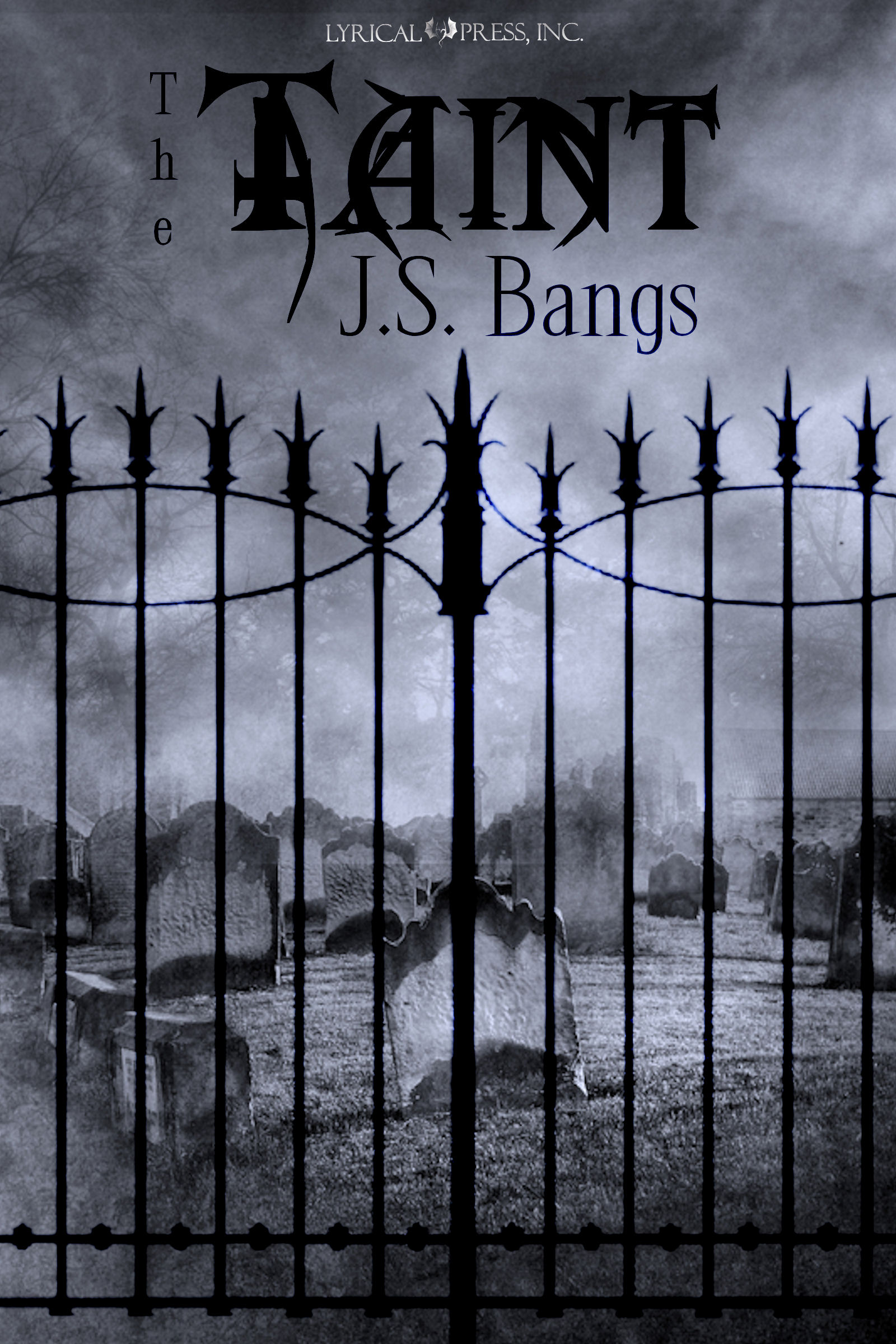
But anyway, there are a few things that went wrong with the original cover that I want to fix this time around. Here’s the old cover for reference:
Originally, I was pretty happy with this cover. And one thing that I still love is the font chosen for the title and byline: jagged, eye-catching, but still readable. It was an excellent choice. However, there are a few things that I now find problematic:
The graveyard image misrepresents the setting and themes of the story. A misty graveyard suggests a ghost story, while the major setting of The Taint is a prison, and its nasties are vampires and zombies.
While the image looks pretty good big, when it’s shrunk down it reduces to a muddy gray rectangle. I first noticed this when I was making my Facebook ad, and in retrospect I think this is pretty important. People browsing for books through an e-reader or a tablet are likely to see the image in a much smaller size than shown above, and this makes a big difference for how much the cover stands out and attracts.
I hope to fix both of these problems this time around.
You may have noticed that The Taint is no longer shown on my sidebar, and is no longer for sale at Lyrical Press. A few days ago Lyrical Press offered to revert the rights to me, and I accepted their offer.
The reasons for their offer and my acceptance were pretty simple: The Taint wasn’t selling very well, and we both thought it was a good idea to try something else. Shortly after The Taint was originally bought Lyrical Press decided to stop buying SFF and horror and concentrate solely on their romance and erotica lines, which means that The Taint was stuck in kind of an odd place with regards to their overall focus. The Taint may actually have been the last non-romance title that Lyrical bought, and it suffered as a result. So when they offered to revert the rights to me, it seemed like a good decision. It was a very amicable separation, and I really have nothing but praise for the professionalism and consideration with which Lyrical handled the whole situation.
The good news is that this gives me a great opportunity to experiment with self-publishing. I have nothing to lose, really: The Taint has already been published traditionally, so there’s nothing to lose by seeing if it can do better self-published. It’ll be a few weeks before that happens, as I have to make a new cover image (rights to the original are owned by Lyrical), and I hope to come up with a better title. But watch this space. I’m going to have fun seeing how this goes.
I’m happy to announce that I sold a short story titled The Judge’s Right Hand to Beneath Ceaseless Skies. This is my first sale to an SFWA-recognized pro market :). Look for the story sometime in November.
And for audio aficionados, the story has also been chosen for the BCS podcast, where it will appear some weeks after the story first appears in print. I’ll link to both the story and the podcast when they appear.
I’m about halfway through my current WIP, which means (naturally) that I’ve spent the last hour reading about placental abruption. This is what happens when you reach the point in your novel at which things must move from Bad to Worse: you get online and you try to find the worst thing that could possibly happen to your characters. Because you love them.
On the one hand, it’s amazing that I can ask Google to please tell me about complications in late-term pregnancy, and a few minutes later I’m looking at pictures of detached placentas. On the other hand, gawd this is going to be hard to write about. Really, really hard. And this isn’t even the worst thing that might happen in this novel.
But it’s like they say: Kill your darlings. Kill them with a detached placenta if you have to. Don’t flinch.
I previously blogged about an experiment in Facebook advertising that I undertook. The gist of the experiment was to see if I could generate an appreciable bump in sales of my e-book The Taint by doing a Facebook ad campaign, and if so, whether that bump was big enough to cause the campaign to pay for itself. And now that we’ve reached the middle of June, the campaign is long over, the sales numbers are in, and I can offer some data and some conclusions.
Preliminaries
Facebook offers you a pretty wide variety of options for how you set up your ad campaign. I went with the defaults for pretty much everything. Most importantly, I chose the automatic bidding strategy, which means that I let FB choose how it was going to spend the money I allocated for the campaign. FB, like Google, allocates ads based on a “bidding” metaphor in which different ads indicate via a virtual “bid” how badly they want to appear in a particular slot. As I understand it, this means that every time FB wants to show you an ad, it goes through all of the active ad campaigns that match something in your profile and asks them how much they’re willing to spend to be shown at that moment. Based on some algorithm that looks at the advertising budget and the target user’s profile, FB decides how much that particular ad slot is “worth” to your ad, and the ad that wants to be shown the most wins.
However, with FB you only pay for clicks, not impressions. An impression is when someone merely sees your ad, while a click is when they actually click on it (duh) and see whatever you linked to.
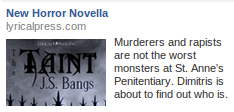
A standard FB ad (which you’ve seen hundreds of if you’ve ever been on FB) consists of a thumbnail-sized image with a few lines of text next to it. I originally was just going to use my book cover as the thumbnail, but it turned into a mushy gray blob when it was scaled down to the proper size. Instead, I cropped out just the title and used that. My finished ad looked like this:
The ad as it appeared in Facebook
Advertising performance
Here’s the raw numbers:
Campaign Reach:
43,535
Frequency:
2.3
Clicks:
21
Click-Through Rate:
0.021%
Spent:
$29.99
First thoughts were, “Wow, that’s a lot of reach,” followed by, “Wow, that’s not very many clicks.” In FB lingo, “Reach” is the number of distinct people who saw the ad, “Frequency” is the average number of times the ad was shown to each person that saw it, and “Clicks” is the actual number of clicks generated because of this. I was pleasantly surprised at how many people saw the ad, even with my very modest bid. If my campaign were the sort of thing where merely getting the word out and increasing awareness helped, I’d consider that a good sign.
But as you can see, the “Click-Through Rate” (CTR) was awful. Or was it? I really have no idea what a realistic CTR is, and whether my ad did better or worse than the average. What is clear is that you need a lot of views to get even a modest number of clicks–which makes since, since I very rarely click on internet advertising, and I don’t expect that a lot of other people do differently.
So I spent $30 to get 21 people to click on my ad, meaning that I spent $1.42 per click. This is not a very good rate. When I’m spending that much per click, my “conversion rate” (the number of clicks that turn into actual sales) would have to be close to 100% in order to break even. Which leads me to my next point.
Effect on sales
I had to wait until the middle of June to get my royalty statement for the month of May, which showed exactly how many books I sold. Since clicking the ad brought you to the main Lyrical Press site, I took the number of sales directly from Lyrical as an indication of the number of sales resulting from the ad. Lyrical’s ebooks are available in a large number of venues, but most likely anyone who bought the book as a result of the ad also bought it directly from Lyrical, since that’s where the ad pointed to. So how many books did I sell directly from the Lyrical site in May?
Zero.
(I did sell books through other storefronts, though.)
This is not terribly surprising, given the numbers above. Based on what I’ve heard on the nets, ad conversion rates vary from 1%-5%, so getting zero conversions from only 21 clicks is possible, even likely. So while this report is kind of glum, we have to accept it as the consequence of our overall ad performance.
Conclusions
The primary question that I wanted to answer by doing this experiment was whether a Facebook ad campaign could create an appreciable spike in sales of an e-book at a low price point. And the answer to that is a resounding no. My small initial outlay did not pay for itself in terms of increased royalties. It would not have paid for itself even if I were self-published and getting 100% of receipts. At the price level I set, there was no perceptible bump in sales at all.
Nonetheless, I consider the experiment a success because it did furnish a clear and unambiguous answer to the question I posed at the beginning. The benefit derived from a low-cost ad campaign doesn’t pay for the ad, and so makes no financial sense for a small-press author such as myself.
There are a few ways I could tweak the experiment which could give different (more profitable) results. Sometime in the future I may try to repeat this experiment varying the parameters below.
Spend more money. It’s possible that my ad budget was so low that I was outbid for all of the high-performing ad slots (in terms of page placement, appropriateness to the user, etc.), and got only the dregs. If this is the case, then spending, say, $100 or $1000 might get me exponentially more results. This would mean that there’s a minimum amount that you have to spend to get an appreciable result from advertising, and that spending any amount below that threshold is simply wasted. In support of this theory, I note that FB told me that there were about 6 million potential viewers of my ad, but I actually hit less than 1% of those.
Get a better ad. I’m pretty happy with what I came up with for my first try, but I’m sure there are ways I could make it more effective. With a little reading on ad design and a little practice, I could probably come up with something more enticing.
Don’t send people to Lyrical. I might get better results if I had the ad point to the book’s Amazon page, since most people will already have an account on Amazon, and anything that removes the barriers to a sale would be a benefit. Furthermore, Amazon owns the currently dominant e-reader, and streamlining sales to the Kindle would be a huge win.
Hopefully this was interesting and helpful to anybody else who is published with small presses or self-published, and who may be contemplating such a move in the future.
So all this talk about self-publishing has gotten me curious about alternate publishing models. As I see it, the main thing that traditional publishing still offers that self-publishing and vanity publishing lack is quality control. A book from a traditional publishing house will have been professionally edited for both content (plot, character, etc.) and mechanics (spelling, punctuation, etc.) It’ll have a professional cover and professional typesetting. The book that emerges from a traditional publisher may not be earth-shaking literature, but at least it will look good and be free of the grossest errors.
Self-published books, on the other hand, are stereotypically full of bad prose and grammatical errors stuffed inside a hideous cover made in MS Paint. Not all self-pubs fit this description, of course, but enough of them do to give the entire model a bad name.
So I says to myself: couldn’t you do both? And I dreamed up a kind of writer’s collective that would try to get the best of both worlds:
Writers pay the collective for most of the cost of producing their book up front.
The writers’ collective ensures that certain standards of quality are met. It requires that all books are professionally edited and fitted with a professional cover design.
The collective acts as the nominal publisher for the book, but under terms that give most of the rights to the author.
The collective takes a small portion of the receipts and uses it to pay for things like distribution and publicity for the entire company, things that cost more money than any one author is likely to be able to afford individually.
I brainstormed/daydreamed a few different ways of paying for this, including a “reverse advance” (the writer pays 100% of costs up front, and gets 100% of receipts until they recoup their costs, after which it’s 85/15) or a milder split costs model (writer pays 50% up front and splits receipts 50/50 until costs are recouped, etc.) There are a variety of possible problems with this, but really, it seems like it should work, right?
And lo and behold Google tells me that it’s been done, and with a certain level of success. The Writer’s Collective linked here has a higher price point than I was imagining—they say that an author could expect to pay $18,000 over the course of the year their book is in production, which is, um, steep—but the basic model is the same. And they do say that they began with a low-cost model similar to what I was imagining, but had to scale up to the higher-cost, high-return model that they use now. Perhaps I’ll contact then to discover the particular reasons for that. Nonetheless, a glance at their books on offer suggests that they’re hitting a much higher level of quality than most e-book publishers, and way higher than most self-pubbed books.
I have no intention to act on any of this in the near future, as I have neither the money nor the time to pursue it right now. But it’s a strange new world in publishing, and who knows what will happen in another 5 years?
Like virtually everyone in the writing world, I’ve been following The Business Rusch for a while, with varying degrees of optimism and trepidation. Kristine Rusch has a largely pessimistic take on traditional publishing, backed up by an impressive amount of business and writing experience, and she’s been developing the thesis that the day is fast approaching when most writers will be better served by self-publishing than traditional publishing. Her most recent salvo on this front was Writing Like It’s 1999, in which she suggests that the publishing business is becoming more like the music business, in which a tiny number of top-tier artists make millions, and everyone else gets screwed. Hooray for us, we’re playing with the big boys now.
I signed up with Amazon, B&N, and Apple’s self-pubbing programs, put together a cover, and put it out there. I’ve since also signed up with Kobo and ePublishing Works (an aggregator which can get it on Sony’s ebookstore), so the book should be in those places Real Soon Now. I broadcast the news on my blog, to all the fans who have ever sent my a nice e-mail on my books, and on Facebook. I put in a couple guest interviews on posts where I flogged the book. I asked everyone I knew to mention it.
Let me tell you this about my experience with self-publishing: it’s damned difficult to break out past the circle of your friends and family. That’s evident from sales, which over the first month, totaled a grand 25 copies.
I am totally blowing the e-publishing world wide open. Amanda Hocking, look out!
I read this thinking, “Yeah, that sounds familiar.”
See, my horror ebook The Taint, while not self-published, is published online and seems to have fallen into the same trap. The sales of the book were pokey from the start, and as the months since the release have passed new sales have slowed to a trickle, much to my disappointment. And this was with the support of the Lyrical Press team, who I don’t fault in this at all, since they provided me with tons of pointers of ways to promote and got me a review in at least one venue that I would never have heard of otherwise. And the promotion that did happen seemed to have worked, since I got the most sales right after the book came out, when I was heavily invested in promotion for a few weeks. But this rumination, in conjunction with Rusch’s writing got me thinking: maybe I can do something about this. The internet is nothing if not an advertising platform—so what if I just tried buying an ad to promote my book?
The advantages of doing this online is that online advertising is cheap and measurable. I decided to make my initial foray into the advertising world with Facebook ads, and Facebook provides me with a very comprehensive set of metrics telling me how many impressions my ad has gotten (how many times it’s been shown), and how many clicks have resulted. At the end of the month I’ll get my royalty statement and I’ll be able to discover exactly how many sales resulted, and determine whether my brief ad campaign actually paid for itself in terms of increased sales. And the cost of the experiment was relatively trivial.
The ad went live two days ago, so I don’t have anything to report yet. I intend to blog the results as they come out, though. Watch this space for future updates.
 J.S. Bangs