So I’m thinking about working on the new cover for The Taint soon. I’m still in the stage of coming up with ideas, which is tough because I suck at covers. I have a poor visual imagination and no flair for art. There’s a reason why I went into writing and not visual arts, and I’m probably going to wind up paying someone to do the cover for me.
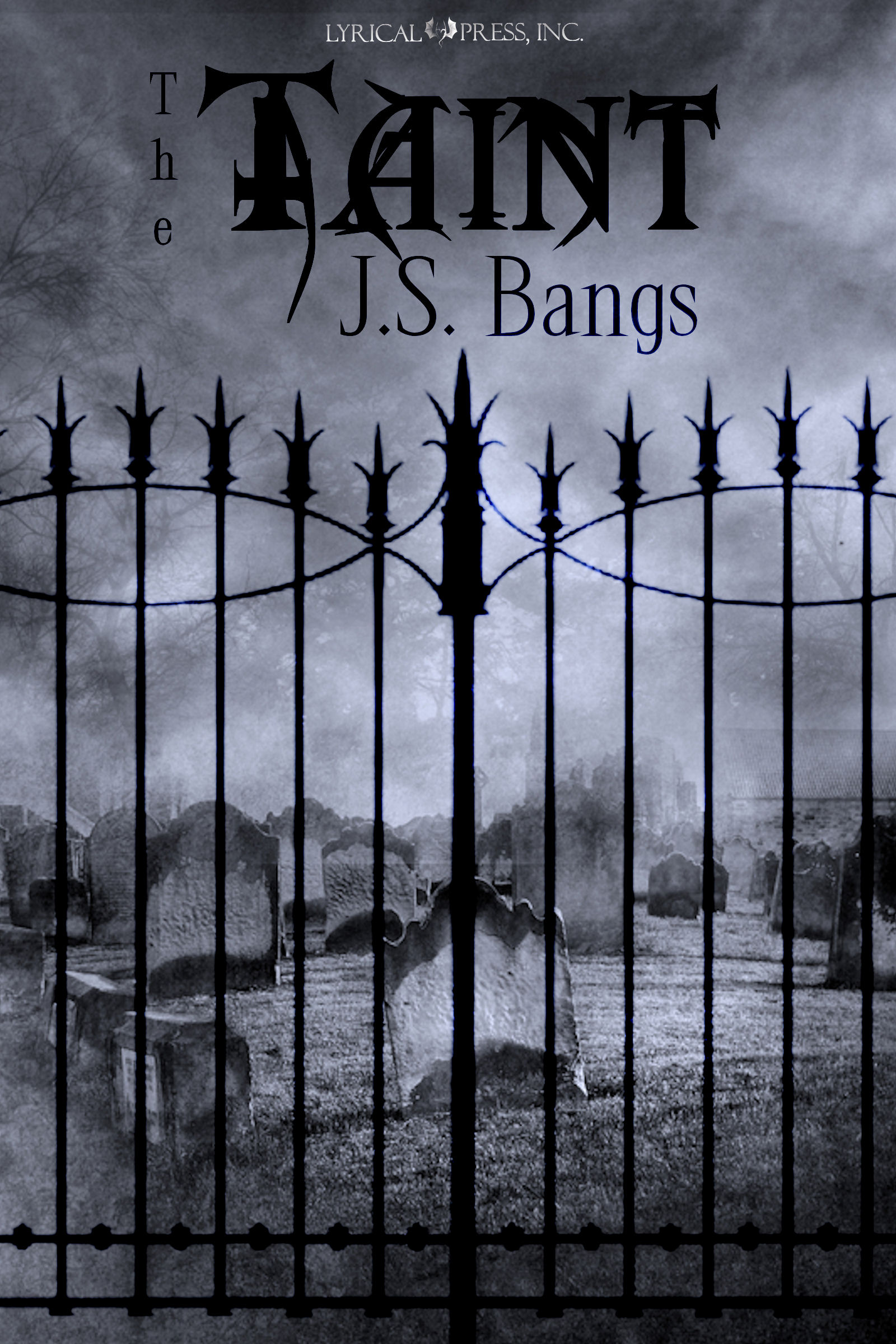
But anyway, there are a few things that went wrong with the original cover that I want to fix this time around. Here’s the old cover for reference:
Originally, I was pretty happy with this cover. And one thing that I still love is the font chosen for the title and byline: jagged, eye-catching, but still readable. It was an excellent choice. However, there are a few things that I now find problematic:
The graveyard image misrepresents the setting and themes of the story. A misty graveyard suggests a ghost story, while the major setting of The Taint is a prison, and its nasties are vampires and zombies.
While the image looks pretty good big, when it’s shrunk down it reduces to a muddy gray rectangle. I first noticed this when I was making my Facebook ad, and in retrospect I think this is pretty important. People browsing for books through an e-reader or a tablet are likely to see the image in a much smaller size than shown above, and this makes a big difference for how much the cover stands out and attracts.
I hope to fix both of these problems this time around.
You may have noticed that The Taint is no longer shown on my sidebar, and is no longer for sale at Lyrical Press. A few days ago Lyrical Press offered to revert the rights to me, and I accepted their offer.
The reasons for their offer and my acceptance were pretty simple: The Taint wasn’t selling very well, and we both thought it was a good idea to try something else. Shortly after The Taint was originally bought Lyrical Press decided to stop buying SFF and horror and concentrate solely on their romance and erotica lines, which means that The Taint was stuck in kind of an odd place with regards to their overall focus. The Taint may actually have been the last non-romance title that Lyrical bought, and it suffered as a result. So when they offered to revert the rights to me, it seemed like a good decision. It was a very amicable separation, and I really have nothing but praise for the professionalism and consideration with which Lyrical handled the whole situation.
The good news is that this gives me a great opportunity to experiment with self-publishing. I have nothing to lose, really: The Taint has already been published traditionally, so there’s nothing to lose by seeing if it can do better self-published. It’ll be a few weeks before that happens, as I have to make a new cover image (rights to the original are owned by Lyrical), and I hope to come up with a better title. But watch this space. I’m going to have fun seeing how this goes.
I’m happy to announce that I sold a short story titled The Judge’s Right Hand to Beneath Ceaseless Skies. This is my first sale to an SFWA-recognized pro market :). Look for the story sometime in November.
And for audio aficionados, the story has also been chosen for the BCS podcast, where it will appear some weeks after the story first appears in print. I’ll link to both the story and the podcast when they appear.
I’ve been posting two posts a week since sometime in mid-July. This was a big stretch for me: before that I averaged something like two posts a month, and I went for long stretches without posting anything at all. Sometime in July I set myself a resolution to post more frequently, and I was able to sustain this goal by a neat trick: I wrote things ahead of time. When I had time to spare I wrote three or four posts at once, and then I used the WP scheduling feature to dribble them out over the next few weeks.
But, of course, it couldn’t last forever. As of today my queue is empty, and I haven’t had time lately to write any more. The most important reason for this is that I’m working head-down on finishing the first draft of my current WIP. There are about 10,000 words to go on that project, which means I should be able to finish in the next week or two, provided I don’t waste time doing anything else.
But not wasting time means not writing blog posts. So I may drop off my posting for a few weeks as I close up on that project, which is ultimately far more important to me than blogging. After that I hope to resume my regular posting schedule, but I will probably fall back to a rate of one post per week rather than two. In exchange, I’ll try to make my posts two times as interesting.
Ladies and gentlemen, let me present to you the most awful piece of extruded fantasy product that I’ve ever had the misfortune to read in its entirety:
Man, this thing was awful
A March into Darkness by Robert Newcomb. If you’ve read this book, then you know what’s coming. It was just… I mean… words fail me. This was bad in nearly every way that it is possible for a book to be bad. I would never have read the entire thing, except that at the time I was under unusual circumstances: I was stuck in a room with nothing else to read for an entire weekend, and one of my fellow room-sitters had this book with him. It was either read this book, or stare at the wall. I chose to read the book.
In retrospect, staring at the wall may have been less painful.
Let me quickly run down the book’s faults, before we move on to the one thing that the book did well.
The protagonist was a complete idiot, and a grating, indulgent whiner at that. Main character stupidity was the main driver of the plot for the first quarter of the book.
The worldbuilding was a fourth-generation Xeroxed copy of a Dungeons and Dragons cliche guide. There was nothing inventive or surprising about any of it. (Well, except for the invisible flying magical manta ray army. That was kind of cool.)
The dialog was awful. It was so banal and so predictable that I learned to just skim the pages of dialog looking for the longer-than-average paragraphs, because that was where the exposition nuggets were buried. Everything else was the most juvenile, cringe-inducing conversation that you’ve ever read.
The characters were factory-built from plastic parts. I can’t remember a single one of them aside from their most generic specifiers: “the protagonist”, “the girl” (there’s only one of significance), “the wizard”, etc.
The plot problems were all solved by a combination of coincidence and application of magical technobabble. The main antagonist is supposedly invincible because he has a kind of magical martial arts training that takes centuries to complete. A major plot point is the protag trying to find the ancient monastery where this technique is taught and begin training, so that he has at least a chance of standing up to the baddie. And then, about 100 pages before the end, they discover a magic spell they can cast that will allow them to skip straight to being a grand-master. And why did we spend all of this time reading about the %!#$&^ training?
But there was one saving grace. One thing, one thing that kept me turning pages instead of going back to the comforting tedium of wall-watching.
The plot moved like a crack money on rocket skates.
Had I been reading under normal circumstances, I probably would not have kept reading long enough for the book to get its plot hooks into me. And even after I had sunk a few hours into the book, I looked up about once a chapter and said, “Why am I still reading this dreck?” But I kept going. Not just because I had nothing else to do, but because I actually wanted to know what happened next. When I had to put the book away for an hour, I kept thinking about it. The girl was in danger! The wizard was going to discover something magical! The protagonist was angsting about something! Would the girl be saved? What did the wizard discover? Will the protag stop being such a putz? I was aware—painfully, eye-gougingly aware—of the fact that every one of these plot points was a cliche. But nonetheless, I cared. Not about the characters, and certainly not about the setting, but about what happened next.
In part, the relentless nature of the plot is what made the later betrayals so galling. When I wondered How would the protag overcome the baddie?, the answer turned out to be By using a magic spell to make the previous 200 pages of martial arts training irrelevant. This made me mad, because I was actually invested in the answer. Not very invested, mind you, but invested enough to be upset that the resolution was so stupid. In fact, it was only as I reached the end of the book that the novel’s full stupidity began to weigh on me, because I realized that the one good thing in this trainwreck was itself going to be derailed, as all of the dilemmas of the plot were resolved in the cheesiest and most obnoxious way possible. And so I resigned myself to skimming over page after page of banal, repetitive dialog and burning through hordes of doomed redshirts on my way to the climax, knowing that it, too, was bound to be a disappointment. And it was a disappointment.
But I did learn some things along the way.
First, plot matters. Many readers get their fix from character, ideas, or prose more than plot. I would normally count myself as one of those. But even a convicted setting-and-style junkie like me couldn’t help but be taken in by the sweet plot crack that Newcomb put into his book, and I kept coming back for another hit. Even after it was clear that the plot had been cut with some nasty stuff, and even after I was sure I was going to regret it. I still wanted more. After a while I started to hate myself, wishing I could kick the habit, but the book would not let me go until I had burned through to the very last page.
The second point is don’t disappoint your reader. If the conclusion of the book had actually satisfied me rather than dissolving into a mushy pile of cliche and frustration, I might have tentatively recommended it. I mean, for a certain kind of reader, the kind who doesn’t care about characterization or prose style or anything else, this could actually be a good book. The opening is kind of interesting. At first it seems like it’s going to go somewhere compelling. If there had been any follow-through, if the author had actually tried to solve his plot problems rather than just hand-wave them away, it might have been kind of okay. Not great literature, mind you, but a pulpy little fantasy romp. Instead it was a disaster.
It turns out that Newcomb’s publishing contract was cancelled after the sequel to this book. I can’t imagine why.
So I’m at work the other day singing along to David Bowie in my cubicle (like you do), and I hear the following lines:
Well she’s a total blam-blam
She said she had to squeeze it but she—
And then she—
And I think to myself, that skipped beat at the end of each line is so much more salacious than anything Bowie could have actually said.
This is an instance of an oft-repeated point: what you can’t see is often far sexier, more horrifying, or more inspiring than what you can see. This is easy to forget. There’s a reason why many modern horror films are referred to as “torture porn” — just as porn reduces eroticism to a numbing, empty series of copulations and money shots, horror that shows us everything is merely desensitizing, destroying the very terror it is supposed to provoke.
A competent writer or director, on the other hand, knows just how much he should show before cutting away.
Consider the shower scene from Psycho. A modern director might have given us a much less coy scene, with full frontal nudity and plenty of close-ups of the knife going in and blood gushing out. Hitchcock knew better. His scene gives us hints of Janet Leigh’s naked body, but not the whole thing. We see the killer’s face, but only obscured by a curtain or hidden in shadow. We see a knife, and we see blood, but the fact of knife piercing flesh is left to implication.
I’ve heard it said that Hitchcock was forced to do this by the censorial codes of the day, and indeed the scene skirted the edge of scandal in its time. But Hitchcock was still a better artist than that. Even if offered today’s license for vulgar exhibitionism, he would know better than to indulge.
On the opposite end of the spectrum, consider this book of “lost” sex scenes from Jane Austen. Granted, the book is a joke. Still, it seems to entirely miss the point of Austen’s dialogues, which are so wonderful precisely because so much is left to inference and implication. The pornographic impulse is completely missing from Austen’s work, as Austen knew that the most romantic scene, indeed the most erotic scene, is one in which the romance and the eros are present only in the blank spaces around the actual words. It says nothing good about us that someone thought that Austen could be “improved” by adding some sex scenes.
(The one bright spot in all this is that this book has plenty of one star reviews.)
What does this have to do with me? Well, I complained a few days ago about not having the appropriate vocabulary to directly describe a childbirth scene, and having to resort to circumlocution and euphemism. I have started to reconsider my position on this. It is possible that these scenes may be made more affecting by avoiding direct description, and leaving the gory and intimate details to the reader’s imagination.
My current WIP, a novel titled The Wedding of Earth and Sky has not one but two childbirth scenes. Both are described fairly graphically (for important plot-thematic reasons). And this presents me with a problem.
It’s impossible to talk about childbirth without talking about vaginas.
Now, I’m perfectly happy talking about vaginas in my novel, but I’d like to be able to do so with language that matches the tone and setting of the story. And the word vagina is entirely unsuited for this task. The word is:
Modern, which clashes with the Bronze Age setting
Clinical, which creates a psychic distance between the reader and the details which are meant to be visceral and intimate
Latinate, which mixes poorly with the earthy, homey feel created by the largely Germanic vocabulary I’ve used elsewhere.
But all of the other one-word options are worse. The word cunt avoids all three of the problems above, but it introduces a new problem, which is that it’s vulgar and may provoke the reader to recoil or snicker. Other options are childish, or something worse.
At present I’m mostly using euphemism and circumlocution, which at least allows me to maintain my tone and setting. But it’s extremely annoying that there is no vocabulary available to me that isn’t fatally tainted by one thing or another.

 J.S. Bangs